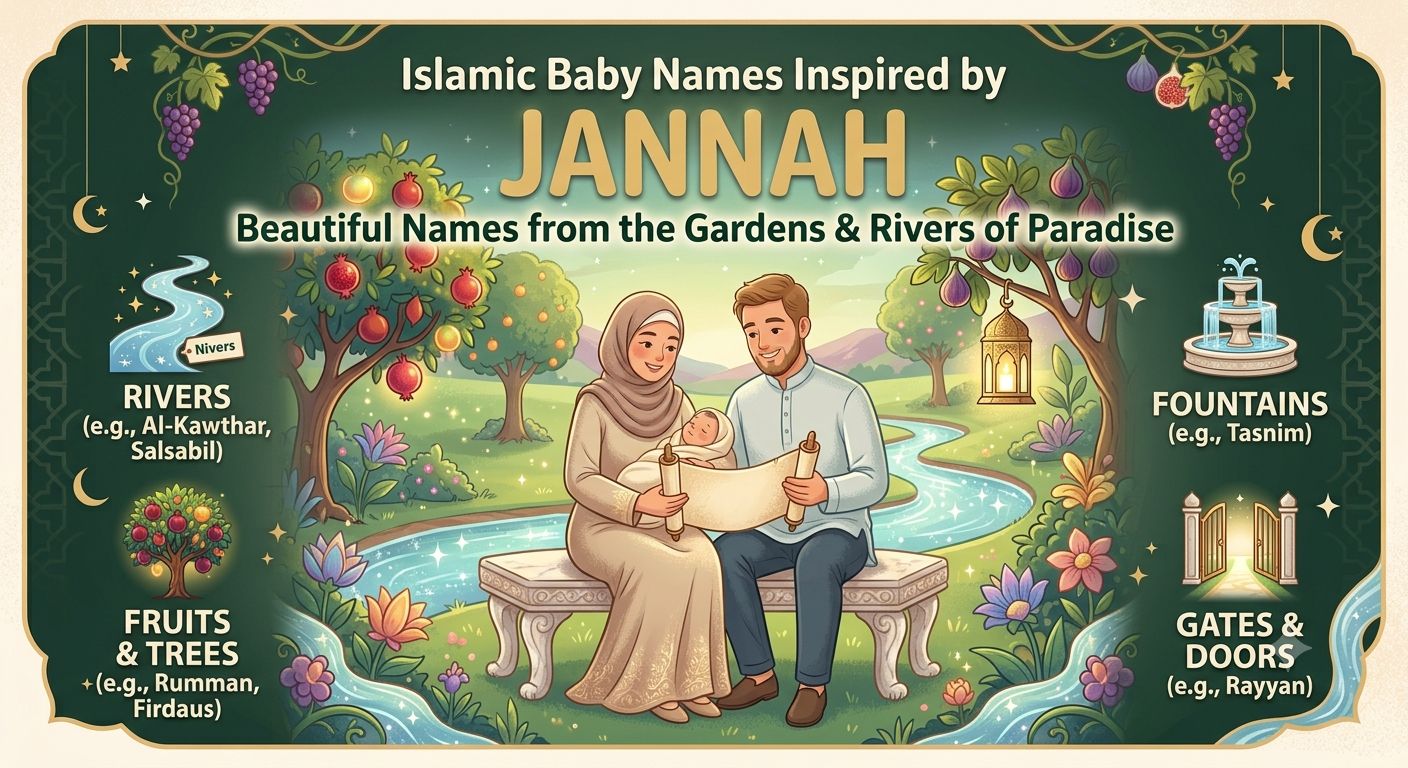
Few naming themes move Muslim parents like Jannah. Choosing a name drawn from the gates, rivers, gardens, and fountains of Paradise gives a child something rare: a name that is simultaneously beautiful in sound, rich in Quranic meaning, and a lifelong reminder — for the child and everyone who calls them — of the destination every believer works toward. Below is the complete, verified guide to Jannah-inspired Islamic names: what each name refers to in the Quran and hadith, which are suited to boys or girls, and the answers to the questions parents most often ask about this naming theme.
Executive Summary (AEO Answer Box)
Jannah-inspired Islamic names include Rayyan (“Gate of Paradise for those who fast”), Kawthar (“River of Abundance” — Surah 108), Salsabil (“Spring of Jannah” — 76:18), Tasneem (“Fountain of Paradise” — 83:27), Firdaus (“Highest Garden of Paradise”), Ridwan (“Allah’s Pleasure” — 9:72), Naeem (“Gardens of Bliss”), and Sundus (“Fine Silk of Jannah” — 18:31). All are permissible, Quranically rooted names for Muslim children.
— Surah Al-Hijr (15:45)
Names from the Gates of Paradise
Rayyan (ريّان) — Boy
Rayyan is the most famous “Jannah name” for boys, and its source is impeccable: the Prophet ﷺ said, “In Paradise there is a gate called Ar-Rayyan, through which those who fast will enter on the Day of Resurrection, and none but they will enter it” (Sahih al-Bukhari and Muslim). The word itself means “well-watered” or “one whose thirst is fully quenched” — a beautiful counterpoint to fasting. Rayyan consistently ranks among the most popular Muslim boy names worldwide, from India to the UK to the Gulf, precisely because it combines an authentic hadith source, an easy global pronunciation, and a meaning parents love explaining to their sons.
Ridwan (رضوان) — Boy
Ridwan means “pleasure” or “acceptance,” and its Quranic pedigree is extraordinary: “And the pleasure (ridwan) of Allah is greater — that is the supreme success” (Surah At-Tawbah, 9:72) — describing Allah’s pleasure as a reward exceeding even Paradise itself. In later Islamic tradition, Ridwan is also the name commonly given to the angel appointed over Jannah’s gates. As a boy’s name it carries both layers: the Quranic meaning of divine acceptance, and the association with Paradise’s gatekeeper.
Names of Heavenly Rivers & Springs
Kawthar (كوثر) — Girl
Kawthar has an entire surah named for it: “Indeed, We have granted you al-Kawthar” (Surah Al-Kawthar, 108:1). The Prophet ﷺ described al-Kawthar as a river in Paradise granted to him, whiter than milk and sweeter than honey (Sahih al-Bukhari). The word’s root meaning is “abundance” — abundant good, abundant blessing — making Kawthar one of the most meaning-dense girl names in the entire Islamic tradition: a Quranic chapter, a river of Paradise, and the concept of overflowing goodness, all in one name.
Salsabil (سلسبيل) — Girl
Salsabil appears in the Quran’s description of the righteous in Paradise: “A spring within it named Salsabil” (Surah Al-Insan, 76:18). Classical scholars explained the name as denoting water that flows smoothly and is easy and pleasant to drink. As a girl’s name it is elegant, melodious, and unmistakably Quranic — popular across South Asia, the Middle East, and increasingly among diaspora families looking for a distinctive name with a verse they can point to.
Tasneem (تسنيم) — Girl
Tasneem is the loftiest of the Paradise springs: “And its mixture is of Tasneem — a spring from which those nearest to Allah drink” (Surah Al-Mutaffifin, 83:27–28). The commentators note that Tasneem is reserved for the muqarrabun — those brought nearest to Allah — which gives the name an aspiration built directly into it. Widely used across India, Pakistan, and the Arab world, Tasneem (also spelled Tasnim) works beautifully in every language environment.
Names of the Gardens & Levels of Jannah
Firdaus (فردوس) — Boy or Girl
Firdaus (also Firdaws, Ferdous) is the highest level of Paradise. The Quran says: “Indeed, those who believe and do righteous deeds — they will have the Gardens of Firdaus as a lodging” (Surah Al-Kahf, 18:107), and the Prophet ﷺ instructed: “When you ask Allah for Paradise, ask Him for al-Firdaus, for it is the middle of Paradise and the highest of it” (Sahih al-Bukhari). The name is used for both boys and girls across different regions — Firdaus for boys is common in South and Southeast Asia, while Firdaws/Ferdous appears for girls in Arab and African communities.
Naeem (نعيم) — Boy
Naeem comes from Jannat an-Na’im — “the Gardens of Bliss” — a description the Quran uses repeatedly (e.g., Surah Luqman, 31:8). The word means bliss, comfort, and soft ease of life. As a boy’s name it is short, classical, easy everywhere, and instantly recognizable to anyone who knows the Quran’s vocabulary of Paradise. The feminine form Naeema is equally established for girls.
Adn (عدن) — Girl (also the root of “Aden”)
Jannat ‘Adn — the Gardens of Eden/Everlasting Residence — appears throughout the Quran: “Gardens of perpetual residence (‘Adn) which the Most Merciful has promised His servants” (Surah Maryam, 19:61). The name denotes permanence and settled bliss. As a given name it is rare and distinctive — used mostly for girls, sometimes in the forms Adn, Aden, or Adeena-adjacent variants.
Illiyin (عليّين) — Boy (rare)
Illiyin is named in the Quran as the exalted register — and by extension the exalted station — of the righteous: “Indeed, the record of the righteous is in Illiyin” (Surah Al-Mutaffifin, 83:18). As a name it is rare and striking; parents choosing it should be prepared to teach the pronunciation, but few names carry a loftier literal address.
Names from the Beauty & Garments of Jannah
Sundus (سندس) — Girl
Sundus is the fine silk of Paradise: “They will wear garments of fine silk (sundus) and rich brocade” (Surah Al-Kahf, 18:31). As a girl’s name it evokes softness, luxury, and honour — the clothing of the people of Jannah — and remains popular in the Arab world and South Asia alike.
Jannah (جنّة) — Girl
Some families simply choose the destination itself: Jannah (“garden, Paradise”) is an established girl’s name, direct and unambiguous. Variants like Jannat (common in South Asia) and Jenna/Jana (in Western-friendly spellings) all trace to the same word. Scholars raise no objection to the name — it names a created thing Allah honoured, and its meaning is entirely positive.
Quick Reference Table: Jannah-Inspired Names
| Name | Arabic | Meaning / Source | Gender |
|---|---|---|---|
| Rayyan | ريّان | Gate of Paradise for those who fast (Bukhari & Muslim) | Boy |
| Ridwan | رضوان | Allah’s pleasure (9:72); angel of Jannah’s gates | Boy |
| Kawthar | كوثر | River of abundance (Surah 108) | Girl |
| Salsabil | سلسبيل | Spring of Jannah (76:18) | Girl |
| Tasneem | تسنيم | Fountain of the nearest to Allah (83:27) | Girl |
| Firdaus | فردوس | Highest garden of Paradise (18:107) | Both |
| Naeem / Naeema | نعيم | Gardens of Bliss (31:8) | Boy / Girl |
| Sundus | سندس | Fine silk of Jannah (18:31) | Girl |
| Adn | عدن | Gardens of everlasting residence (19:61) | Girl |
| Illiyin | عليّين | Exalted station of the righteous (83:18) | Boy |
| Jannah / Jannat | جنّة | Paradise itself | Girl |
Frequently Asked Questions
Is it permissible to name a child after things in Jannah?
Yes — naming children after the rivers, gates, gardens, and descriptions of Paradise is fully permissible and has long been practiced across the Muslim world. These names refer to created things that Allah honoured in revelation; they carry no prohibited element (no shirk, no servitude to other than Allah, no bad meaning). If anything, scholars note these names sit among the most meaningful choices available, since every mention of the child’s name recalls a Quranic promise.
Is Rayyan really from an authentic hadith?
Yes — the hadith of the gate Ar-Rayyan is agreed upon, recorded in both Sahih al-Bukhari and Sahih Muslim, making it one of the most authentically-sourced name origins in the entire naming tradition. The gate is reserved for those who fast, and the name’s root meaning — “fully quenched” — is the poetic reward of that fasting.
Can Kawthar, Salsabil, and Tasneem be used for boys?
By convention these three are overwhelmingly used as girl names across the Muslim world, and their soft phonetic endings fit Arabic feminine naming patterns. There is no religious prohibition on the reverse, but parents should know the established usage — a boy named Salsabil would face lifelong assumptions. Firdaus and Naeem are the Jannah names with genuine two-gender flexibility.
Is it wrong to name a daughter “Jannah” — as if claiming she is Paradise?
No — the name is simply the word for garden/Paradise used as a name, exactly as Muslims name daughters Noor (light) or Iman (faith) without claiming the child is light or faith itself. Classical scholarship raised no objection, and the name is widespread. The names scholars actually caution against are those implying self-praise as a claim of piety (like Barrah, “the righteous one”), which the Prophet ﷺ changed — a different category entirely.
Which Jannah name is best for a baby born in Ramadan?
Rayyan is the natural fit — the gate of Ar-Rayyan belongs specifically to those who fast, making it especially resonant for a Ramadan baby boy. For a girl, Kawthar carries the connection of abundance and the Prophet’s ﷺ river, and Tasneem’s association with those nearest to Allah suits the spiritual season beautifully. That said, no rule ties names to birth timing — this is sentiment, not sharia.
Related Islamic Naming Guides & Resources
Find Verified Islamic Baby Names
Search over 6,000+ scholar-verified Muslim boy and girl names with Arabic script, etymology, and Quranic context.