Noor Nama — Gulf Hub

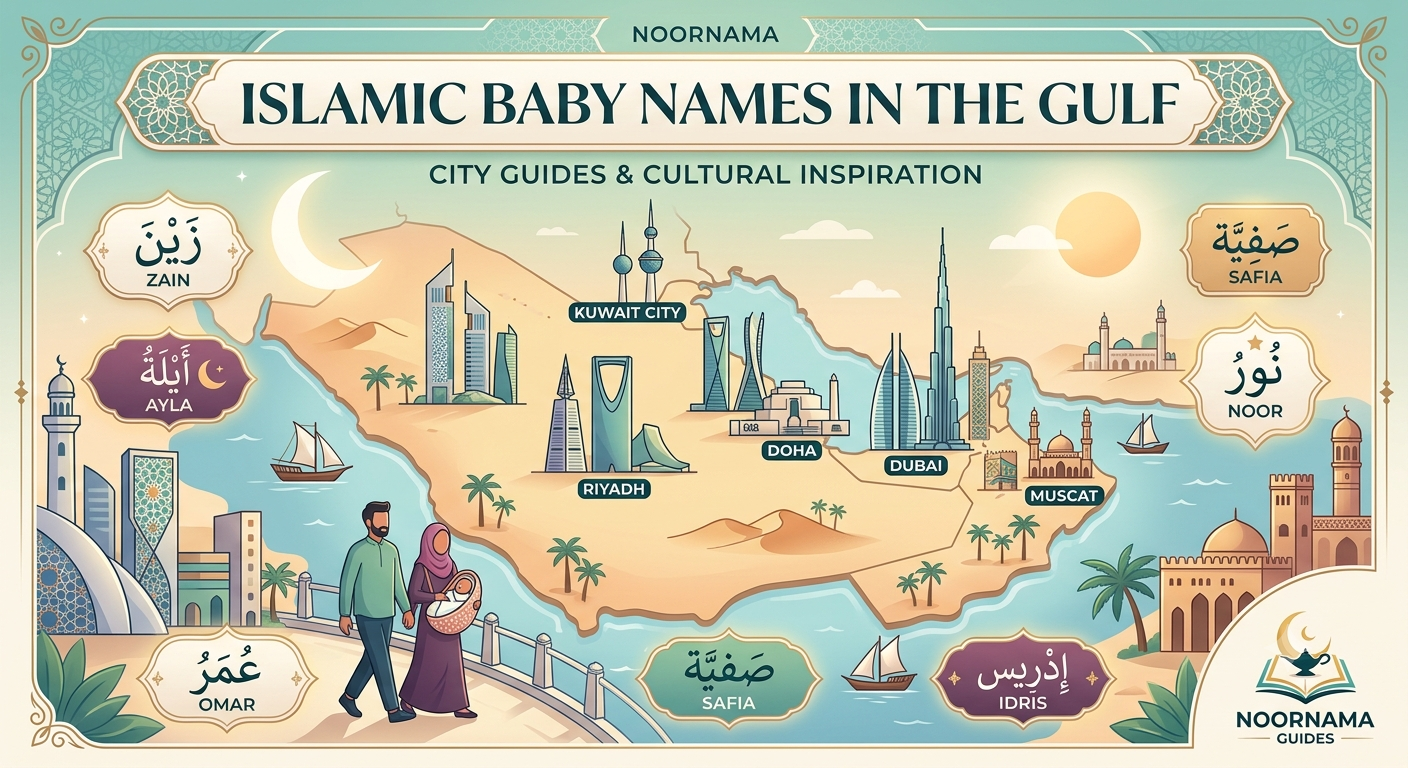
Islamic Baby Names in the Gulf

Quick Summary: Across the UAE, Saudi Arabia, Qatar, Kuwait, and Bahrain, naming traditions blend deeply rooted Khaleeji tribal heritage with the customs of the region’s vast South Asian expatriate community. Both share a profound respect for classical Arabic scholarship and names carrying the meaning of the ninety-nine Names of Allah. The meaning always comes first — never a star sign or a number.

Source-linked Arabic meanings, city-by-city naming guides, and personalised reflection reports for Muslim families across the Gulf.

In the Gulf, naming a child carries the dignity of classical Arabic heritage and the weight of Islamic faith. Emirati and Saudi families honouring tribal and prophetic naming custom, and the millions of South Asian, Levantine, and East African expatriate families who have built their lives across the region, each choose a name with the same care: an authentic Arabic root, a noble meaning, and a lifelong du’a.

This hub gathers that heritage city by city — the local naming preferences of Dubai, Abu Dhabi, Riyadh, Doha, Kuwait City, and Manama — alongside a source-linked reference table and the naming guidance every Muslim parent in the region asks about.

“The names dearest to Allah are Abdullah and Abdur-Rahman.”
— Prophet Muhammad ﷺ, narrated in Sahih Muslim 2132

Choose Your City

Each guide reflects the local Muslim community — its heritage, its most-loved names, and its naming customs. Select your city to begin.

*Kuwait and Bahrain are new additions to our regional directory; their city guides are being finalised.

The Gulf Naming Tradition

Across the Gulf, two great naming traditions meet. Local Arab families — Emirati, Saudi, Qatari, Kuwaiti, and Bahraini — draw from a classical Khaleeji heritage rooted in tribal honour, Quranic virtue, and the names of the Prophets and their Companions. Tribal naming customs here often favour compound names built on lineage — “bin” (son of) and “bint” (daughter of) — a structure that predates Islam but was preserved and elevated by it.

At the same time, the Gulf’s vast South Asian expatriate community — Indian, Pakistani, and Bangladeshi families across Dubai, Riyadh, Doha, and beyond — brings a naming tradition shaped by Urdu literary culture and prophetic love, often preferring names that travel comfortably between Arabic, Urdu, and English contexts.

Both traditions share one foundation: the Islamic name as a prayer and a lifelong blessing. Names expressing servitude to Allah — Abdullah, Abdur-Rahman, Abdulaziz — are especially honoured across the region, since they carry the meaning most beloved to the Prophet ﷺ himself.

Names Loved Across the Gulf

These classical names are chosen again and again by families across the Emirates, Saudi Arabia, Qatar, Kuwait, and Bahrain — Arabic script, meaning, and source shown for each.

Arabic Name Meaning Source
محمد Muhammad The praised one Quran
أحمد Ahmad Most commendable Quran
يوسف Yusuf God increases (Prophet Yusuf) Quran
إبراهيم Ibrahim Father of many (Prophet Ibrahim) Quran
بلال Bilal Freshness, moisture Companion
عائشة Aisha Living, prosperous Companion
فاطمة Fatima One who abstains Family of the Prophet ﷺ
خديجة Khadija Honoured, esteemed Companion
مريم Maryam Devout Quran
زينب Zainab A fragrant flowering tree Family of the Prophet ﷺ
نور Noor Light Quranic word
آمنة Amina Trustworthy, secure Arabic — mother of the Prophet ﷺ

Meanings follow the Noor Nama verification standard.

Naming Notes City by City

Dubai & Abu Dhabi

The UAE is home to one of the most naming-diverse Muslim populations anywhere — Emirati families, alongside enormous South Asian, Levantine, Iranian, and East African communities. Parents here often favour names that read cleanly in both Arabic and English, since children move fluidly between English-medium schooling and Arabic religious education.

Riyadh

Saudi Arabia sits at the historical and linguistic heart of the Arabic language, and Riyadh’s naming customs lean classical — tribal names, prophetic names, and names of the Sahabah remain the default rather than the exception.

Doha

Qatar’s rapid growth has brought a wide expatriate mix into a historically tribal naming culture, and Doha families increasingly balance heritage names with global pronounceability.

Kuwait City & Manama

Kuwait’s naming tradition is known for its generosity-themed names (Kareem, Sakhi, Jawad) reflecting a cultural value the country takes pride in, while Bahrain’s small but ancient Muslim community — one of the region’s oldest — favours names with deep classical roots.

Reflect on Your Child’s Name — Free

The Noor Nama tool lets you explore a name in light of your child’s details and reflect on its meaning — grounded in classical Islamic scholarship, offered always as reflection and aspiration, never prediction.

  • Classical Arabic meaning and root
  • Quranic significance and Sunnah connection
  • Source-linked hadith and Quran references
  • Reflection, not prediction — no astrology, no numerology

Start the Free Reflection →

Deeper written reports — with expanded source citations and heritage classification — are available after the free reflection, delivered digitally worldwide.

Frequently Asked Questions

Does Noor Nama cover traditional Gulf Arabic and Emirati names?

Yes. Gulf Arabic and Emirati names are rooted in classical Arabic and tribal naming tradition, most tracing back to Arabic virtue words, prophetic names, or noble qualities. Noor Nama traces the Arabic root and documented meaning of Gulf names.

Does Noor Nama serve South Asian expatriate families in the Gulf?

Yes. The free reflection tool and written reports are delivered digitally, serving Indian, Pakistani, and Bangladeshi families across Dubai, Riyadh, Doha, and the wider Gulf exactly as anywhere else in the world.

Does choosing a name involve astrology or numerology?

No. Noor Nama is built on reflection, not prediction. A name is chosen for its documented meaning and good association — never because of a star sign, birth number, or constellation. Knowledge of the unseen (ghayb) belongs to Allah alone.

What are common Gulf naming customs involving “bin” and “bint”?

Many Gulf families use “bin” (son of) or “bint” (daughter of) to record lineage in a child’s full name — a pre-Islamic Arabian custom preserved and dignified by Islam. How this is recorded on official documents varies by country, so it’s worth checking your local civil registry’s format in advance.

When should a Muslim baby be named?

The Sunnah is to name the child on the seventh day, together with the aqiqah. Naming on the day of birth is also reported and permitted. In every case, the meaning of the name comes first.

Outside the Gulf? Explore our guides for the United Kingdom, the United States, Australia, and India.