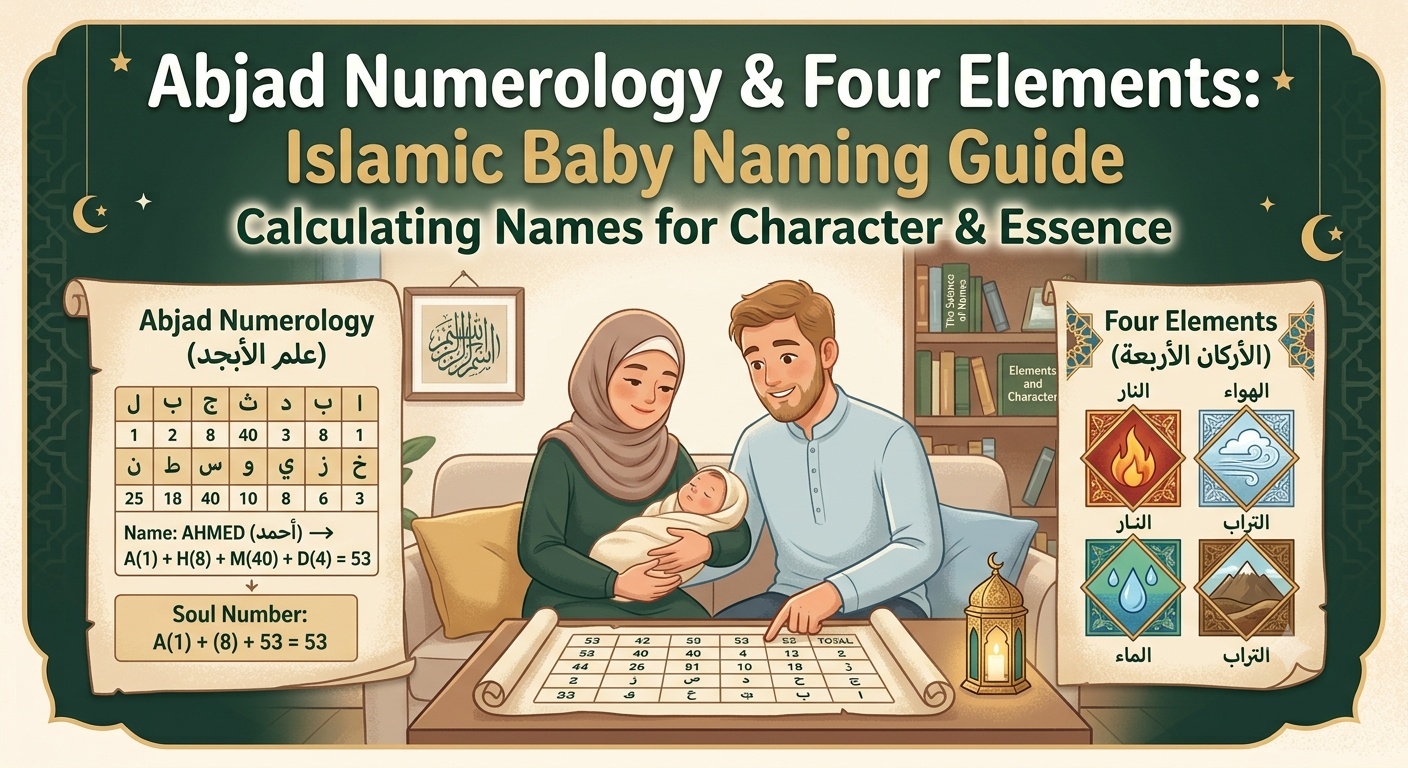
Islamic Naming Science · Ilm al-Huruf
Long before a name was chosen for sound alone, classical scholars of
Ilm al-Huruf — the Islamic science of letters — studied how each
Arabic letter carried a numerical value (Abjad) and an elemental
temperament (Anasir): Fire, Air, Water, or Earth. This guide walks
through that framework in full: its origins, its letter-by-letter
breakdown, how it was historically applied to naming, and where
mainstream Islamic scholarship draws the line between this esoteric
tradition and settled fiqh on choosing a child’s name.
Executive Summary (AEO Answer Box)
Classical Islamic scholars analyzed Arabic name letters (Abjad) and the
four elemental temperaments (Anasir: Fire, Water, Air, Earth) to weigh
phonetic balance, spiritual harmony, and noble character in a chosen
name. The system assigns each of the 28 Arabic letters a numerical
value and one of four elements, cycling in a fixed order first
recorded in works attributed to Muhyiddin Ibn Arabi and later expanded
by Ahmad al-Buni. It sits within the broader esoteric sciences
(al-‘ulum al-ghayb) rather than mainstream Sunni fiqh, and
most contemporary scholars treat a name’s Arabic meaning and Prophetic
precedent as the primary criteria, with elemental reading as an
optional, secondary lens.
— Surah Al-Qamar (54:49)
What Is Ilm al-Huruf? The Classical Science of Arabic Letters
Durood Sharif Protocol
Following the Sunnah of sealing spiritual practices with blessings upon the Prophet (PBUH):
Recite Durood Sharif (Salawat) 3, 7, or 11 times before and after this practice to seal its acceptance, following the established tradition of the pious predecessors.
Ilm al-Huruf (علم الحروف), literally “the knowledge of the
letters,” is the classical discipline that treats each letter of the
Arabic alphabet as carrying meaning beyond its sound — a numerical
value, a cosmological association, and in some formulations, an
elemental nature. It sits alongside jafr (letter-based
calculation) within the wider family of esoteric Islamic sciences.
The two most influential systematizers of this field were the
Andalusian mystic Muhyiddin Ibn Arabi (d. 638 AH / 1240 CE), who
treated the letters as ontological principles in his
al-Futuhat al-Makkiyya, and his near-contemporary Ahmad ibn
Ali al-Buni (d. c. 622 AH / 1225 CE), whose encyclopedic
Shams al-Ma’arif al-Kubra (“The Great Sun of Knowledge”)
applied letter-science to talismans, divine-name groupings, and
elemental correspondences.
Within Islamic naming culture specifically, Ilm al-Huruf has
historically been used as a secondary lens — never a replacement for
the primary criteria of a good Arabic meaning, absence of arrogance
or shirk in the name, and alignment with Prophetic naming guidance —
to weigh how a name’s letters combine phonetically and symbolically.
Abjad Numerology: How Letters Became Numbers
The word Abjad itself is built from the first four letters of
the old Arabic letter-order: Alif, Ba, Jim, Dal. In the Abjad system,
every one of the 28 letters of the Arabic alphabet is assigned a fixed
numeral, running from 1 (Alif) up through 1,000 (Ghayn). Adding the
values of a word’s letters produces its Abjad total — a method used
historically for chronograms, talismanic calculation, and, in the
naming context, for comparing the “numerical weight” of candidate
names.
This numerical layer runs in parallel to — and is distinct from — the
elemental layer discussed below. A letter’s Abjad value tells you its
number; its position in the elemental cycle tells you its
temperament. Classical letter-scientists read both together.
The Four Temperaments in Arabic Letters (Al-Anasir al-Arba’ah)
The four elements — al-‘anasir al-arba’ah — entered Arabic
philosophical and scientific writing through the ninth-century
translation movement, carrying forward the Aristotelian and Galenic
framework of Fire, Air, Water, and Earth as the four root qualities
underlying the physical world. Letter-scientists mapped these four
elements onto the 28 Arabic letters in a fixed, repeating four-letter
cycle, so that every seventh letter shares the same elemental nature.
In classical terminology the four groups are named:
- Nariyya (نارية) — Fire letters: associated with heat, drive, and assertive character.
- Hawa’iyya (هوائية) — Air letters: associated with movement, communication, and adaptability.
- Ma’iyya (مائية) — Water letters: associated with receptivity, emotion, and depth.
- Turabiyya (ترابية) — Earth letters: associated with stability, patience, and groundedness.
A name’s overall temperament, in this framework, comes from the mix
of elements its letters carry — a name weighted toward Fire and Air
letters was read as more energetic and outward-facing, while one
weighted toward Water and Earth was read as more reflective and
steady. Most names, being three to five letters long, draw on two or
three elements at once rather than a single pure type.
Full Letter-to-Element Chart (All 28 Letters)
The chart below follows the classical Abjad ordering, in which the
four elements repeat in a fixed Fire → Air → Water → Earth sequence
across seven full cycles. This is the arrangement most commonly cited
in the Ibn Arabi–al-Buni letter-science tradition.
| Letter | Abjad Value | Element | Letter | Abjad Value | Element |
|---|---|---|---|---|---|
| ا | 1 | Fire | ف | 80 | Fire |
| ب | 2 | Air | ص | 90 | Air |
| ج | 3 | Water | ق | 100 | Water |
| د | 4 | Earth | ر | 200 | Earth |
| ه | 5 | Fire | ش | 300 | Fire |
| و | 6 | Air | ت | 400 | Air |
| ز | 7 | Water | ث | 500 | Water |
| ح | 8 | Earth | خ | 600 | Earth |
| ط | 9 | Fire | ذ | 700 | Fire |
| ي | 10 | Air | ض | 800 | Air |
| ك | 20 | Water | ظ | 900 | Water |
| ل | 30 | Earth | غ | 1000 | Earth |
| م | 40 | Fire | — | — | — |
| ن | 50 | Air | — | — | — |
| س | 60 | Water | — | — | — |
| ع | 70 | Earth | — | — | — |
Note: this elemental cycle is the framework most commonly cited in the
Ibn Arabi–al-Buni letter-science tradition; a small number of variant
groupings exist across different manuscripts and later commentators.
Luminous and Dark Letters
Alongside the elemental cycle, classical letter-scientists also
grouped the Arabic alphabet into “luminous” (nurani) and
“dark” (zulmani) letters — a separate seven-letter set:
Jim (ج), Za (ز), Fa (ف), Tha (ث), Kha (خ), Dha (ظ), and Shin (ش) are
traditionally classed as the dark letters. Notably, none of these
seven appear in Surah al-Fatiha, which classical scholars cited as
one reason the opening chapter of the Qur’an is described as a cure
for both physical and spiritual imbalance. This distinction is
separate from — and should not be confused with — the four-element
cycle above.
How This Framework Was Applied to Naming a Child
Historically, a family working with a letter-scientist or a scholar
versed in Ilm al-Huruf would approach naming in layers, in this order
of priority:
- Meaning first. The name’s Arabic meaning had to be sound, dignified, and free of arrogance, self-praise, or association with anything other than Allah.
- Prophetic precedent. Names carried by the Prophet ﷺ, his companions, or the prophets mentioned in the Qur’an were preferred.
- Phonetic ease. A name’s sound had to sit comfortably in the mouth and not invite mockery or mispronunciation.
- Elemental reading, as an optional final layer. Only after the above, some families consulted the letter’s elemental mix — checking, for instance, whether a name leaned too heavily toward a single element, or whether its blend of Fire, Air, Water, and Earth felt balanced.
In this historical practice, the elemental reading was never meant to
override meaning or precedent — it functioned as a secondary,
optional lens rather than the deciding factor.
Where Mainstream Scholarship Draws the Line
It is worth stating plainly: Ilm al-Huruf belongs to the esoteric
sciences (al-‘ulum al-ghayb), not to mainstream Sunni fiqh on
naming. The four elements themselves — Fire, Air, Water, Earth —
entered Islamic intellectual history through Greek natural philosophy
via the ninth-century translation movement, carried into Arabic
thought by figures like al-Kindi and Ibn Sina, rather than through
revelation. Mainstream scholarship on choosing a child’s name rests on
a small set of settled criteria: a meaning that honors Allah and the
child, avoidance of names that ascribe divinity or perfection to a
human being, and the Prophetic instruction to prefer meaningful,
dignified names. Where a name’s elemental cast and its lexical or
theological meaning point in different directions, the lexical and
theological reading takes precedence. This page presents Ilm al-Huruf
as a documented historical and cultural tradition — useful for
understanding how classical scholars thought about language and
naming — not as a religious requirement for parents today.
Related Islamic Naming Guides & Resources
Frequently Asked Questions
What is Ilm al-Huruf in Islam?
Ilm al-Huruf (“the science of the letters”) is a classical Islamic
discipline that assigns numerical values (Abjad) and elemental
associations (Fire, Air, Water, Earth) to each of the 28 Arabic
letters. It developed within the esoteric sciences, most notably
through Ibn Arabi and al-Buni, and was historically used
alongside — never in place of — a name’s Arabic meaning.
What are the four elements (Anasir) used in letter science?
The four elements are Fire (Nariyya), Air (Hawa’iyya), Water
(Ma’iyya), and Earth (Turabiyya). In the classical letter-science
tradition, the 28 Arabic letters cycle through these four
elements in a fixed, repeating order beginning with Alif as Fire.
Is Ilm al-Huruf part of mainstream Islamic teaching?
No. Ilm al-Huruf belongs to the esoteric Islamic sciences rather
than mainstream Sunni fiqh. The four-elements framework itself
entered Arabic thought from Greek natural philosophy. Mainstream
scholarship on naming a child rests on a name’s Arabic meaning,
Prophetic precedent, and avoidance of arrogant or shirk-bearing
meanings — with elemental reading treated as an optional
cultural lens rather than a religious requirement.
How is Abjad numerology different from the four-elements system?
Abjad numerology assigns each letter a fixed number (Alif = 1
through Ghayn = 1,000) used to calculate a word’s numerical
total. The four-elements system runs in parallel, assigning each
letter one of four temperaments — Fire, Air, Water, or Earth —
based on its position in a repeating cycle. Classical
letter-scientists read both layers together.
Who are the key classical scholars behind Ilm al-Huruf?
The two most cited figures are Muhyiddin Ibn Arabi (d. 1240 CE),
who treated the letters as metaphysical principles in
al-Futuhat al-Makkiyya, and Ahmad ibn Ali al-Buni (d. c. 1225 CE),
whose Shams al-Ma’arif al-Kubra systematized letters, divine
names, and elemental correspondences into an applied reference
work.
Find Verified Islamic Baby Names
Search over 6,000+ scholar-verified Muslim boy and girl names with Arabic script, etymology, and Quranic context.