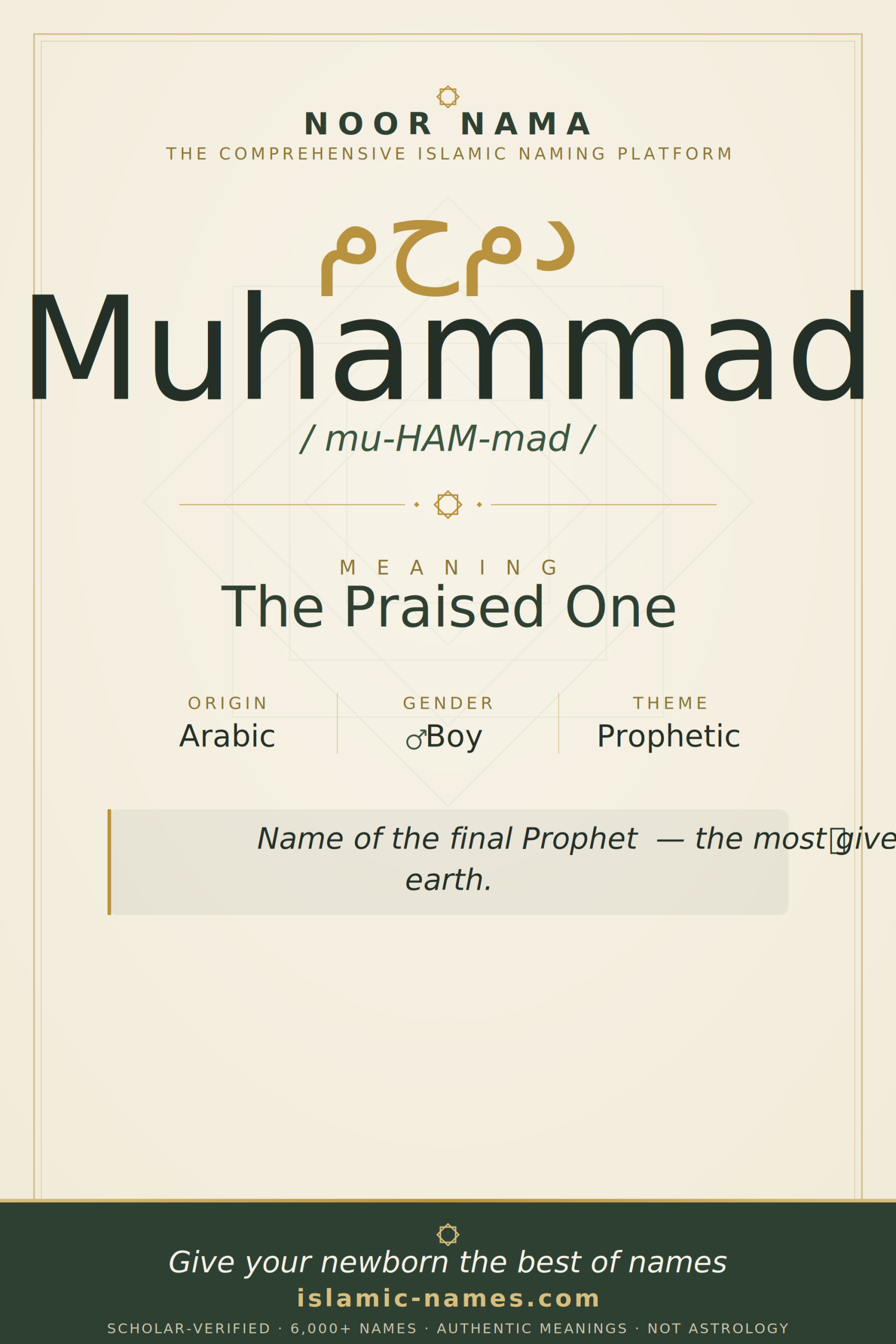
What is the meaning of the name Muhammad Name Meaning, Origin & Islamic Significance in Islam?
The name Muhammad Name Meaning, Origin & Islamic Significance is a traditional Islamic child name meaning "The praised one, one worthy of repeated praise". In Muslim culture, naming a child Muhammad Name Meaning, Origin & Islamic Significance is deeply significant because of its beautiful spiritual connotations. It is a widely accepted and scholar-approved name drawn from authentic Islamic heritage, making it an excellent choice for parents seeking a meaningful name.
The praised one, one worthy of repeated praise
Muhammad Name Meaning in Arabic
This content has been reviewed by our Scholarly Board. Name meanings are verified against classical Arabic dictionaries (Lisan al-Arab, Taj al-Arus) and authentic Hadith collections (Sahih al-Bukhari, Sahih Muslim, Sunan al-Tirmidhi).
The name Muhammad comes from the trilateral root ح م د (ḥ-m-d), which conveys the act of praising, thanking, or speaking well of someone. From this root arise words like ḥamd (praise), maḥmūd (praised), and Aḥmad (more praiseworthy). The pattern mufaʿʿal indicates intensive, repeated action — thus Muhammad signifies “one who is constantly and abundantly praised.”
Classical lexicons such as Lisān al-ʿArab and Tāj al-ʿArūs confirm this derivation, noting that the name was known in pre-Islamic Arabia but became uniquely associated with the Prophet ﷺ after his mission. The root also appears in the Quranic phrase al-ḥamdu lillāh (all praise belongs to Allah), linking the name to the central Islamic concept of gratitude to the Creator.
Is Muhammad Mentioned in the Quran?
The name Muhammad appears explicitly four times in the Quran (3:144, 33:40, 47:2, 48:29), each time affirming his role as Allah’s Messenger. Surah Muhammad (Chapter 47) bears his name, revealed in Madinah to address the early community’s struggles and the distinction between truth and falsehood. The Quran also refers to him by titles such as Rasūl Allāh (Messenger of Allah) and Khātam al-Nabiyyīn (Seal of the Prophets), establishing his unique station in revelation history.
Muhammad ﷺ: The Messenger of Allah
Muhammad ibn ʿAbdullāh ﷺ was born in Makkah around 570 CE, orphaned early, and raised by his grandfather and uncle. At age forty, he received the first revelation in the Cave of Ḥirāʾ, beginning a 23-year mission that transformed the Arabian Peninsula. He ﷺ established the first Muslim community in Madinah, conveyed the Quran, and exemplified the highest moral character — described by his wife ʿĀʾishah (RA) as “the Quran walking.”
His life ﷺ is preserved in meticulously transmitted reports (ḥadīth) covering worship, law, ethics, and interpersonal conduct. Muslims follow his Sunnah as the practical embodiment of Quranic guidance. He ﷺ passed away in 632 CE in Madinah, where his mosque and resting place remain a focal point of visitation and love for believers worldwide.
How to Pronounce Muhammad
The classical Arabic pronunciation is mu-HAM-mad. The name flows easily in both Arabic and English, making it a practical choice for Muslim families in the USA, UK, Canada, and Australia.
| Pronunciation | Where It’s Common |
|---|---|
| mu-HAM-mad | Standard Arabic pronunciation with stress on the second syllable |
| mu-HAM-med | Common English approximation |
| Mo-HAM-mad | Regional variation heard in South Asia and parts of Africa |
Muhammad Spelling Variations: Mohammed, Mohammad, Muhammed & More
Choose the spelling that matches your family’s heritage:
| Spelling | Region / Community |
|---|---|
| Mohammed | Most common English transliteration historically |
| Mohammad | Standard in many official documents and passports |
| Muhammed | Variant reflecting the doubled ‘m’ in Arabic script |
| Mehmed | Ottoman Turkish form used historically in the Balkans and Turkey |
| Muhamed | Simplified spelling seen in Southeast Europe and diaspora |
Cute Nicknames for Muhammad
Hamza, Hammadi, Momo, Hamood, Maddi, Muhannad
Abjad Value of Muhammad
In the traditional Abjad system of Arabic letter values, مُحَمَّد calculates to 92. This classical scholarly numbering of Arabic letters is presented for knowledge only and carries no fortune-telling meaning. A child’s destiny is with Allah alone.
How Popular Is Muhammad?
Muhammad is widely considered the most popular given name in the world, borne by an estimated 150 million men and boys across every continent. It has topped baby-name charts in the UK, France, Belgium, and the Netherlands for years, reflecting both Muslim demographic growth and the name’s cross-cultural resonance. In the United States, it has ranked in the top 300 since 2000 and continues to rise.
Its phonetic simplicity — three syllables, clear vowels, no difficult consonants — makes it easily pronounceable in dozens of languages. The spelling variations accommodate different transliteration systems while preserving the recognizable core. For Muslim families in the West, Muhammad offers a name that is simultaneously deeply rooted, globally recognized, and practically effortless in daily life.
Muhammad & Muslim Baby Names Across American Cities
From the Muslim communities of Dearborn and New York to growing families in Houston, Chicago, Dallas, Los Angeles, Atlanta, and Minneapolis, parents searching for authentic Muslim boy names choose Muhammad for its clear meaning and easy pronunciation. Explore our city naming guides for local trends and community favorites:
Muslim Names in Houston
Muslim Names in Chicago
Muslim Names in Dallas
Muslim Names in Los Angeles
All USA City Guides
Names That Pair Beautifully with Muhammad
Sister Names
Fatima · Aisha · Khadija · Maryam · Zainab · Ruqayyah · Umm Kulthum · Asma
Brother Names
Ahmad · Ali · Hasan · Husayn · Ibrahim · Yusuf · Isa · Abdullah
Frequently Asked Questions About the Name Muhammad
Is Muhammad a Quranic name?
Yes, Muhammad is explicitly mentioned four times in the Quran (3:144, 33:40, 47:2, 48:29) as the name of the final Prophet ﷺ. Surah 47 is named after him.
What is the difference between Muhammad and Ahmad?
Both derive from the root ḥ-m-d (praise). Muhammad means “the praised one” (passive participle, intensive form), while Ahmad means “more praiseworthy” or “most commendable” (elative form). The Quran 61:6 mentions Ahmad as a name foretelling the Prophet ﷺ.
Can non-Arabs name their child Muhammad?
Absolutely. The name is used by Muslims of every ethnicity — South Asian, African, European, Southeast Asian, and Western converts. It is not restricted to Arabs; the Prophet ﷺ said, “An Arab has no superiority over a non-Arab except by piety.”
Is it permissible to use Muhammad as a middle name?
Yes, many Muslims give Muhammad as a first or middle name to honor the Prophet ﷺ. In some cultures it is customary for every boy to carry Muhammad as part of his name, often combined with a second name for daily use (e.g., Muhammad Ali, Muhammad Yusuf).
Why is Muhammad so common worldwide?
Muslims name sons after the Prophet ﷺ out of love, reverence, and hope for his intercession. A ḥadīth states: “Name yourselves by my name…” The name’s global spread follows the expansion of Islam over 14 centuries, making it a shared heritage across cultures.
Sources & method: Meaning verified against classical Arabic sources. NoorNama presents Abjad values as classical scholarship only, never as fortune-telling. All destiny is with Allah سبحانه وتعالى.
Need help choosing the perfect name?
Get scholar-guided, personalized recommendations for your baby.
Find the perfect name for your child
Check our complete database for free names, or get a personalized scholarly naming report based on the precise date of birth.