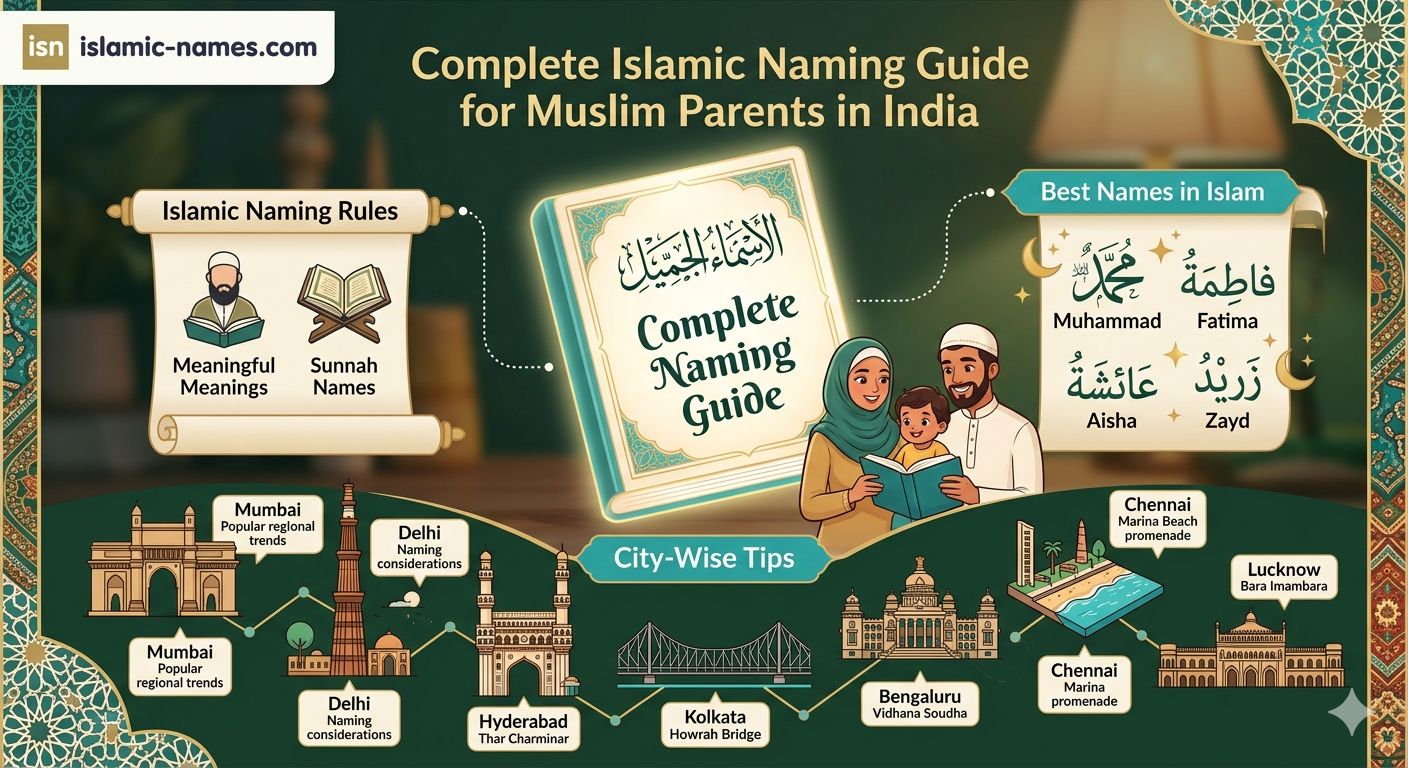
From the aqeeqah ceremony to forbidden names, the classical Abjad scholarly tradition, and practical tips for Muslim parents across Mumbai, Delhi, Hyderabad, Chennai, Bangalore, Kerala, Gujarat, Lucknow and beyond.
What are the rules for naming a child in Islam? The name must have a good meaning; names of Allah require the Abd prefix (Abdullah, Abdur Rahman); names implying shirk are forbidden; Prophets’ and companions’ names are strongly encouraged; and the name should ideally be announced on the 7th day during the aqeeqah ceremony. Non-Arabic names are permissible if their meaning is good — the criterion is meaning, not language of origin.
Why Names Matter in Islam
Durood Sharif Protocol
Following the Sunnah of sealing spiritual practices with blessings upon the Prophet (PBUH):
Recite Durood Sharif (Salawat) 3, 7, or 11 times before and after this practice to seal its acceptance, following the established tradition of the pious predecessors.
“On the Day of Resurrection you will be called by your names and the names of your fathers, so keep good names.”
— Sunan Abi Dawud 4948
In Islam, a name is not an administrative label — it is a lifelong du’a (supplication) carried by the child, and a declaration of identity heard by every person they meet. The name shapes first impressions, reflects parental values, and — according to hadith — will be called out on the Day of Judgment.
For Muslim families in India’s diverse cities, an Islamic name serves a triple function: it preserves religious identity in a multicultural society, it honours the Sunnah of the Prophet ﷺ, and it gives the child a meaning to grow into. Families from Mumbai’s Bohra neighbourhoods to Chennai’s Rowther communities, from Lucknow’s Nawabi tradition to Kerala’s Mappila heritage, all share this responsibility — with naming traditions shaped by centuries of distinct Islamic civilisation in each region.
The Prophet ﷺ changed bad names. Multiple hadith record the Prophet ﷺ renaming companions whose names carried negative, idolatrous, or inauspicious meanings. Renaming is not only permissible — it is Sunnah when the existing name has a problem.
Naming Timeline: The 7th Day & the Aqeeqah Ceremony
The Prophet ﷺ established a clear timeline for naming a newborn, anchored to the aqeeqah ceremony. Understanding this timeline is the first practical step for every new Muslim parent.
-
At
BirthTahneek — The First Blessing
Immediately after birth, a soft date is rubbed on the baby’s palate by a righteous person. The adhan is called in the right ear; iqamah in the left. This is the Islamic welcome into the world — before any official name announcement.
-
Day
7Aqeeqah — The Preferred Naming Day
2 sheep for a boy, 1 sheep for a girl are sacrificed. The child’s head is shaved and sadaqah equal to the hair’s weight in silver is given to the poor. The chosen name is formally announced. This is the most beloved moment in the Islamic calendar for a new arrival.
-
Day
14Second Opportunity (If Day 7 Missed)
If the 7th day is missed for any reason, the 14th day is the next preferred occasion. The full aqeeqah is performed as above.
-
Day
21Third Opportunity
If both the 7th and 14th pass, the 21st day is the third preferred time. After this, aqeeqah can be performed at any point — there is no expiry on this Sunnah.
-
Any
TimeNo Expiry — The Sunnah Remains Valid
Aqeeqah can be performed in adulthood for those for whom it was not done in infancy. A bad name can be changed at any age. The obligation to give a good Islamic name has no expiry.
The Islamic Naming Framework — Three Tiers
Scholars across all four major madhabs classify Islamic naming rules into a three-tier framework, giving parents a practical decision guide:
| Tier | Ruling | Condition | Examples |
|---|---|---|---|
| 🔴 Tier 1 | Haram — Forbidden | Shirk; servitude to other than Allah; exclusive divine attributes used alone; names of known enemies of Islam | Abdul Nabi, Abd al-Uzza, Rahman (alone), Malik al-Amlak |
| 🟡 Tier 2 | Makruh — Disliked | Ugly, inauspicious, or embarrassing meaning; unwieldy composite names; names evoking negative character | Harb (war), Murrah (bitterness), Hanzalah (stinking) |
| 🟢 Tier 3 | Mustahabb — Recommended | Names of Allah with Abd prefix; Prophets; companions; Ahl al-Bayt; names with praiseworthy meanings | Abdullah, Muhammad, Fatimah, Bilal, Maryam, Noor |
Names Encouraged in Islam
1. Names of Allah — with the Abd Prefix (Mandatory)
The most beloved names to Allah are those that express servitude to Him. The word Abd (عبد — servant of) must precede any Divine attribute. Using the Divine name alone as a human name is not permissible.
2. Names of the Prophets and Messengers
All 25 Prophets mentioned in the Quran have names explicitly encouraged: Muhammad, Ahmad, Ibrahim, Ismail, Musa, Isa, Yusuf, Dawud, Sulayman, Idris, Yahya, Zakariyya, Nuh, Hud, Salih, Lut, Yunus, Ilyas, Alyasa, Dhul Kifl, Shu’ayb, Adam, Hud, Salih. The Prophet ﷺ’s name Muhammad is the most widespread male Muslim name globally.
3. Names of the Companions & Ahl al-Bayt
Men: Abu Bakr, Umar, Uthman, Ali, Bilal, Hamza, Zayd, Khalid, Anas, Talha, Zubair, Ammar, Salman.
Women: Khadijah, Aisha, Fatimah, Zainab, Ruqayyah, Umm Kulthoom, Hafsa, Asma, Sumayyah, Safiyya.
4. Names with Good Meanings in Any Language
A name need not be Arabic to be permissible. Any name — Tamil, Bengali, Urdu, Persian, Turkish — is acceptable if it carries a good meaning and does not contradict tawheed. The companions of the Prophet ﷺ included Bilal (Ethiopian origin), Salman (Persian), and Suhaib (Byzantine). Language of origin is never the criterion — meaning is.
Key Principle: The Islamic naming criterion is meaning, not language. A well-meaning Tamil or Bengali name is more Islamically sound than an Arabic name with a negative root.
Names of Allah — The Complete Abd Prefix Table
The prefix Abd (for males) and Amat (for females) transforms any Divine attribute into a permissible and honourable name. The most widely used across Indian cities:
| Name | Meaning | Female Form | Common in India |
|---|---|---|---|
| Abdullah | Servant of Allah — most beloved to Allah ﷻ | Amatullah | Universal — all cities |
| Abdur Rahman | Servant of the Most Merciful | Amatur Rahman | Universal — all cities |
| Abdul Karim | Servant of the Most Generous | Amatul Karim | Hyderabad, Delhi |
| Abdul Ghafoor | Servant of the All-Forgiving | Amatul Ghafoor | Hyderabad, Bangalore |
| Abdul Razzaq | Servant of the All-Provider | Amatur Razzaq | Delhi, Ahmedabad |
| Abdul Wahhab | Servant of the All-Giver | Amatul Wahhab | Mumbai, Pune |
| Abdul Hakeem | Servant of the All-Wise | Amatul Hakeem | Chennai, Kolkata |
| Abdul Qadir | Servant of the All-Powerful | Amatul Qadir | Lucknow, Tamil Nadu |
| Abdul Latif | Servant of the Most Subtle | Amatul Latif | Kerala, Kozhikode |
| Abdul Samad | Servant of the Eternal | Amatus Samad | Bhopal, Indore |
| Abdul Majeed | Servant of the Most Glorious | Amatul Majeed | Mumbai, Hyderabad |
| Abdul Hameed | Servant of the All-Praiseworthy | Amatul Hameed | Tamil Nadu, Gujarat |
Best Boy Names in Islam — Top 20 with Meanings
“The most beloved of names to Allah are Abdullah and Abdul Rahman.”
— Sahih Muslim 2132 · The most-cited hadith in Islamic naming scholarship
| Name | Arabic | Meaning | Heritage |
|---|---|---|---|
| Muhammad | محمد | The Praised One | Quran · 33:40, 48:29 |
| Ahmad | أحمد | Most Praiseworthy | Quran · 61:6 |
| Ibrahim | إبراهيم | Father of Nations | Quran · Surah 14 |
| Yusuf | يوسف | Allah Increases in Grace | Quran · Surah 12 |
| Zayd | زيد | Growth, Abundance | Quran + Sahabi · 33:37 — only Sahabi named in Quran |
| Ali | علي | Elevated, Noble | Prophet’s Family |
| Umar | عمر | Flourishing, Long Life | Sahabi · 2nd Caliph RA |
| Bilal | بلال | Moisture, Refreshing | Sahabi · First Muezzin RA |
| Hamza | حمزة | Strong, Steadfast | Sahabi · Lion of Allah RA |
| Khalid | خالد | Eternal, Immortal | Sahabi · Sword of Allah RA |
| Hasan | حسن | Handsome, Good | Prophet’s Family · Grandson RA |
| Husayn | حسين | More Beautiful | Prophet’s Family · Grandson RA |
| Anas | أنس | Affection, Closeness | Sahabi RA |
| Dawud | داود | Beloved | Quran · 4:163 |
| Sulaiman | سليمان | Man of Peace | Quran · Surah 27 |
| Salman | سلمان | Safe, Peaceful | Sahabi (Persian) RA |
| Rayyan | ريان | Gate of Paradise for those who fast | Hadith · Bukhari 1896 |
| Talha | طلحة | Tall, Flourishing | Sahabi · 10 Promised Paradise RA |
| Idrees | إدريس | Studious, Learned | Quran · 19:56 |
| Farhan | فرحان | Joyful, Happy | Classical Arabic |
Best Girl Names in Islam — Top 20 with Meanings
| Name | Arabic | Meaning | Heritage |
|---|---|---|---|
| Fatimah | فاطمة | One Who Weans (from evil) | Prophet’s Family · Daughter RA |
| Aisha | عائشة | She Who Lives, Thriving | Prophet’s Family · Wife RA |
| Khadijah | خديجة | Born Prematurely (honoured) | Prophet’s Family · First Wife RA |
| Maryam | مريم | Beloved; Devoted Servant | Quran · Surah 19 — explicitly Quranic |
| Zainab | زينب | Ornament of the Father | Prophet’s Family · Daughter RA |
| Ruqayyah | رقية | Rising, Elevated | Prophet’s Family · Daughter RA |
| Asma | أسماء | Names; High Status | Sahabi · “Woman of Two Belts” RA |
| Hafsa | حفصة | Lioness, Gatherer | Prophet’s Family · Wife RA |
| Sumayyah | سمية | Lofty, Distinguished | Sahabi · First Martyr in Islam RA |
| Safiyya | صفية | Pure, Chosen | Prophet’s Family · Wife RA |
| Aminah | آمنة | Trustworthy, Safe | Prophet’s Family · Mother of Prophet ﷺ |
| Sakina | سكينة | Tranquility, Divine Calm | Prophet’s Family · Daughter of Husain RA |
| Noor | نور | Light; Divine Radiance | Quran-derived · 24:35 · not a Quranic personal name |
| Safa | صفاء | Purity, Clarity | Classical Arabic · Quranic reference 2:158 |
| Hana | هناء | Happiness, Bliss | Classical Arabic |
| Khawla | خولة | Female Deer; Beauty | Sahabi RA |
| Umm Kulthoom | أم كلثوم | Mother of Kulthoom (honoured) | Prophet’s Family · Daughter RA |
| Sara | سارة | Pure, Happy, Noble Lady | Prophet’s Family · Wife of Ibrahim ﷺ |
| Bushra | بشرى | Glad Tidings, Good News | Quran-derived · 2:97, 10:64 · not a personal name in Quran |
| Jameelah | جميلة | Beautiful | Classical Arabic · Prophet ﷺ recommended renaming |
Forbidden & Disliked Names in Islam
❌ Absolutely Forbidden (Haram): Abdul Nabi, Ghulam Nabi, Abdul Hussain, Ghulam Ali (servitude to anyone other than Allah) · Rahman alone, Kareem alone, Ahad alone (exclusive divine attributes without Abd prefix) · Abd al-Uzza, Abd al-Lat, Abd Manat (pre-Islamic idols) · Malik al-Amlak (attributes of Allah alone) · Names of known enemies of Islam used to honour them.
🟡 Disliked (Makruh): Harb (war) · Murrah (bitterness) · Hanzalah (stinking plant) · Dunia (worldly life) · Overly long composite names that create lifelong administrative difficulties · Names that mock Islamic concepts.
A Common Problem in Indian Muslim Families
Names like Abdul Nabi and Ghulam Rasool are historically widespread across Lucknow, Patna, Hyderabad, and rural UP — passed down through generations before this ruling was widely understood. The scholarly consensus across all four madhabs is clear: these names are impermissible, and changing them to Abdullah or a Prophet’s name is both permissible and encouraged.
Note on “Abdul Mustafa”: Whether “Abdul Mustafa” (servant of the Chosen One — a title of the Prophet ﷺ) carries the same problem as Abdul Nabi is a genuine scholarly debate. Some scholars consider it permissible since “Mustafa” is a Divine selection (Allah chose him); others consider it equivalent to Abdul Nabi. The safest and most agreed-upon option is Abdullah. Consult your local imam if you are specifically considering this name.
How to Choose an Islamic Name — 5 Steps
Following this five-step process ensures a name that meets every Islamic naming standard before the 7th day arrives.
-
1
Choose a naming category
Decide which tier to draw from: a name of Allah with the Abd prefix (most recommended), a Prophet’s name, a companion’s name, or a name with a praiseworthy meaning. This narrows thousands of options to a workable shortlist.
-
2
Verify the Arabic root meaning
Look up the classical Arabic trilateral root — not just a common translation. The root’s meaning is definitive. Many names that appear beautiful carry obscure secondary meanings in the root. Use the IslamicNames.com verified name directory for this step.
-
3
Cross-check in your regional language
In India, check that the name does not carry an embarrassing meaning in Marathi (Mumbai/Pune), Tamil (Chennai), Bengali (Kolkata), Gujarati (Ahmedabad/Surat), Telugu (Hyderabad), or Kannada (Bangalore). Arabic emphatic consonants often simplify in regional pronunciation, creating new-sounding words. See the regional compatibility table below.
-
4
Check for shirk or forbidden elements
Confirm the name does not imply servitude to anyone other than Allah, does not use an exclusive Divine attribute alone, and is not the name of a known idol. If unsure, consult your local imam before the 7th day — this is precisely what scholars are there for.
-
5
Announce on the 7th day with Aqeeqah
On the 7th day, perform the aqeeqah sacrifice, shave the child’s head, give sadaqah, and formally announce the name to family and community. Register the name on government documents (birth certificate) as soon as practical thereafter.
Your Child Has a Specific Hijri Birth Date.
Noor Nama Finds the Names That Align With It.
Once you understand the Islamic naming framework above, Noor Nama™ takes you one step further — mapping your child’s exact Hijri date of birth to the 12 Buruj and identifying the Blessed Letters documented by classical Islamic scholars. The result: a personalised shortlist of scholar-approved names filtered by the same framework you have just read.
- ✦ Hijri calendar mapping of your child’s exact birth moment
- ✦ Blessed Letters from the Burj — from Ilm al-Jafr scholarship
- ✦ Scholar-approved names in Arabic, Urdu-Persian, and regional traditions
- ✦ Sunnah Gemstone from the classical Jafr matrix — free preview
Free · No signup · Instant results · Not Astrology
The Abjad & Blessed Letters Tradition in Islamic Naming
Classical Islamic scholarship includes a tradition that modern Muslims are often unaware of: Ilm al-Jafr (the science of letter-mathematics) and the Abjad system, which assigns numerical values to Arabic letters and has been used by scholars for over a thousand years to understand the spiritual qualities embedded in words — including names.
“Allah created 28 letters, and from these letters He created all creation.”
— Attributed to classical Sufi scholarship · The foundation of the Islamic letter-wisdom tradition
What this tradition is — and what it is not
The Abjad tradition is not astrology. Astrology claims to predict future events or personalities from celestial positions — and predictive claims about the unseen (ghayb) are not permissible in Islam. The Abjad and Jafr traditions are different: they are frameworks for reflecting on the spiritual qualities of words, letters, and sacred seasons documented by scholars like Imam Ali ibn Abi Talib RA and later formalised by scholars including Ahmad ibn Ali al-Buni (12th–13th century).
Within this tradition, the 12 Buruj (the twelve divisions of the Islamic lunar year) each correspond to specific Arabic letters, elements (Fire, Earth, Air, Water), gemstones mentioned in Sunnah, and spiritual qualities. A child born in a specific Hijri month is understood to have entered the world in the spiritual register of that Burj — and the Blessed Letters associated with it can serve as a reflective guide when choosing a name.
How scholars have used this tradition: Classical Islamic naming scholars used Abjad letter-values to assess whether a chosen name carried harmonious spiritual qualities for a particular child. This is a reflective framework — not a prediction. It does not claim to know the child’s future; it reflects on the spiritual register of their birth moment as documented in classical Islamic scholarship. The Noor Nama™ tool applies this same framework digitally.
City-Wise Islamic Naming Guide for Indian Muslim Parents
India’s Muslim communities span multiple madhabs, languages, and naming traditions developed over centuries. Each major city has a distinct character — see our dedicated city guides for full detail, or use the practical notes below.
🌊 Mumbai
Communities: Dawoodi Bohras (Fatimid tradition — Taher, Murtaza, Sakina, Zehra), Memons (classical Arabic), Konkani Muslims, Sunni UP/Bihar families.
Language check: Marathi and Gujarati. Bohra spelling conventions: Fatema not Fatima, Aly not Ali.
Key tension: Urdu-Persian names (Danish, Rukhsar) are accepted in Mumbai — the city is more accepting of Persian naming than purely Arabic-focused cities.
🏛️ Delhi NCR
Communities: UP/Bihar-origin majority (strong Sahabi naming: Bilal, Zubair, Talha), Old Delhi Mughal heritage (Arsalan, Zafar, Gulshan), government/professional families.
Language check: Hindi/Urdu — Arabic names adapt directly; minimal cross-check issues.
Pitfall: Overly composite names create lifelong document problems. Concise names (Adam, Zayn, Sara) increasingly preferred.
🕌 Hyderabad
Communities: Deccani Sunni majority, significant Shia community (Old City), Telugu-speaking Muslims. Strong Nizami scholarly tradition.
Language check: Telugu and Urdu. Most Arabic names adapt well to Telugu phonology.
Pitfall: “Syed” prefix widely used — the core name must still meet Islamic naming rules regardless of prefix.
🌴 Kerala
Communities: Mappila Muslims — India’s oldest Muslim community (629 CE Arab trading origin). No Urdu influence; direct Arabic connection.
Language check: Malayalam. Distinctive phonetics: Fatima → Fathima, Muhammad → Muhammed, Mustafa → Musthafa.
Distinctive: Quranic prophets’ names (Sulaiman, Ayoob, Nooh) far more common in Kerala than anywhere else in India.
🏺 Tamil Nadu
Communities: Labbai, Rowther, Maraikkar — Tamil-speaking Muslims with 1,300 years of history. No Urdu layer.
Distinctive: Abdul compound names most prominent in India — Abdul Rahman, Abdul Kadir, Abdul Hameed. Sahih Muslim 2132 (“most beloved names to Allah”) taken very seriously here.
Language check: Tamil. Emphatic Arabic consonants simplified in Tamil phonetics.
💻 Bangalore
Communities: Old Bangalore Dakhni Muslims, Beary Muslims (Arab coastal origin), tech-professional migrants from every Indian state.
Distinctive: Zayd — the only Sahabi named by name in the Quran (33:37) — is popular here among educated professionals for this very reason.
Trend: Globally pronounceable + deep Islamic provenance: Zayd, Faisal, Rehan, Sana, Inaya.
📜 Gujarat (Ahmedabad · Surat)
Communities: Dawoodi Bohras (Fatimid lineage — Taher, Sakina, Zehra), Memons (Quranic prophets: Yusuf, Ibrahim, Suleman), Ismaili Khojas.
Distinctive: Three distinct Muslim communities with theologically separate naming traditions. Surah Yusuf carries special resonance for Gujarat’s trading heritage.
Bohra spelling: Fatema (not Fatima), Aly (not Ali), Zehra, Taher — all from Lisan al-Dawat conventions.
👑 Lucknow & UP
Communities: Nawabi Urdu-Persian tradition. Tehzeeb (refinement) is an explicit naming criterion — a name must sound beautiful in Lucknawi Urdu, not just carry correct Islamic meaning.
Pitfall: “Abdul Nabi” and “Ghulam Rasool” remain common in rural UP — scholars consistently advise updating to Abdullah.
Distinctive: Tamkeen, Zeeshan, Raza — distinctly Lucknawi Urdu-Persian names found nowhere else with the same frequency.
🎵 Kolkata & Bengal
Communities: Bengali-speaking Sunni Muslims. Murshidabad Nawabi heritage. Kazi Nazrul Islam’s influence on Bengali Muslim literary culture.
Language check: Bengali — Arabic names are Bengalized with characteristic vowel shifts: Hussain → Hossain, Hasan → Hoshen.
Distinctive: Bengali-Arabic naming fusion; strong Persian influence from Murshidabad Nawabi tradition; Urdu minimally used.
Regional Language Compatibility Quick-Check
Before finalising a name, identify which language cross-check is most critical for your city:
| State / Region | Language | Key Phonetic Note | Safe Approach |
|---|---|---|---|
| Maharashtra (Mumbai, Pune, Nagpur) | Marathi | Arabic ق often becomes ‘k’; ع becomes a vowel | Say name aloud in Marathi; ask a Marathi-speaking friend |
| Tamil Nadu (Chennai, Coimbatore, Madurai) | Tamil | Emphatic consonants (ص ط ض ظ) simplified; ث→s | Write name in Tamil script; check for unintended Tamil word |
| West Bengal (Kolkata, Murshidabad) | Bengali | ح→h/a; names with ‘ain may sound like Bengali words | Verify full Bengali pronunciation of the name |
| Gujarat (Ahmedabad, Surat, Vadodara) | Gujarati | Arabic consonants generally adapt cleanly | Check Gujarati dictionary for similar-sounding words |
| Telangana/AP (Hyderabad) | Telugu | Arabic names adapt well; long vowels preserved | Verify ḍ/d sounds in Telugu context |
| Karnataka (Bangalore, Mangaluru) | Kannada | Similar to Telugu; Arabic emphatics simplified | Check Kannada pronunciation; especially ‘gh’ sounds |
| UP/Bihar (Lucknow, Patna, Agra) | Hindi/Urdu | Closest to Arabic phonetically — minimal issues | Arabic names translate almost directly into Urdu |
| Kerala (Kozhikode, Malappuram) | Malayalam | Arabic adapts well; ط→th (Fathima not Fatima) | Verify ل/ن combinations in Malayalam context |
Frequently Asked Questions
[inames_faq] shortcode. IslamicNames Suite auto-injects FAQPage JSON-LD schema.
Final Checklist Before You Choose a Name
- ✅ Does the name have a good meaning in its root language?
- ✅ Is it free from any form of shirk? (No Abdul Nabi, no Abd al-Uzza, no Rahman alone.)
- ✅ Is it free from ugly, inauspicious, or embarrassing meanings in Arabic?
- ✅ Did you cross-check in your regional language (Marathi / Tamil / Bengali / Gujarati / Telugu / Kannada)?
- ✅ Is it pronounceable by your child when they grow up — and by their school peers?
- ✅ Have you used Noor Nama™ to identify Blessed Letters for your child’s Hijri birth date?
- ✅ Have you planned the aqeeqah for the 7th day?
- ✅ Did you consult a scholar for any names you were unsure about?
- ✅ Is the name registered on the birth certificate?
May Allah bless all new parents with righteous children who live up to the beautiful names chosen for them. Ameen.
Explore the Full IslamicNames.com Directory
Find, verify, and explore thousands of Islamic names — all checked for meaning, origin, and Islamic appropriateness:
Muslim Girl NamesFull A–Z directory →
Quranic NamesNames from the Quran — with Surah refs →
Noor Nama™ ToolFree personalised Hijri assessment →
Forbidden Names7 categories to avoid — full guide →
Ilm al-Jafr GuideClassical Abjad & Jafr tradition →
Sunnah GemstonesGemstones in Islamic tradition →
Names Starting with MMuhammad, Musa, Mariam & more →