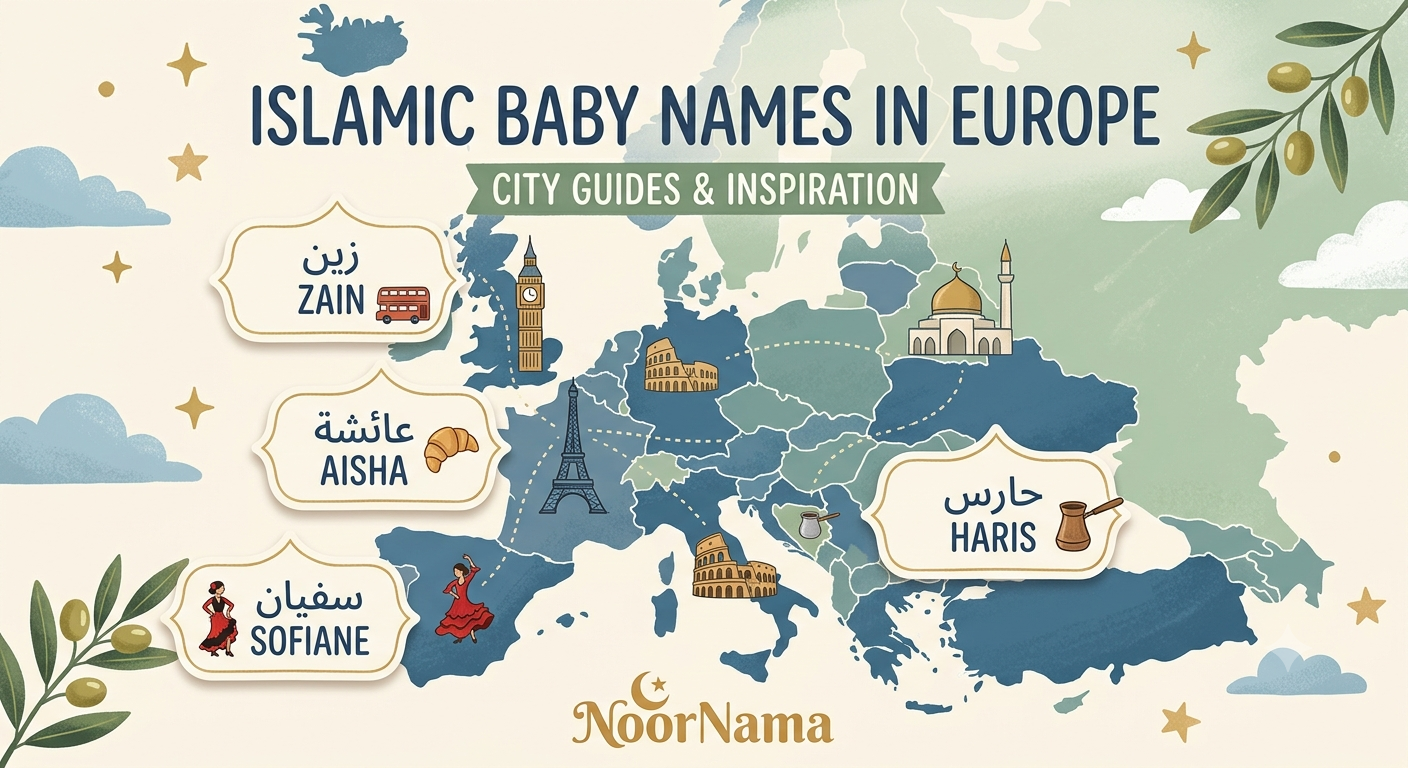
NoorNama — Europe
City guides, Arabic meanings, local spellings, and personalised Islamic name reports for Muslim families across Europe.
Across Europe, Muslim families choose names that preserve Islamic meaning while fitting naturally into everyday life in French, German, Dutch, and other local languages. A good name must sound dignified, carry a sound Arabic root, and remain clear across generations of family and community.
That is especially important in European Muslim homes, where one name may appear in several forms: in Arabic script, in a passport spelling, in a local school register, and in the spoken pronunciation of parents or grandparents. NoorNama helps families connect all of these forms back to the original Islamic name.
“The names dearest to Allah are Abdullah and Abdur-Rahman…”
— Prophet Muhammad ﷺ, narrated in Sunan Abi Dawud
◆Choose Your City
Each guide reflects a real Muslim community, including its naming preferences, language habits, and common spelling styles. Start with the city closest to your family context.
Paris →
France · Maghrebi and West African heritage
Frankfurt →
Germany · Strong Turkish and broader Muslim tradition
As you expand this hub, add future city pages here for Brussels, Rotterdam, Berlin, Cologne, Marseille, Lyon, Vienna, and Stockholm.
◆The European Muslim Naming Tradition
Europe is home to long-established Muslim communities shaped by migration, scholarship, family memory, and local language. In many homes, the chosen name must satisfy several goals at once: correct Islamic meaning, ease of pronunciation, elegance in writing, and familiarity across both Muslim and wider European society.
That is why names such as Maryam, Adam, Yusuf, Amina, Bilal, Ibrahim, Sara, and Noor remain so beloved. They are deeply rooted in Islamic usage, recognisable across languages, and easy to carry in both religious and civic life.
Arabic root
A sound Islamic name should be traced back to its original Arabic form, so the family understands its true meaning rather than relying on guesswork or social media lists.
Local spelling
European spellings may differ by language, but the underlying name often remains the same, such as Yacine and Yasin, or Mehdi and Mahdi.
Family usability
The best names work well in daily speech, school records, official documents, and within the broader family circle.
◆Arabic Names and European Spellings
One of the most common questions in Europe is whether a local spelling changes the Islamic value of a name. In most cases, it does not. What matters first is the underlying name, its meaning, and its origin.
Yacine
Usually reflects the classical name Yasin, adapted to familiar French spelling patterns.
Nour
A common local spelling of Nur or Noor, retaining the meaning of light.
Mehdi
A familiar North African and French spelling linked to the classical Arabic name Mahdi.
Yusuf
Often stays close to the classical form and is widely recognised across Europe.
Meryem
A regional spelling associated with Maryam, especially in Turkish-speaking families.
Ibrahima
A respected regional form connected to Ibrahim, widely used in Francophone Muslim communities.
For that reason, NoorNama does not treat spelling as decoration. It helps families identify the source name, the correct Arabic root, and the relationship between local pronunciation and classical form.
◆Naming Patterns Across Europe
European Muslim naming culture is not one single tradition. It includes Maghrebi, Turkish, West African, Arab, Balkan, and South Asian influences, often meeting within the same city or even the same extended family.
Maghrebi families
Often favour names familiar across North Africa and France, including spellings shaped by Francophone usage while keeping strong Arabic identity.
Turkish families
Frequently preserve names used across Türkiye and the wider Muslim world, sometimes with Turkish-influenced pronunciation or forms such as Meryem.
West African families
May use regionally loved Islamic names that remain firmly tied to Qur’anic and Arabic tradition, especially in Francophone settings.
Mixed-heritage households
Often seek names that sound clearly Islamic, travel well across languages, and feel comfortable for both sides of the family.
◆How to Choose Well
For many parents, the strongest approach is to shortlist a few names and then compare them carefully rather than choosing only by popularity. A good decision usually rests on five points: meaning, Arabic root, Islamic associations, pronunciation, and family acceptance.
- Check the original Arabic form of the name.
- Confirm the meaning from a serious source, not only baby-name list websites.
- Consider whether the spelling used in Europe still points clearly to the same name.
- Say the name aloud in the languages your family uses at home.
- Think about how the name will look on official documents, school records, and family announcements.
The Complete Islamic Baby Name Report
A personalised, research-based report on the name you are considering, prepared for Muslim families who want more than a one-line meaning. It is especially useful in Europe, where families often need clarity on Arabic roots, local spellings, and how a name should be understood across languages.
- Full classical Arabic meaning and root.
- Qur’anic significance and Sunnah connection.
- Help with transliteration and local spelling variants.
- Abjad numerological value.
- The 12 Buruj birth framework.
- A printable PDF certificate in Arabic and English.
◆Explore More Muslim Name Guides
This Europe hub is designed to grow into a wider regional library. As new pages are added, each city guide can focus on local community history, common naming patterns, and spelling habits specific to that city.
France
Build next around Marseille and Lyon, where local pages can complement your Paris guide with broader Francophone Muslim naming patterns.
Germany
Berlin and Cologne would strengthen coverage beyond Frankfurt and help capture wider German Muslim search intent.
Benelux and beyond
Brussels, Rotterdam, Antwerp, Vienna, and Stockholm are natural future hubs for multilingual Muslim family searches.
◆Frequently Asked Questions
Do Muslim families in Europe often use local spellings of Arabic names?
Yes. Many Muslim families in Europe use French, Dutch, or German spellings of classical Arabic names. What matters first is the original name, its Islamic meaning, and its root.
Does NoorNama cover Maghrebi, Turkish, West African, and South Asian naming traditions in Europe?
Yes. European Muslim communities draw on several naming traditions, and NoorNama helps trace these names back to their classical Arabic forms and meanings.
Can I order a personalised Islamic baby name report from anywhere in Europe?
Yes. The NoorNama Complete Islamic Baby Name Report is delivered digitally by email, so families across Europe can order it easily.
Is the report useful if grandparents use a different spelling of the same name?
Yes. The report can clarify the Arabic source name, the transliteration, and the local spelling, helping the whole family understand that they are often looking at the same name in different forms.
Outside Europe? Explore our wider Islamic baby name guides, or browse our Muslim baby names in India by state and city.