Last updated: October 2026 · A summary of mainstream scholarly positions across the four madhhabs
The Golden Rule: Every Name Must Have a Good Meaning
One principle governs everything below: the name should have a good meaning. The Prophet ﷺ said:
— Sunan Abi Dawud 4948 (scholars differ on its grading; its meaning is supported by other authentic texts below)
The Prophet ﷺ also changed names with poor meanings: Barrah (“pious”) became Zaynab (Sahih Muslim 2142), and ʿĀṣiya (“disobedient”) became Jamīla (Sahih Muslim 2139). He also advised that the most beloved names to Allah are Abdullah and Abdur-Rahman (Sahih Muslim 2132).
In short: if a name’s meaning is ugly, arrogant, implies servitude to anyone but Allah, or specifically identifies another religion, it is forbidden or disliked.
Category 1: Names Exclusive to Allah
Some of Allah’s beautiful names (al-asmā’ al-ḥusnā) belong to Him alone. Giving them to a human, in their absolute form, claims a divine attribute.
| Name | Meaning | Ruling |
|---|---|---|
| Allah | God | Haram |
| Ar-Rahman (with al-) | The Most Merciful | Haram |
| Al-Khaliq | The Creator | Haram |
| Al-Quddus | The Holy | Haram |
| Al-Ahad | The One | Haram |
| Al-Malik (absolute) | The King | Haram in this absolute form |
What about “Rahman” without “Al-”? Many scholars say Rahman is itself exclusive to Allah and should not be used alone, while others tolerate it as common usage. The safe form is Abdur-Rahman, “servant of the Most Merciful.”
Permissible overlaps: names describing qualities humans can also have, such as Ali (high), Rashid (rightly guided), Kareem (generous) and Malik (a human king), are permitted in the human sense.
Category 2: “Abd” + Anyone Other Than Allah
Abd means “slave/servant,” and worship belongs only to Allah. Names formed as Abd + a non-Allah word are forbidden; scholars have reported consensus on this, with Abd al-Muttalib mentioned as a historical exception some scholars discuss. This is one of the most common naming mistakes in South Asia.
| Name | Meaning | Ruling |
|---|---|---|
| Abdul Kaaba | Slave of the Kaaba | Haram |
| Abdul Uzza, Abdul Manat | Slave of a pre-Islamic idol | Haram (shirk) |
| Abdul Nabi | Slave of the Prophet ﷺ | Haram |
| Abdul Rasool | Slave of the Messenger | Haram |
| Abdul Husayn | Slave of Husayn (RA) | Haram |
| Abdul Murtaza | Slave of Ali (al-Murtaza) | Haram |
What if the intention was cultural or loving? The wording still means “slave of,” so scholars advise changing it, for example Abdul Husayn to Abdullah or Abdul-Haleem.
Category 3: Names of Angels
Scholars differ on naming a child after an angel. Imam Malik is reported to have disliked Jibreel-type names, while others permit them. Because no Companion is known to have used these names, many scholars advise against them.
| Name | Ruling | Reason |
|---|---|---|
| Jibreel, Mikael, Israfil | Makruh by many; permitted by some | Honoured angels, but not used as names in the Prophetic era |
| Azrael | Strongly discouraged; some call it haram | Not a name in the Quran or authentic hadith; evokes the Angel of Death |
| Malak (“angel”) | Discouraged; scholars differ | A common noun; some fatwas permit it |
Better alternatives: Abdullah, a Prophet’s name (Muhammad, Ibrahim, Musa), or a Companion’s name (Umar, Ali, Hamza).
Category 4: Names That Identify Another Religion
Names with a good meaning that are shared with Islam are fine, such as Dawud (David), Yaqub (Jacob) and Maryam (Maria). But names that specifically identify another faith, such as its deities, founders or religious titles, are forbidden.
| Name | Religion | Ruling |
|---|---|---|
| Ram, Krishna, Shiva | Hindu deities | Haram |
| Buddha | Buddhism’s founder | Haram |
| Guru Nanak | Sikhism’s founder | Haram |
| Christian / Christiana | Christian identity | Haram |
| George (Georgios) | Christian saint (Saint George) | Discouraged; scholars differ (see below) |
Names with no religious meaning? Names like Rohan (Sanskrit, “ascending”) carry no religious significance and are generally permissible, though an Islamic name with a beautiful meaning is better.
Category 5: Ghulam Names
Ghulam literally means “boy/slave.” Names like Ghulam Muhammad and Ghulam Ali are very common in South Asia. Scholars differ here:
- Many scholars treat Ghulam Muhammad and Ghulam Husayn like Abd names and say they should be avoided or changed, because they imply servitude to a human.
- Others, including many South Asian scholars, note that ghulam can mean “attendant/follower,” and treat such names as permissible or only disliked.
| Name | Meaning | Ruling |
|---|---|---|
| Ghulam Muhammad | Servant/slave of Muhammad | Avoid; scholars differ |
| Ghulam Ali, Ghulam Husayn | Servant/slave of Ali, Husayn | Avoid; scholars differ |
Safer alternatives: Muhammad Abdullah or simply Abdullah. If an adult already carries a Ghulam name, they may follow their own scholar’s guidance on whether to change it.
Category 6: Arrogant or Ugly Names
The Prophet ﷺ changed Barrah to Zaynab because it praises oneself (Sahih Muslim 2142). He also said the most despicable name to Allah is Malik al-Amlak (“King of Kings”) (Sahih al-Bukhari 6205, Sahih Muslim 2143), and that the worst names are Harb and Murrah (Sunan Abi Dawud 4950).
| Name | Meaning | Ruling |
|---|---|---|
| Malik al-Amlak, Shahanshah | King of Kings | Haram (explicit hadith) |
| Shaitan, Iblis | Satan | Haram |
| Barrah | Pious (self-praise) | Avoid; Prophet changed it |
| Harb, Murrah | War, bitter | Disliked |
| Hazn | Rugged / sorrowful | Disliked; Prophet advised Sahl |
| Nar, Jahim, Saqar | Fire, Hellfire | Disliked |
| Afzal | Most superior | Generally permitted in the human sense |
Category 7: Gender-Mismatched Names
The Prophet ﷺ cursed men who imitate women and women who imitate men (Sahih al-Bukhari 5885). Scholars apply this by analogy to names: giving a girl a strictly male name, or a boy a strictly female name, is disliked (makruh), and some scholars go further.
| Male name given to a girl | Female name given to a boy |
|---|---|
| Ali, Hamza, Umar, Usman | Fatima, Aisha, Khadija, Zaynab |
Unisex options: Noor (light), Iman (faith) and Amal (hope) are used for both genders in many cultures.
Haram Names for Girls
“Haram names in Islam for girl” is one of the most common searches on this topic. These apply specifically to girls:
| Name | Meaning / issue | Ruling |
|---|---|---|
| Al-Lat, Al-Uzza, Manat | Female pre-Islamic idols | Haram |
| Lakshmi, Saraswati, Durga | Hindu goddesses | Haram |
| Christiana | Christian identity | Haram |
| ʿĀṣiya (عاصية) | Disobedient | Avoid; Prophet changed it |
| Barrah | Pious (self-praise) | Avoid; Prophet changed it |
| Ali, Hamza, Umar, Usman | Male names | Disliked |
Haram Names for Boys
| Name | Issue | Ruling |
|---|---|---|
| Abdul Kaaba, Abdul Uzza, Abdul Manat | Servitude to non-Allah | Haram |
| Abdul Nabi, Abdul Rasool, Abdul Husayn | Servitude to a human | Haram |
| Ar-Rahman, Al-Malik, Al-Quddus | Exclusive names of Allah | Haram |
| Ram, Krishna, Buddha, Guru Nanak | Other religions’ figures | Haram |
| Malik al-Amlak, Shahanshah | “King of Kings” | Haram |
| Ghulam Muhammad, Ghulam Ali | “Slave of” a human | Avoid; scholars differ |
| Jibreel, Mikael, Israfil, Azrael | Angel names | Discouraged |
| Rasul, Nabi | Titles of the Prophet ﷺ | Discouraged |
| Fatima, Aisha, Khadija | Female names | Disliked |
Is Azrael Haram in Islam?
Azrael is strongly discouraged, and some scholars call it haram. There is no single agreed ruling, but the reasons given are:
- It is not a Quranic or authentic Prophetic name. The Quran says Malak al-Mawt (ملك الموت), “the Angel of Death.” The name “Azrael” (عزرائيل) is not in the Quran or the authentic hadith.
- Its origin is outside revelation. The name is widely traced to Jewish tradition (Azriel, often read as “help of God”) and entered popular Islamic culture through Isra’iliyyat narrations. The etymology is debated.
- It evokes fear. The Prophet ﷺ encouraged beautiful names and changed names with sad or harsh meanings.
- No Companion is known to have used it.
If you already used it, consider Abdullah, Abdur-Rahman or a Prophetic name.
Is the Name George Haram in Islam?
Scholars differ. Here is the breakdown:
- Meaning: Greek Georgios means “farmer” or “earth-worker,” a harmless meaning.
- The concern: “George” is strongly tied to Saint George, venerated by Orthodox, Catholic and Anglican Christians, and is widely seen as a Christian name. Some scholars forbid it for Muslims on the grounds of resembling another faith.
- The lenient view: others permit it where it is a common secular name (for example, in the West) and carries no religious intention. Choosing it as a religious name is a different matter.
- Arabic equivalent: Jirjis / Jurj (جرجس / جرج), used mostly by Arabic-speaking Christians.
Short answer: it is best avoided for a Muslim child. If you love the meaning, choose Harith (حارث, “cultivator,” a name the Prophet ﷺ praised in Sunan Abi Dawud 4950), Fallah (فلاح) or a Prophetic name.
If You Already Named Your Child a Forbidden Name
Do not panic. Allah is al-Ghafūr, al-Raḥīm. If you named your child out of ignorance:
- Stop using the name and choose a good Islamic one. For boys: Abdullah, Abdur-Rahman, Muhammad, Ibrahim. For girls: Fatima, Aisha, Khadija, Maryam.
- Make the change. Islam requires no court. Make du’a, tell your family, and update legal documents when possible.
- Explain kindly to an older child: “We made a mistake. Your new name is [X], and it means [Y].”
Do not feel ashamed. The Prophet ﷺ himself changed names, and moving to a better name is Sunnah, not a failure.
Best & Worst Names: Summary Table
| Category | Examples | Ruling |
|---|---|---|
| Best names | Abdullah, Abdur-Rahman, Muhammad, Ibrahim, Fatima, Aisha, Khadija | Highly recommended |
| Good names | Hasan, Husayn, Ali, Zayd, Umar, Usman, Maryam, Harith | Permissible |
| Disliked / avoid | Jibreel, Azrael, Harb, Murrah, Ghulam Muhammad, George | Avoid |
| Forbidden | Allah, Abdul Kaaba, Abdul Nabi, Malik al-Amlak, Shaitan, Ram, Krishna | Must change |
| Shirk | Abdul Uzza, Abdul Manat | Repent and change |
Arabic & French Quick Answers
هل اسم جورج حرام؟
اسم «جورج» مرتبط بالقديس جورج المسيحي. اختلف العلماء فيه: منهم من منعه تجنباً للتشبه بغير المسلمين، ومنهم من أجازه إذا كان اسماً شائعاً بلا قصد ديني. والأولى تركه واختيار اسم إسلامي مثل «حارث» أو «فلاح» أو اسم نبي أو صحابي.
ما الأسماء المحرمة في الإسلام؟
الأسماء المحرمة أو المكروهة سبع فئات: أسماء الله الخاصة به، والتعبيد لغير الله مثل «عبد الكعبة» و«عبد النبي»، وأسماء الملائكة كعزرائيل (مكروه عند الجمهور)، وأسماء الأديان الأخرى مثل «رام» و«كريشنا»، وأسماء «غلام» (وفيها خلاف)، وأسماء التعالي والقبح مثل «ملك الأملاك»، وأسماء الجنس الآخر.
Prénom interdit en islam
Les prénoms interdits ou déconseillés en islam sont ceux qui sont exclusifs à Allah (comme Ar-Rahman seul), ceux qui impliquent la servitude envers un autre qu’Allah (comme Abdul Kaaba), les noms d’anges (comme Azrael, déconseillé), les noms qui désignent une autre religion (comme Ram ou Krishna), les noms arrogants ou laids (comme Malik al-Amlak) et les prénoms du sexe opposé. Pour George, les savants divergent : il est préférable de l’éviter. Choisissez plutôt Abdullah, Abdur-Rahman ou un nom de prophète.
Frequently Asked Questions
What is the list of forbidden names in Islam?
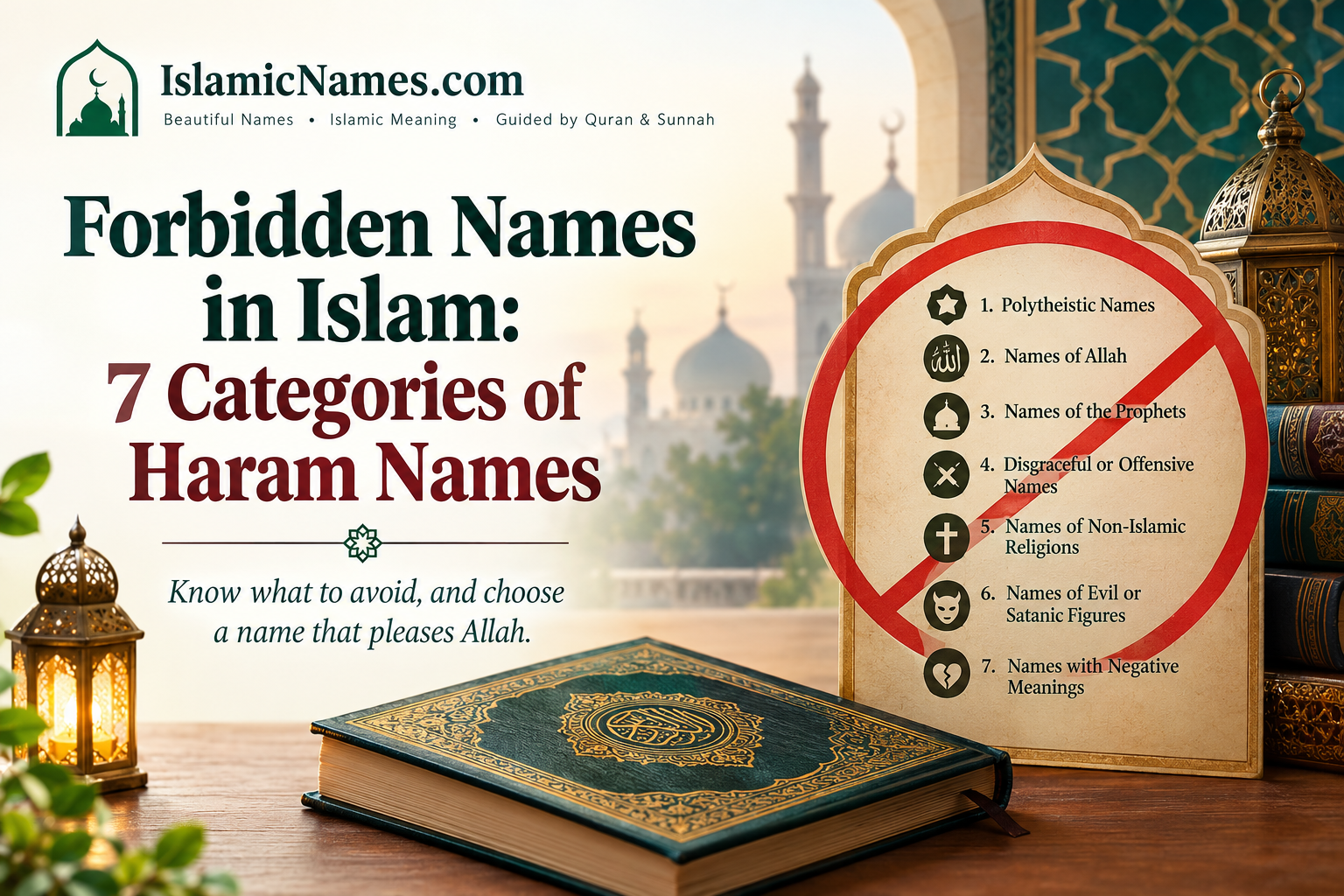
The 7 categories are: (1) names exclusive to Allah; (2) “Abd” + a non-Allah word (Abdul Kaaba, Abdul Nabi); (3) angel names (Jibreel, Mikael, Azrael); (4) names that identify another religion (Ram, Krishna, Christian); (5) Ghulam names (Ghulam Muhammad), where scholars differ; (6) arrogant or ugly-meaning names (Malik al-Amlak); (7) gender-mismatched names.
What are haram names for girls?
Female pre-Islamic idols (Al-Lat, Al-Uzza, Manat), Hindu goddess names (Lakshmi, Saraswati, Durga) and Christian identity names (Christiana) are forbidden. ʿĀṣiya (عاصية, “disobedient”) and Barrah, both changed by the Prophet ﷺ, and strictly male names given to girls are disliked.
Can I name my son Azrael in Islam?
It is strongly discouraged, and some scholars call it haram. The name is not in the Quran or authentic hadith and evokes the Angel of Death. Abdullah, Abdur-Rahman or a Prophetic name is better.
Is the name George haram in Islam?
Scholars differ. It is closely tied to Saint George, so many advise avoiding it, while others permit it as a common secular name. Harith, Fallah or a Prophetic name is a safer choice.
Is it haram to name my child after angels?
Scholars differ. Naming after Jibreel, Mikael or Israfil is disliked by many (Imam Malik is reported to have disliked it) and permitted by others. Azrael is more strongly discouraged.
Is “Ghulam Muhammad” haram?
Scholars differ. Many advise avoiding it because “ghulam” can mean “slave,” while others permit it in the sense of “attendant.” There is no authentic hadith that explicitly forbids it. The safest choice is Abdullah or Abdur-Rahman.
Is “Rahman” haram without “Abdul”?
Many scholars say Rahman should not be used alone because it is exclusive to Allah, while some tolerate it as common usage. The safe form is Abdur-Rahman.
What if I already named my child a haram name?
Stop using it, choose a good Islamic name, tell your family, update legal documents when possible, and explain kindly to the child if they are old enough. Allah is Most Forgiving.
Can I keep my non-Muslim name after converting to Islam?
Usually yes, if the name has a good meaning and does not identify another religion. Names like “Christian” or “Ram,” or names implying servitude to other than Allah, should be changed.
Is the name “Muslim” allowed?
Yes. The hadith scholar Muslim ibn al-Hajjaj bore the name. It can cause confusion in English, so Abdullah may be easier.
Muslim Boy Names
Muslim Girl Names
Sources & method: This page summarises mainstream scholarly positions across the Hanafi, Shafi’i, Maliki and Hanbali schools. Hadith references: Sunan Abi Dawud 4948 (good names; grading disputed), Sunan Abi Dawud 4950 (best and worst names), Sahih Muslim 2132 (Abdullah and Abdur-Rahman), Sahih Muslim 2139 and 2142 (name changes), Sahih al-Bukhari 6205 / Sahih Muslim 2143 (King of Kings), Sahih al-Bukhari 5885 (imitating the opposite gender). Rulings on Azrael, George, angel names and Ghulam names vary between scholars.
We reflect; we never judge. NoorNama reflects on Islamic naming principles and does not issue fatwas. For a specific ruling, consult a qualified scholar. All destiny is with Allah سبحانه وتعالى.