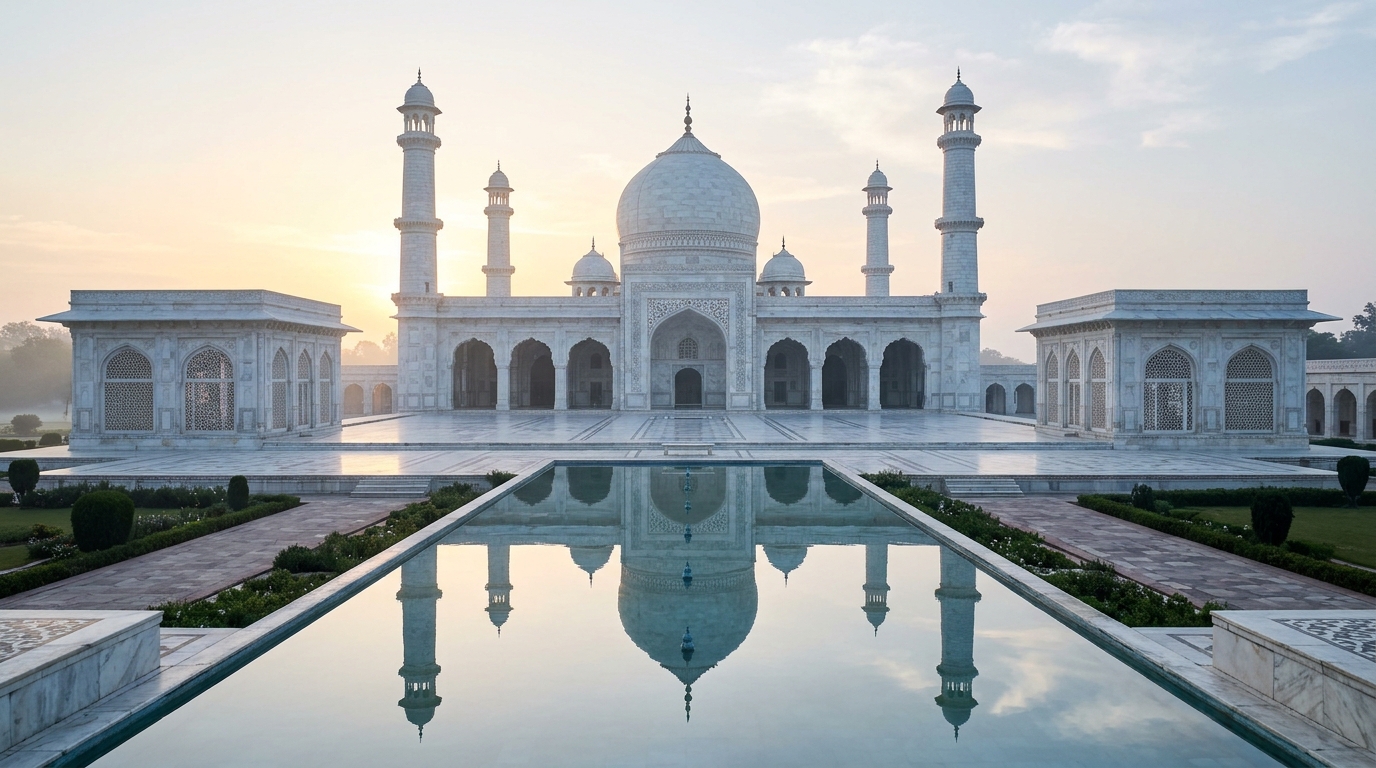
Welcoming a child into the Indian Muslim community is a sacred celebration that bridges over a thousand years of authentic Islamic scholarship, rich regional cultures, and modern civic governance. Encompassing more than 200 million Muslims across every state and union territory—from the Mughal, Rohilla, and Awadhi heritage of Uttar Pradesh and Delhi, to the historic Mappila coast of Kerala, the Deccani royal courts of Hyderabad and Bijapur, the Surti Vohra merchant traditions of Gujarat, and the affectionate dak naam customs of Bengal—this flagship guide provides parents with authentic prophetic newborn adab, step-by-step Ruqyah Shar’iyyah protection, vital Indian Academy of Pediatrics (IAP) clinical boundaries, and essential civic birth registration protocols under the Registration of Births and Deaths Act (RBD 1969).
أُعِيذُكُمَا بِكَلِمَاتِ اللَّهِ التَّامَّةِ، مِنْ كُلِّ شَيْطَانٍ وَهَامَّةٍ، وَمِنْ كُلِّ عَيْنٍ لَامَّةٍ
“I seek refuge for you both in the perfect words of Allah, from every devil and every harmful creature, and from every evil eye.”
The Prophet Muhammad ﷺ recited this exact protection supplication over his beloved grandsons Al-Ḥasan and Al-Ḥusayn (Ṣaḥīḥ al-Bukhārī 3371, narrated by Ibn ‘Abbās). When supplicating for an individual infant, say u‘eedhuka (أُعِيذُكَ) for a baby boy or u‘eedhuki (أُعِيذُكِ) for a baby girl.
Clinical Care Comes First: A Sacred Sunnah Boundary
In orthodox Islamic theology, seeking competent medical treatment (tad&amacron;w&imacron;) is not merely permissible—it is an obligatory Sunnah commanded by the Messenger of Allah ﷺ. Spiritual supplication, du‘a, and Ruqyah never replace diagnostic medicine; rather, true trust in Allah (tawakkul) requires pursuing the medical means (asb&amacron;b) created by Allah.
تَدَاوَوْا فَإِنَّ اللَّهَ عَزَّ وَجَلَّ لَمْ يَضَعْ دَاءً إِلَّا وَضَعَ لَهُ دَوَاءً، غَيْرَ دَاءٍ وَاحِدٍ الْهَرَمُ
“Seek medical treatment, O servants of Allah, for Allah has not created a disease without creating a cure for it, except for one illness: old age.”
— Sunan Abī Dāwūd 3855 (Graded Ṣaḥīḥ by Al-Albani; also recorded in Sunan al-Tirmidhi 2038).
When to Seek Immediate Hospital Casualty / NICU Care in India:
In accordance with clinical standards set by the Indian Academy of Pediatrics (IAP) and the All India Institute of Medical Sciences (AIIMS), do not delay for religious home remedies or visits to shrines if your newborn exhibits any of the following critical red flags:
- Fever of 100.4°F (38.0°C) or higher in an infant under 3 months: This is a medical emergency requiring urgent hospital evaluation for neonatal sepsis, bacteremia, meningitis, or urinary tract infection.
- Neonatal Jaundice within first 24 hours: Any yellowing of the skin appearing on Day 1, or jaundice extending past the chest to the abdomen, palms, and soles of the feet, requires immediate serum bilirubin testing to prevent acute bilirubin encephalopathy (kernicterus).
- Respiratory Distress: Rapid breathing (> 60 breaths per minute), chest in-drawing (subcostal retractions), nasal flaring, or rhythmic grunting sounds while exhaling.
- Poor Feeding & Dehydration: Refusal to feed for two or more consecutive nursing sessions, fewer than 4 to 6 wet diapers in 24 hours, sunken soft spot (anterior fontanelle), or dry mucous membranes.
- Extreme Lethargy: Baby is floppy, unusually difficult to awaken, does not respond to maternal touch or voice, or has a weak, high-pitched inconsolable cry.
- Cyanosis or Pallor: Bluish discoloration around the lips, tongue, or central body (central cyanosis), or an ashen, mottled complexion.
Immediate Emergency Protocol: Call your city ambulance service (108 / 102) or proceed directly to the nearest pediatric casualty ward or tertiary hospital. You may recite du‘a and Ruqyah while traveling to the hospital—never in place of emergency transport.
The Sunnah Shield: Al-‘Ayn (The Evil Eye) & Digital Adab
In Indian culture, the concept of nazar (the evil eye) is pervasive. Parents frequently worry that admiration from strangers, relatives, or social media viewers will bring misfortune, illness, or excessive crying upon their newborn.
The Evil Eye is Real in Islamic Orthodoxy
Islamic belief affirms that Al-‘Ayn is real, as explicitly affirmed by the Prophet Muhammad ﷺ:
الْعَيْنُ حَقٌّ، وَلَوْ كَانَ شَيْءٌ سَابَقَ الْقَدَرَ سَبَقَتْهُ الْعَيْنُ
“The evil eye is real. If anything could precede the divine decree, it would be the evil eye.”
— Ṣaḥīḥ Muslim 2188 (narrated by Ibn ‘Abbās; also confirmed in Ṣaḥīḥ al-Bukhārī 5740).
Scholars explain that Al-‘Ayn operates through deep envy (hasad) or even unrestrained, unblessed admiration that fails to invoke Allah’s name. However, the Prophet ﷺ taught us that divine protection is comprehensive and easily accessible to every parent without fear or superstition.
The Mu‘awwidhatayn: Morning & Evening Parental Fortress
The primary shield taught by the Messenger of Allah ﷺ is the recitation of the Mu‘awwidhatayn—Surah Al-Falaq (113) and Surah An-N&amacron;s (114)—along with Surah Al-Ikhl&amacron;s (112) and Ayat al-Kursi (Al-Baqarah 2:255).
Abu Sa‘id al-Khudri narrated that the Messenger of Allah ﷺ used to seek protection from the jinn and the evil eye of men until the Mu‘awwidhatayn were revealed. When they were revealed, he adopted them and left aside everything else (Sunan al-Tirmidhi 2058, Hasan Sahih).
Digital Adab: WhatsApp Status, Instagram & Family Groups in India
In contemporary India, the instant sharing of newborn portraits across WhatsApp family groups, Instagram reels, and Facebook status is second nature. Classical scholars advise parents to exercise discernment:
- Guard the Vulnerable Early Weeks: An infant in their first 40 days is physically developing and spiritually delicate. Avoid broadcasting daily newborn photos to wide public audiences.
- Remind Viewers to Invoke Barakah: Whenever admiring an infant, train family members to say “M&amacron;sh&amacron;’All&amacron;h Tab&amacron;rakAll&amacron;h” (مَا شَاءَ اللَّهُ تَبَارَكَ اللَّهُ) or “B&amacron;rakAll&amacron;hu fīk” (بَارَكَ اللَّهُ فِيكَ). The Prophet ﷺ said: “Why would one of you kill his brother? When you see something that pleases you, pray for blessing for him.” (Muwatta Malik 1716).
- Conceal Excessive Luxuries: In an era of economic disparity, flaunting lavish newborn gifts, expensive jewelry, or ornate nurseries can incite unconscious resentment or jealousy.
Kala Teeka, Mirchi Utarna & Folk Practices: A Compassionate Pastoral Guide
Throughout India, grandmothers (dadi, nani) and well-meaning relatives often insist on traditional folk customs to protect newborns from buri nazar. When discussing these practices, we must speak with immense pastoral kindness: these actions arise from deep, overflowing parental love and protective anxiety. However, true protection lies exclusively in what the Prophet ﷺ sanctioned.
1. Kala Teeka (The Black Kohl Dot)
The Folk Intention: Applying a small black dot of kajal or kohl on the infant’s forehead, cheek, or behind the ear. Elders believe that introducing a deliberate “imperfection” will prevent onlookers from casting an envious gaze.
Scholarly Clarification: In Islamic theology, inanimate black powder has no metaphysical power to repel spiritual evil or deflect the divine decree. While applying clean antimony (ithmid) to an infant’s eyes for medicinal purposes has Sunnah context, placing a superstitious dot to ward off unseen harm borders on an ungrounded amulet (tamimah).
✓ The Sunnah Alternative: Gently explain to elders: “We honor your loving care, but our Prophet ﷺ taught us a higher, luminous protection that never washes off: the sacred words of Surah Al-Falaq, Surah An-Nas, and the du‘a of Al-Hasan and Al-Husayn.”
2. Mirchi Utarna / Mirchi Jalana (Burning Dry Red Chillies)
The Folk Intention: Circling seven dry red chillies around a crying infant’s head and casting them into burning coals or a hot tawa. Elders claim that if the smoke does not induce coughing, severe nazar was present and has been “burned away.”
Scholarly & Medical Clarification: This ritual has zero foundation in the Qur’an, the Hadith, or classical Islamic scholarship. From a pediatric standpoint, inhaling acrid capsaicin fumes is medically hazardous to an infant’s delicate developing airway, triggering bronchospasm and coughing fits.
✓ The Sunnah Alternative: Replace burning smoke with the gentle Sunnah practice of Nafth (light dry breath over cupped palms after reciting the Mu‘awwidhatayn) and softly stroking the infant’s head and chest.
3. Kala Dhaga (Black Thread) & Commercial Ta’weez
The Folk Intention: Tying black consecrated threads (ganda dhaga) around an infant’s wrist, ankle, or waist, or hanging commercial metal amulets around the neck.
Scholarly Clarification: The Prophet ﷺ explicitly warned against placing faith in physical strings: “Whoever ties a knot and blows on it has practiced magic... and whoever hangs an amulet is left to its defense.” (Sunan al-Nasa’i 4079, Sunan al-Tirmidhi 2072). Furthermore, strings around a newborn’s neck or limbs present strangulation and tourniquet risks.
✓ The Sunnah Alternative: Empower parents to recite directly over their babies. Protection is a living, conscious conversation between the parent and Allah—not a piece of yarn tied to an ankle.
Ruqyah Shar’iyyah for Newborns: Empowering Indian Parents
Many Indian Muslim parents believe that performing Ruqyah requires summoning a specialized “peer”, “baba”, or faith healer. In authentic Islam, the most beloved and effective Ruqyah over a baby is performed directly by the infant’s mother and father, whose love and sincere intention are unmatched.
The Three Scholarly Consensus Conditions (Al-Hafidh Ibn Hajar al-‘Asqalani)
In Fatḥ al-Bārī (his masterwork commentary on Sahih al-Bukhari), Imam Ibn Hajar al-‘Asqalani established that scholars unanimously agree that Ruqyah is lawful and permissible only when three strict conditions are met:
- With the Speech of Allah (The Qur’an) or His Names and Attributes: It must consist exclusively of verses from the Holy Qur’an, names of Allah, or authentic prayers taught by the Prophet ﷺ.
- In the Arabic Language or a Clear, Understandable Tongue: It cannot contain unintelligible chants, mysterious incantations, coded numerical grids, or foreign symbols.
- With Firm Belief that Ruqyah Has No Intrinsic Power: One must believe that the words have no independent healing capability; healing occurs solely by the will and decree of Allah Almighty.
Step-by-Step: Performing Parental Ruqyah on Your Infant
While not strictly obligatory for personal du‘a, performing Ruqyah in a state of ritual cleanliness enhances spiritual presence and serenity (sakīnah).
Hold your palms cupped in front of your lips, exactly as the Prophet ﷺ did each night before sleeping.
Recite Surah Al-Fatihah, Ayat al-Kursi, and the three Quls (Surah Al-Ikhlas, Surah Al-Falaq, Surah An-Nas) with focused intention for divine guardianship.
Blow a gentle, dry breath (without saliva) into your cupped palms three times, imparting the barakah of the Quranic recitation.
Wipe your hands softly over the infant’s head, face, chest, and limbs, concluding with the Prophetic supplication (U‘eedhuka / U‘eedhuki bi-kalimatillahi-t-tammah...).
⚠ Consumer Warning: What Authentic Ruqyah is NOT
Beware of commercial practitioners, roadside astrologers, or self-proclaimed healers who ask for the mother’s maiden name to calculate numerology, write numerical squares (abjad tables), demand exorbitant cash fees, or claim exclusive spiritual access. Authentic Sunnah Ruqyah is free, transparent, grounded entirely in the Holy Qur’an, and best practiced by the infant’s own loving parents.
Åy&amacron;t ash-Shif&amacron;: The Six Verses of Qur’anic Healing
Scholarly Attribution: The compilation known as Åy&amacron;t ash-Shif&amacron; represents a time-honored classical scholarly tradition recorded by the celebrated spiritual master Imam Abū al-Qāsim al-Qushayrī (d. 465 AH) in Al-Ris&amacron;lah al-Qushayriyyah. These six verses contain the root word shif&amacron;’ (healing) and are recited for bodily and spiritual tranquility; they are not an obligatory fixed Prophetic ritual, but an authentic classical compilation venerated by Sunni scholarship for over a millennium.
وَيَشْفِ صُدُورَ قَوْمٍ مُّؤْمِنِينَ
“And [Allah] shall heal the hearts of a believing people.”
يَا أَيُّهَا النَّاسُ قَدْ جَاءَتْكُم مَّوْعِظَةٌ مِّن رَّبِّكُمْ وَشِفَاءٌ لِّمَا فِي الصُّدُورِ وَهُدًى وَرَحْمَةٌ لِّلْمُؤْمِنِينَ
“O mankind, there has come to you instruction from your Lord and healing for what is in the breasts and guidance and mercy for the believers.”
يَخْرُجُ مِن بُطُونِهَا شَرَابٌ مُّخْتَلِفٌ أَلْوَانُهُ فِيهِ شِفَاءٌ لِّلنَّاسِ
“There emerges from their bellies a drink of varying colors, in which there is healing for people.”
وَنُنَزِّلُ مِنَ الْقُرْآنِ مَا هُوَ شِفَاءٌ وَرَحْمَةٌ لِّلْمُؤْمِنِينَ
“And We send down of the Qur’an that which is healing and mercy for the believers.”
وَإِذَا مَرِضْتُ فَهُوَ يَشْفِينِ
“And when I am ill, it is He who cures me.” (Supplication of Prophet Ibrahim ﷹ).
قُلْ هُوَ لِلَّذِينَ آمَنُوا هُدًى وَشِفَاءٌ
“Say: It is, for those who believe, a guidance and healing.”
Curated Islamic Names for Indian Muslim Parents: Quranic Meaning & Elegance
Choosing a righteous, dignified name (Tasmiyah) is the very first civil and spiritual gift you bestow upon your child. In the authentic hadith, the Prophet ﷺ said: “On the Day of Resurrection you will be called by your names and your fathers’ names, so give yourselves good names.” (Sunan Abī Dāwūd 4948). Below are the most sought-after boy and girl names searched by millions of Indian parents, complete with Arabic roots and scriptural resonance.
Muslim Ladkiyon Ke Naam (Female Islamic Names & Meanings)
Searched as ‘ladkiyon ke islami naam’, ‘female muslim names and meaning’, and ‘islamic ladies name’ across India:
Meaning: Turning sincerely towards Allah in repentance; gate of Jannah. Derived from the Arabic root in&amacron;bah (إنابة) found in Surah Hud (11:88) and Surah Luqman (31:15).
Meaning: Divine care, protection, and gracious guardianship. Signifies a baby girl enveloped in Allah’s personal mercy and solicitude.
Meaning: Radiant light, joy, and agility; gift of Allah. Celebrated for its gentle phonetic rhythm in Urdu, Bengali, and Dakhni.
Meaning: Women of Paradise with luminous, beautiful eyes. Derived directly from the Quranic description Hoor ‘Een in Surah Al-Waqi‘ah and Surah Ar-Rahman.
Meaning: Respectable, noble, and honorable; gifted with divine vision and high moral standing among peers.
Meaning: Maryam (the only woman named in the Qur’an, pious devotee); Fatimah (the beloved daughter of the Prophet ﷺ, shining leader of the women of Paradise).
Muslim Ladkon Ke Naam (Male Islamic Names & Meanings)
Searched as ‘muslim ladkon ke naam’, ‘musalman ladke ka naam’, and ‘chele der islamic naam’ across India:
Meaning: Lion, courageous warrior; symbol of fearlessness and moral resolve. Widely beloved across North India, Hyderabad, and Mumbai for its commanding presence.
Meaning: Graceful, beautiful, one who beautifies and adorns his surroundings with righteous character and hospitality.
Meaning: Most compassionate, deeply merciful, kind-hearted. Derived from the divine attribute of Rahmah (Surah Al-Anbiya 21:83: Anta Arhamur-Rahimeen).
Meaning: Gift of God, praying soul, intelligent leader. Daniyal honors the righteous prophetic figure celebrated for divine wisdom.
Meaning: Aariz signifies a respected leader, noble commander, or rain-bearing cloud bringing life to dry soil. Rayan denotes the gate of Paradise reserved for the fasting.
Meaning: The Prophet ﷺ declared: “The names most beloved to Allah are ‘Abdullah and ‘Abdur-Rahman.” (Ṣaḥīḥ Muslim 2132).
Theological Anchors: Asmaul Husna, 25 Prophets, Sahaba & Scholarly Pillars
In India, parents studying names frequently search for core catechetical Islamic pillars. Naming a child after the divine attributes (prefixed with ‘Abd), the noble prophets of the Qur’an, or the illustrious companions grounds the child in profound spiritual genealogy.
1. Allah Ke 99 Naam (The 99 Beautiful Names of Allah) & Naming Adab
The Prophet ﷺ said: “Allah has ninety-nine names, one hundred minus one; whoever learns them will enter Paradise.” (Ṣaḥīḥ al-Bukhārī 2736).
2. The 25 Prophets (Nabi) Mentioned by Name in the Holy Qur’an
Frequently searched in India as ‘25 nabi name list in order’. Bestowing a prophetic name instills courage and steadfastness:
3. Sahaba & Female Sahaba (Sahabiyyat) Names
Emulating the noble companions connects an infant to heroic virtue:
- Abu Bakr as-Siddiq, ‘Umar ibn al-Khattab
- ‘Uthman ibn ‘Affan, ‘Ali ibn Abi Talib
- Bilal ibn Rabah, Salman al-Farsi
- Talhah, Zubayr, Sa‘d ibn Abi Waqqas
- Hamzah ibn ‘Abdul-Muttalib, Khalid ibn al-Walid
- Khadijah bint Khuwaylid, ‘A‘ishah bint Abi Bakr
- Fatimah az-Zahra, Asma bint Abi Bakr
- Hafsah, Umm Salamah, Zaynab bint ‘Ali
- Nusaybah bint Ka‘b (Umm ‘Amarah), Sumayyah
- Rufaydah al-Aslamiyyah (First Islamic Nurse)
- Tawrat (Torah): Revealed to Prophet Musa ﷹ
- Zabur (Psalms): Revealed to Prophet Dawud ﷹ
- Injil (Gospel): Revealed to Prophet ‘Isa ﷹ
- Al-Qur’an al-Kareem: Revealed to Prophet Muhammad ﷺ
- Imam Abu Hanifa (d. 150 AH, founder of Hanafi Fiqh)
- Imam Malik ibn Anas (d. 179 AH, founder of Maliki Fiqh)
- Imam Muhammad al-Shafi‘i (d. 204 AH, Shafi‘i Fiqh)
- Imam Ahmad ibn Hanbal (d. 241 AH, Hanbali Fiqh)
Baby Boy Circumcision (Khitān / Khatna) in India: Medical Safety
Circumcision (khitān or khatna) is an established Sunnah of the fitrah praised across all Islamic schools of law. In India, historically, khatna was frequently performed at home by traditional community barbers (ustad or jarrah). Modern pediatric and surgical consensus has established vital life-saving boundaries for contemporary parents.
Clinical Protocols & Avoiding Roadside / Barber Risks
The Indian Association of Pediatric Surgeons (IAPS) strongly advises that neonatal circumcision must be performed exclusively by qualified pediatric surgeons or urologists in sterile surgical environments.
- Mandatory Sterile Environment: Traditional non-medical circumcisions carry extreme risks of life-threatening wound infections, neonatal tetanus, uncontrolled hemorrhage, and accidental glans injury.
- Adequate Local Anesthesia: Performing circumcision without pain relief is unnecessary cruelty. Reputable Indian hospitals administer a dorsal penile nerve block or ring block with lidocaine, ensuring the baby experiences minimal distress.
- Exclusion of Anatomical Variants: If an infant is born with hypospadias (urethral opening on the underside of the penis) or chordee (curvature), circumcision is strictly contraindicated; the foreskin must be preserved for future reconstructive surgery.
- Post-Procedure Wound Care: Apply sterile petroleum jelly or prescribed antibiotic ointment at each diaper change to prevent the raw glans from adhering to diaper fabric.
Arranging the ‘Aqīqah in India: Sunnah Rites & Local Distribution
The ‘Aqīqah is the sacrifice of livestock performed as an act of thanksgiving to Allah Almighty upon the birth of a child. The Prophet ﷺ stated: “Every child is pledged to his ‘Aqīqah, which is sacrificed on his behalf on the seventh day, he is named, and his head is shaved.” (Sunan Abī Dāwūd 2838, Sahih).
Sacrificial Guidelines
In accordance with the Sunnah:
- For a Baby Boy: Two sound goats or sheep of equal size.
- For a Baby Girl: One sound goat or sheep.
- The animal must meet all criteria of Udhhiyah / Qurbani (healthy, uninjured, free from blindness or severe limp, and having reached the minimum age of one year for sheep/goats).
Halq (Shaving Hair) & Silver Charity
On the seventh day following birth:
- Shave the infant’s head completely with care.
- Collect and weigh the shaved hair on a precision jeweler’s balance.
- Calculate the equivalent market weight in fine silver (chandi) and donate that amount in cash as sadaqah to local poor families or destitute widows.
Indian Civil Birth Registration: RBD Act 1969 & Baal Aadhaar
Registering your newborn’s birth with Indian civil authorities is not only a statutory legal obligation under the Registration of Births and Deaths Act, 1969—it is also the foundational document guaranteeing your child’s future civic rights, school admission, and passport issuance.
21 Calendar Days
Births occurring in hospitals or nursing homes must be registered with the local Registrar (Municipal Corporation / Nagar Nigam / Gram Panchayat) within 21 days free of cost.
CRS & State Portals
Access the central Civil Registration System (crsorgi.gov.in) or state-specific portals such as e-NagarSewa (UP), BMC (Mumbai), BBMP (Bengaluru), or Sevana (Kerala).
Blue Baal Aadhaar
UIDAI issues a Blue Baal Aadhaar card for infants under 5. It requires only the birth certificate and parent’s Aadhaar; no biometric fingerprint is taken until age 5.
⚠ Essential Advisory: Exact Naming Consistency Across All Documents
In India, bureaucratic discrepancies between documents create severe hurdles later during CBSE / ICSE board exam registrations, NEET / JEE entrances, and Passport Seva Kendra (PSK) applications.
- Standardize Abbreviations: Decide from Day 1 whether your child’s name is written as “Mohd”, “Md”, “Mohammad”, or “Muhammad”. A discrepancy between the Birth Certificate and Aadhaar will lead to rejected passport applications.
- Permanent Surnames: Ensure the child’s surname aligns with parental school leaving certificates (TC) and Aadhaar to prevent gazette notification requirements later in life.
- RBD Amendment 2023: Under the amended Act, the digital birth certificate is the single definitive proof of date and place of birth for educational admissions, government jobs, and driving licenses throughout India.
The Indian Muslim Mosaic: Regional Naming Traditions
India’s 200+ million Muslims represent one of the world’s richest tapestries of linguistic and regional diversity. Understanding your regional naming heritage honors the sacred memory of pious ancestors:
1. North India & Awadh (UP, Delhi, Bihar)
Characterized by classical Persian-Urdu elegance, Lakhnawi adab, and sacred Quranic reverence. Common honorable prefixes and suffixes include Mirza, Begum, Syed, Ansari, and Qureshi. Names frequently feature composite compound forms: Muhammad Zayan, Fatima Zahra, Syeda Anabia.
2. Deccan, Hyderabad & Bijapur
Rooted in the royal Adil Shahi and Asaf Jahi court traditions, Dakhni Urdu linguistic warmth, and historic Arab-Hadhrami migration in Hyderabad’s Barkas quarter. Names often blend classical Arabic gravitas with Deccani affection: Mir Arham, Sultana, Khanum, and Chous.
3. Malabar (Mappila) & Tamil Nadu
Home to the ancient spice-route Arab-Malabar synthesis dating back to the 7th century. In Kerala, Mappila names feature unique Arabic-Malayalam phonetics (Kunjahmed, Fathima, Mammad), while Tamil Muslims honor lineages like Marakkar (navigators), Rowther (cavalry), and Labbai (scholars).
4. Bengal & Seemanchal (Kolkata to Kishanganj)
Blends formal Quranic Arabic primary names with the cherished Bengali dak naam (affectionate household nickname such as Mishu, Rimi, Babu). In Seemanchal (Kishanganj, Purnia, Araria), the Surjapuri community preserves unique Indo-Aryan linguistic idioms with sacred Islamic names.
5. Gujarat & Konkan (Vohra, Memon & Bohra)
Represented by legendary mercantile communities: Surti Sunni Vohras, Kathiawadi Memons, Dawoodi Bohras, and Konkani coastal seafarers. Names embody integrity, commerce, and faith: Patel, Memon, Vohra, Lokhandwala, paired with righteous first names like Ibrahim, Ayesha, Zaid.
6. Kashmir Valley & Jhelum
Steeped in the Rishi-Sufi tradition of Mir Sayyid Ali Hamadani and Sheikh Noor-ud-din Wali. Surnames celebrate historic craft guilds and saintly lineages: Mir, Dar, Bhat, Lone, Wani, alongside classical Arabic names like Hamza, Zainab, Burhan, and Inaya.
Browse Islamic Baby Naming Guides Across 101 Indian Cities
NoorNama provides localized naming guides, local mosque registers, civil birth registration addresses, and hospital resources for 101 cities across India. Select your city to explore:
Frequently Asked Questions by Indian Muslim Parents
Q: Is putting a kala teeka on my baby permissible in Islam?
Answer: Applying a cosmetic kohl mark with the superstitious belief that it repels evil spirits or wards off nazar has no basis in the Sunnah and borders on an amulet (tamimah). While parents do this with loving protective intentions, the authentic Prophetic method is far superior: recite Surah Al-Falaq, Surah An-Nas, and the authentic prayer of the Prophet ﷺ (U‘eedhuka / U‘eedhuki bi-kalimatillahi-t-tammah).
Q: What is the official deadline to register a birth in India?
Answer: Under the Registration of Births and Deaths Act (RBD 1969), births must be reported to the local Registrar (Municipal Corporation, Nagar Nigam, or Gram Panchayat) within 21 calendar days. Registration within this window is free of charge. After 21 days, registration requires late penalty fees and medical officer or SDM verification.
Q: Can parents perform Ruqyah on their own newborn?
Answer: Yes, absolutely. In fact, scholars state that personal parental recitation is the most beloved, authentic, and effective Ruqyah. No special authorization or commercial “healer” is needed. Simply recite Surah Al-Fatihah, Ayat al-Kursi, and the Mu‘awwidhatayn into your cupped palms, blow gently (Nafth), and softly stroke your baby’s head and body.
Q: Why is spelling consistency between Birth Certificate and Aadhaar critical?
Answer: Under the 2023 amendment to the RBD Act, the digital birth certificate is the single proof of identity and age across India. If your child’s name is spelled differently on the Hospital Discharge, Municipal Birth Certificate, School TC, or Baal Aadhaar (e.g. “Mohd” vs “Muhammad”), your child will encounter severe bureaucratic rejection during Passport Seva Kendra verification and central exam board registrations. Standardize the spelling from Day 1.
Q: When must we call the doctor instead of relying solely on prayer?
Answer: Seeking medical treatment is a religious obligation. According to Indian Academy of Pediatrics (IAP) clinical standards, any fever of 100.4°F (38.0°C) or higher in a baby under 3 months, neonatal jaundice appearing in the first 24 hours, respiratory distress, lethargy, or failure to feed requires immediate hospital casualty / NICU evaluation. Recite du‘a while en route to medical care.
Need Guidance on Selecting the Ideal Islamic Name for Your Baby?
Explore our comprehensive city-by-city directories, or request a scholar-verified linguistic analysis of your preferred name to ensure Quranic authenticity, flawless Arabic morphology, and harmonious civic alignment.
Explore NoorNama Baby Names Directory →