What is the meaning of the name Diyana Name Meaning, Origin & Islamic Significance in Islam?
The name Diyana Name Meaning, Origin & Islamic Significance is a traditional Islamic child name meaning "Radiance, brilliant light". In Muslim culture, naming a child Diyana Name Meaning, Origin & Islamic Significance is deeply significant because of its beautiful spiritual connotations. It is a widely accepted and scholar-approved name drawn from authentic Islamic heritage, making it an excellent choice for parents seeking a meaningful name.
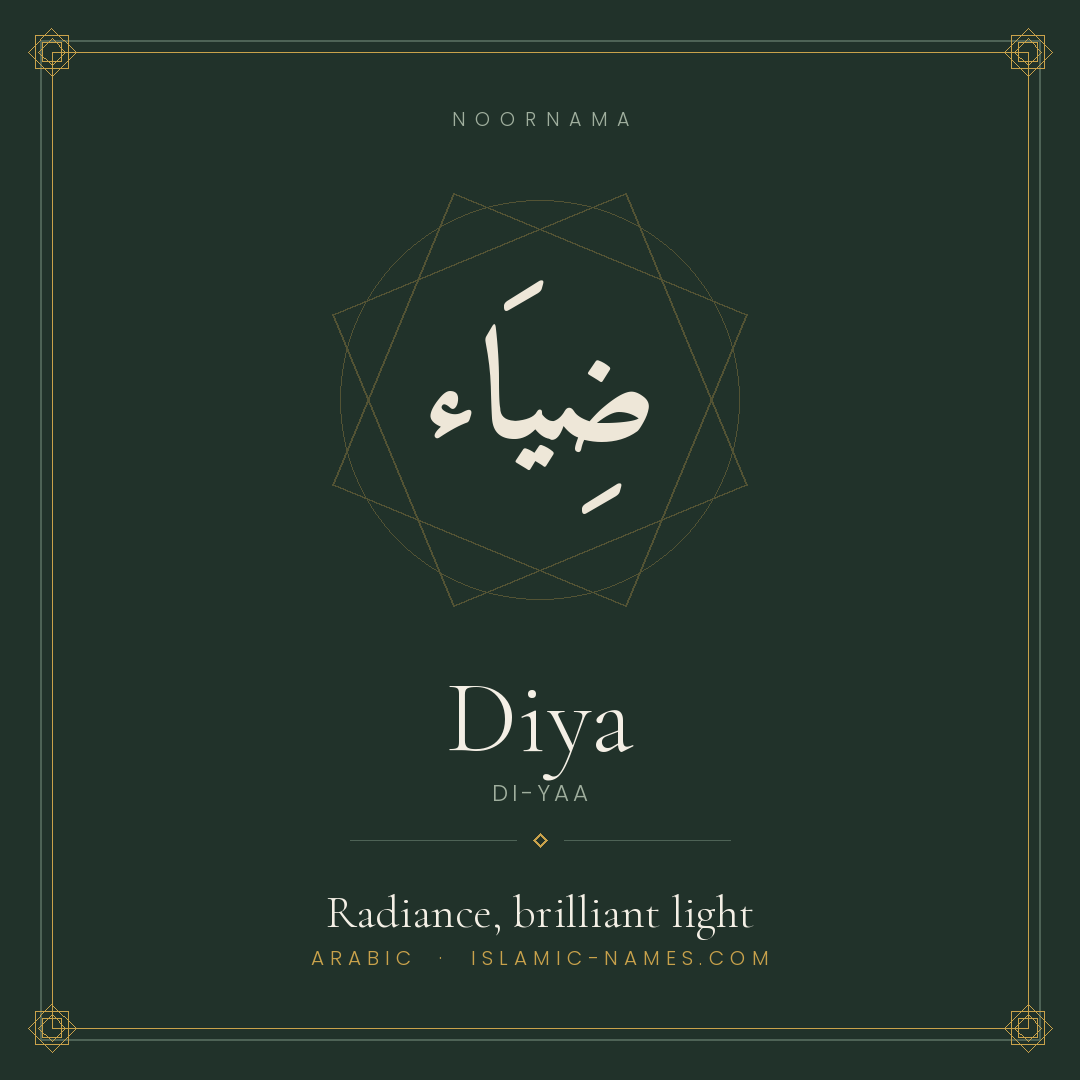
Radiance, brilliant light
Diya Name Meaning in Arabic
This content has been reviewed by our Scholarly Board. Name meanings are verified against classical Arabic dictionaries (Lisan al-Arab, Taj al-Arus) and authentic Hadith collections (Sahih al-Bukhari, Sahih Muslim, Sunan al-Tirmidhi).
The name Diya stems from the Arabic root ḍ-w-ʾ (ض و أ), which gives rise to words denoting light, radiance, and the act of shining. The form ضِيَاء specifically refers to a brilliant, self‑emanating light — like the sun or a blazing lamp — distinct from reflected light. This root appears in classical Arabic poetry and prose to describe the splendor of dawn, the glow of fire, and the metaphorical light of knowledge.
Linguistically, Diya is a masculine noun of the pattern fiʿāl, indicating intensity and permanence of the quality. It shares its root with ḍawʾ (light) and aḍāʾa (to illuminate), reinforcing a sense of active brilliance. Parents who choose Diya often appreciate its direct Quranic vocabulary and its evocation of the divine attribute Al‑Nūr (The Light), making it a name that carries both linguistic beauty and theological depth.
Is Diya Mentioned in the Quran?
The word ḍiyāʾ appears in the Quran, notably in verses that contrast the radiant light of the heavens with the darkness of disbelief. For example, Allah describes the sun as a ḍiyāʾ (radiant light) and the moon as a reflected light (nūr), highlighting the distinction between self‑generated brilliance and borrowed illumination. This Quranic usage underscores the name’s association with divine guidance, clarity, and the uncreated light of Allah. Choosing Diya connects a child to this sacred vocabulary of light and revelation.
How to Pronounce Diya
The classical Arabic pronunciation is di-YAA. The name flows easily in both Arabic and English, making it a practical choice for Muslim families in the USA, UK, Canada, and Australia.
| Pronunciation | Where It’s Common |
|---|---|
| di-YAA | Standard Arabic pronunciation with emphasis on the long ‘aa’ |
| DEE-yah | Common English approximation used in Western contexts |
| ZEE-ah | South Asian variant where the ḍād is pronounced as ‘z’ |
Diya Spelling Variations: Zia, Dhiya, Diyaa & More
Choose the spelling that matches your family’s heritage:
| Spelling | Region / Community |
|---|---|
| Zia | Common transliteration in South Asia and the West, reflecting a ‘z’ sound for ḍād |
| Dhiya | Transliteration that retains the ‘dh’ digraph for the Arabic letter ḍād |
| Diyaa | Extended spelling to indicate the long final vowel in Arabic |
| Ziya | Turkish and Persian-influenced spelling, also used in Southeast Asia |
| Dhiyaa | Less common variant combining ‘dh’ and double ‘aa’ for precise vowel length |
Cute Nicknames for Diya
Dee, Didi, Yaya
Abjad Value of Diya
In the traditional Abjad system of Arabic letter values, ضِيَاء calculates to 812. This classical scholarly numbering of Arabic letters is presented for knowledge only and carries no fortune-telling meaning. A child’s destiny is with Allah alone.
How Popular Is Diya?
Diya has seen steady popularity across the Muslim world, from the Middle East to South Asia and diaspora communities in Europe and North America. Its brevity, easy pronunciation, and profound meaning make it a favored choice for parents seeking a name that is both traditional and globally accessible. In recent decades, Diya has also gained recognition beyond Muslim circles due to its phonetic simplicity and positive connotations of light.
In Western countries, Diya (often spelled Zia or Dhiya) fits comfortably alongside familiar names like Maya, Lia, or Noah, reducing the likelihood of mispronunciation. Its Quranic pedigree adds a layer of spiritual depth that resonates with families who value a name rooted in scripture. While not among the top‑ranked names in national statistics, Diya enjoys consistent, quiet usage that reflects its timeless appeal.
Diya & Muslim Baby Names Across American Cities
From the Muslim communities of Dearborn and New York to growing families in Houston, Chicago, Dallas, Los Angeles, Atlanta, and Minneapolis, parents searching for authentic Muslim boy names choose Diya for its clear meaning and easy pronunciation. Explore our city naming guides for local trends and community favorites:
Muslim Names in Houston
Muslim Names in Chicago
Muslim Names in Dallas
Muslim Names in Los Angeles
All USA City Guides
Names That Pair Beautifully with Diya
Sister Names
Nur · Zia · Bahira · Munira · Nura · Zuhra · Diyaa · Anwara
Brother Names
Nur · Siraj · Munir · Anwar · Bahir · Zuhair · Misbah · Zia
Frequently Asked Questions About the Name Diya
Is Diya a Quranic name?
Yes, the word ḍiyāʾ appears in the Quran, describing the sun’s radiant light. It is a direct Quranic vocabulary word, not merely a derived name.
What is the difference between Diya and Nur?
Both mean light, but Diya (ḍiyāʾ) implies a brilliant, self‑generated light like the sun, while Nur (nūr) often denotes a softer, reflected or spiritual light.
Sources & method: Meaning verified against classical Arabic sources. NoorNama presents Abjad values as classical scholarship only, never as fortune-telling. All destiny is with Allah سبحانه وتعالى.
{“@context”: “https://schema.org”, “@type”: “Article”, “headline”: “Diya Name Meaning, Origin & Islamic Significance”, “description”: “Diya (ضِيَاء) means radiance, brilliant light. Complete Islamic naming guide: pronunciation, origin, and heritage.”, “author”: {“@type”: “Organization”, “name”: “NoorNama”, “url”: “https://islamic-names.com”}, “publisher”: {“@type”: “Organization”, “name”: “NoorNama”, “url”: “https://islamic-names.com”}, “about”: {“@type”: “Thing”, “name”: “Diya (given name)”}}
{“@context”: “https://schema.org”, “@type”: “FAQPage”, “mainEntity”: [{“@type”: “Question”, “name”: “Is Diya a Quranic name?”, “acceptedAnswer”: {“@type”: “Answer”, “text”: “Yes, the word ḍiyāʾ appears in the Quran, describing the sun’s radiant light. It is a direct Quranic vocabulary word, not merely a derived name.”}}, {“@type”: “Question”, “name”: “What is the difference between Diya and Nur?”, “acceptedAnswer”: {“@type”: “Answer”, “text”: “Both mean light, but Diya (ḍiyāʾ) implies a brilliant, self‑generated light like the sun, while Nur (nūr) often denotes a softer, reflected or spiritual light.”}}]}
Need help choosing the perfect name?
Get scholar-guided, personalized recommendations for your baby.
Find the perfect name for your child
Check our complete database for free names, or get a personalized scholarly naming report based on the precise date of birth.