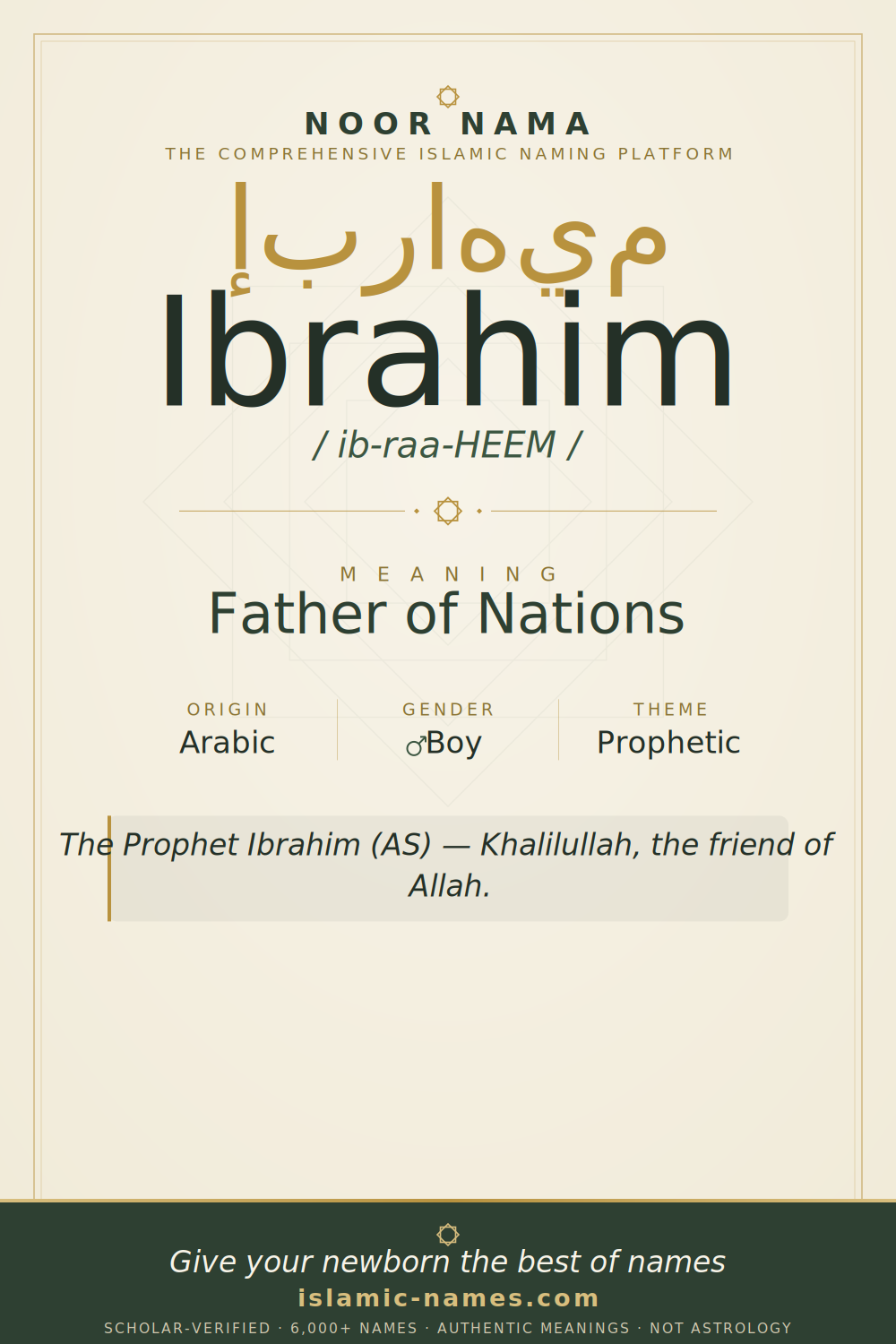
What is the meaning of the name Ibrahim Name Meaning, Origin & Islamic Significance in Islam?
The name Ibrahim Name Meaning, Origin & Islamic Significance is a traditional Islamic boy name rooted in Arabic origins meaning "Father of Nations". In Muslim culture, naming a child Ibrahim Name Meaning, Origin & Islamic Significance is deeply significant because of its beautiful spiritual connotations. It is a widely accepted and scholar-approved name drawn from authentic Islamic heritage, making it an excellent choice for parents seeking a meaningful name.
Father of Nations
Ibrahim Name Meaning in Arabic
This content has been reviewed by our Scholarly Board. Name meanings are verified against classical Arabic dictionaries (Lisan al-Arab, Taj al-Arus) and authentic Hadith collections (Sahih al-Bukhari, Sahih Muslim, Sunan al-Tirmidhi).
The name Ibrahim derives from the ancient Semitic root associated with ‘father of multitudes’ or ‘exalted father,’ reflecting the Quranic narrative where Allah changes Abram’s name to Abraham as a covenant promise. In Arabic, the form إِبْرَاهِيم preserves this venerable heritage, linking the bearer to the primordial legacy of pure monotheism (ḥanīfiyyah) that Prophet Ibrahim ﷺ embodied.
Classical linguists note that the name’s structure — with its distinctive hamza and long vowels — marks it as a non-Arabic loanword fully naturalized in the Quran’s Arabic, signifying its universal prophetic scope. While its ultimate etymology traces to Hebrew Avraham, the Quranic Ibrahim stands as an independent divine designation, honored in daily prayers and the Hajj rites, making it a living connection to the Abrahamic covenant.
Is Ibrahim Mentioned in the Quran?
Ibrahim ﷺ is mentioned by name 69 times across 25 surahs of the Quran, making him one of the most frequently referenced prophets. His story unfolds in key passages such as Surah Al-Baqarah (2:124-141), where his trial, leadership, and prayer for a Muslim nation are highlighted, and Surah Ibrahim (14), named after him. The Quran presents him as the archetypal ḥanīf — one who turns away from falsehood toward pure tawhid — and as the spiritual father of the Muslim ummah, whose legacy shapes Islamic worship from salat to Hajj.
Ibrahim (AS): The Friend of Allah
Prophet Ibrahim (AS) earned the unique title Khalilullah — the Friend of Allah — through his absolute devotion and willingness to sacrifice everything for God’s pleasure. From his youthful destruction of idols in his father’s workshop to the supreme trial of preparing to sacrifice his beloved son Ismail (AS), his life exemplifies total submission. The Quran declares: ‘And Allah took Ibrahim as an intimate friend’ (4:125), an honor reflected in every Muslim’s daily tashahhud.
His legacy is woven into Islam’s pillars: the Ka’bah he rebuilt with Ismail (AS), the standing at Arafat, the stoning of Jamarat, and the sacrificial udhiyah all commemorate his actions. Muslims invoke blessings upon him in every prayer, and his supplication — ‘Our Lord, make us Muslims in submission to You’ (2:128) — remains the blueprint for generational faith. Naming a son Ibrahim connects him to this unbroken chain of prophetic heritage.
How to Pronounce Ibrahim
The classical Arabic pronunciation is ib-raa-HEEM. The name flows easily in both Arabic and English, making it a practical choice for Muslim families in the USA, UK, Canada, and Australia.
| Pronunciation | Where It’s Common |
|---|---|
| ib-raa-HEEM | Standard Arabic pronunciation with stress on final syllable |
| EE-bruh-heem | Common English Anglicization |
| ib-ra-HEEM | Alternative Arabic stress pattern heard in some regions |
Ibrahim Spelling Variations: Ibraheem, Brahim, Abraham & More
Choose the spelling that matches your family’s heritage:
| Spelling | Region / Community |
|---|---|
| Ibraheem | Common alternative transliteration preserving the long ‘ee’ sound |
| Brahim | Maghrebi short form widely used in North Africa |
| Abraham | Biblical and Western form familiar across cultures |
| Ebrahim | Persian and South Asian variant spelling |
| Ibraahim | Less common elongated spelling emphasizing the long vowels |
Cute Nicknames for Ibrahim
Ibra, Brahim, Rahim, Abe, Ibby
Abjad Value of Ibrahim
In the traditional Abjad system of Arabic letter values, إبراهيم calculates to 259. This classical scholarly numbering of Arabic letters is presented for knowledge only and carries no fortune-telling meaning. A child’s destiny is with Allah alone.
How Popular Is Ibrahim?
Ibrahim remains a perennial favorite across the Muslim world, consistently ranking among the top boys’ names from Morocco to Indonesia, Turkey to South Africa. Its Quranic authority and prophetic prestige give it timeless appeal, while its phonetic clarity — three syllables, open vowels — makes it easily pronounced in diverse languages. In Western countries, Ibrahim has risen steadily in popularity charts, appreciated for its recognizable biblical parallel (Abraham) and dignified sound.
The name’s cross-cultural familiarity is a practical advantage: teachers, doctors, and colleagues across faiths recognize it instantly, yet it retains its distinctly Islamic identity. Many families choose Ibrahim to honor the prophetic lineage while giving their son a name that travels well globally. Its variants like Brahim or Ebrahim offer regional flavor without losing the core connection to the Friend of Allah.
Ibrahim & Muslim Baby Names Across American Cities
From the Muslim communities of Dearborn and New York to growing families in Houston, Chicago, Dallas, Los Angeles, Atlanta, and Minneapolis, parents searching for authentic Muslim boy names choose Ibrahim for its clear meaning and easy pronunciation. Explore our city naming guides for local trends and community favorites:
Muslim Names in Houston
Muslim Names in Chicago
Muslim Names in Dallas
Muslim Names in Los Angeles
All USA City Guides
Names That Pair Beautifully with Ibrahim
Sister Names
Maryam · Hajar · Sarah · Aisha · Fatimah · Khadijah · Zainab · Ruqayyah
Brother Names
Ismail · Ishaq · Yusuf · Musa · Isa · Nuh · Adam · Yunus
Frequently Asked Questions About the Name Ibrahim
Is Ibrahim a Quranic name?
Yes, Ibrahim is explicitly named in the Quran 69 times across 25 surahs, including Surah Ibrahim (Chapter 14) which bears his name. He is presented as a prophet, a leader, and the friend of Allah (Khalilullah).
What is the meaning of Ibrahim in Islam?
Ibrahim means the Arabic name of Prophet Abraham, honored as Khalilullah (Friend of Allah). It signifies a divinely chosen patriarch of monotheism, father of prophets, and exemplar of complete submission to God.
How popular is the name Ibrahim worldwide?
Ibrahim is among the most popular Muslim boys’ names globally, ranking in the top 10 in many Muslim-majority countries and rising in Western nations. Its Quranic status and cross-cultural recognition contribute to its enduring popularity.
What are common nicknames for Ibrahim?
Common affectionate nicknames include Ibra, Brahim, Rahim, Abe, and Ibby. Regional variations like Brahim are especially popular in North Africa, while Abe connects to the biblical Abraham.
Is there a specific root for the name Ibrahim in Arabic?
The name Ibrahim is a Quranic Arabic form of the ancient Semitic name Abraham. While its ultimate etymology relates to ‘father of multitudes,’ the Quranic Ibrahim is considered a divine designation rather than a derivative of Arabic root letters, fully naturalized in the Quran’s language.
Sources & method: Meaning verified against classical Arabic sources. NoorNama presents Abjad values as classical scholarship only, never as fortune-telling. All destiny is with Allah سبحانه وتعالى.
Need help choosing the perfect name?
Get scholar-guided, personalized recommendations for your baby.
Find the perfect name for your child
Check our complete database for free names, or get a personalized scholarly naming report based on the precise date of birth.