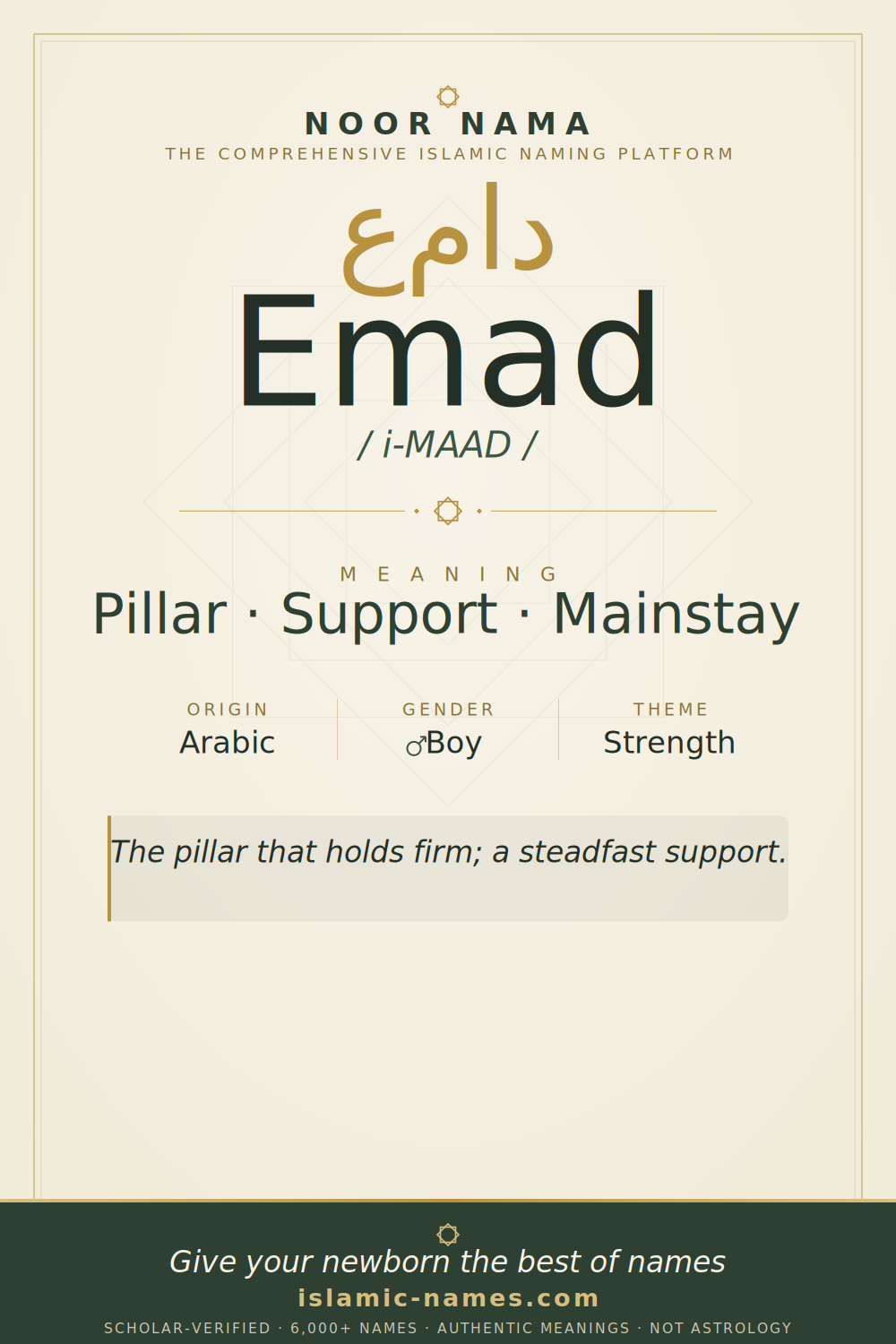
Pillar · Support · Mainstay
Emad Name Meaning in Arabic
The name derives from the Arabic root ʿ‑M‑D (ع م د), which carries the sense of propping up, reinforcing, or serving as a central column. In classical usage, ʿimād denotes the main pillar of a tent or building, the element without which the whole would collapse. This root appears in Qur’anic Arabic describing divine support and the firm establishment of truth.
Over centuries the form ʿImād evolved into the modern vocalisation Emad, preserving the core meaning of unshakeable support. The word is used both as a noun for a physical pillar and metaphorically for a person who provides moral or communal stability, making it a timeless choice for a boy’s name.
Is Emad Mentioned in the Quran?
While the exact name Emad does not appear in the Qurʾān, the concept of a firm pillar is echoed in verses that describe Allah as the ultimate support for believers (e.g., “And rely upon the Ever‑Living who does not die”). Islamic tradition encourages giving children names that reflect noble qualities such as strength, trustworthiness, and steadfastness, and Emad fits this guidance perfectly.
How to Pronounce Emad
The classical Arabic pronunciation is i-MAAD. The name flows easily in both Arabic and English, making it a practical choice for Muslim families in the USA, UK, Canada, and Australia.
| Pronunciation | Where It’s Common |
|---|---|
| i-MAAD | Standard Arabic |
| EE-mad | Anglicized/Western |
Emad Spelling Variations: Emad, Imad, Emaad & More
Choose the spelling that matches your family’s heritage:
| Spelling | Region / Community |
|---|---|
| Emad | Standard transliteration |
| Imad | Common alternative |
| Emaad | Variant spelling |
| Amad | Less common form |
Cute Nicknames for Emad
Emi, Mado, Addy
Abjad Value of Emad
In the traditional Abjad system of Arabic letter values, عماد calculates to 115. This classical scholarly numbering of Arabic letters is presented for knowledge only and carries no fortune-telling meaning. A child’s destiny is with Allah alone.
How Popular Is Emad?
Emad has enjoyed steady popularity across the Arab world, South Asia, and Muslim communities in the West for several decades. Its short, two‑syllable structure makes it easy to pronounce in English and other languages, contributing to its cross‑cultural appeal.
In recent years the name ranks among the top 200 boy names in several Middle‑Eastern countries and appears frequently in diaspora birth registries, reflecting both traditional reverence and modern practicality.
Emad & Muslim Baby Names Across American Cities
From the Muslim communities of Dearborn and New York to growing families in Houston, Chicago, Dallas, Los Angeles, Atlanta, and Minneapolis, parents searching for authentic Muslim boy names choose Emad for its clear meaning and easy pronunciation. Explore our city naming guides for local trends and community favorites:
Muslim Names in Houston
Muslim Names in Chicago
Muslim Names in Dallas
Muslim Names in Los Angeles
All USA City Guides
Names That Pair Beautifully with Emad
Sister Names
Aisha · Fatima · Zahra · Mariam · Layla · Noor · Hana · Sara
Brother Names
Ali · Omar · Hassan · Yusuf · Bilal · Khalid · Zaid · Tariq
Frequently Asked Questions About the Name Emad
Is Emad a Qur’anic name?
Emad itself is not found in the Qurʾān, but its root meaning of firm support aligns with Qurʾanic themes of reliance on Allah and steadfastness.
What is the Arabic script for Emad?
The name is written عماد in Arabic script.
Can Emad be used for girls?
Traditionally Emad is a masculine name; feminine forms such as Imada exist but are rare.
How common is Emad in Western countries?
It is moderately familiar in Muslim communities in Europe and North America, often recognized and pronounced without difficulty.
Does the name have any special religious significance?
Beyond its positive meaning of pillar and support, there is no specific hadith or verse that singles out Emad; its value lies in the virtuous quality it conveys.
More Girl Names
More Boy Names
Sources & method: Meaning verified against classical Arabic sources. NoorNama presents Abjad values as classical scholarship only, never as fortune-telling. All destiny is with Allah سبحانه وتعالى.