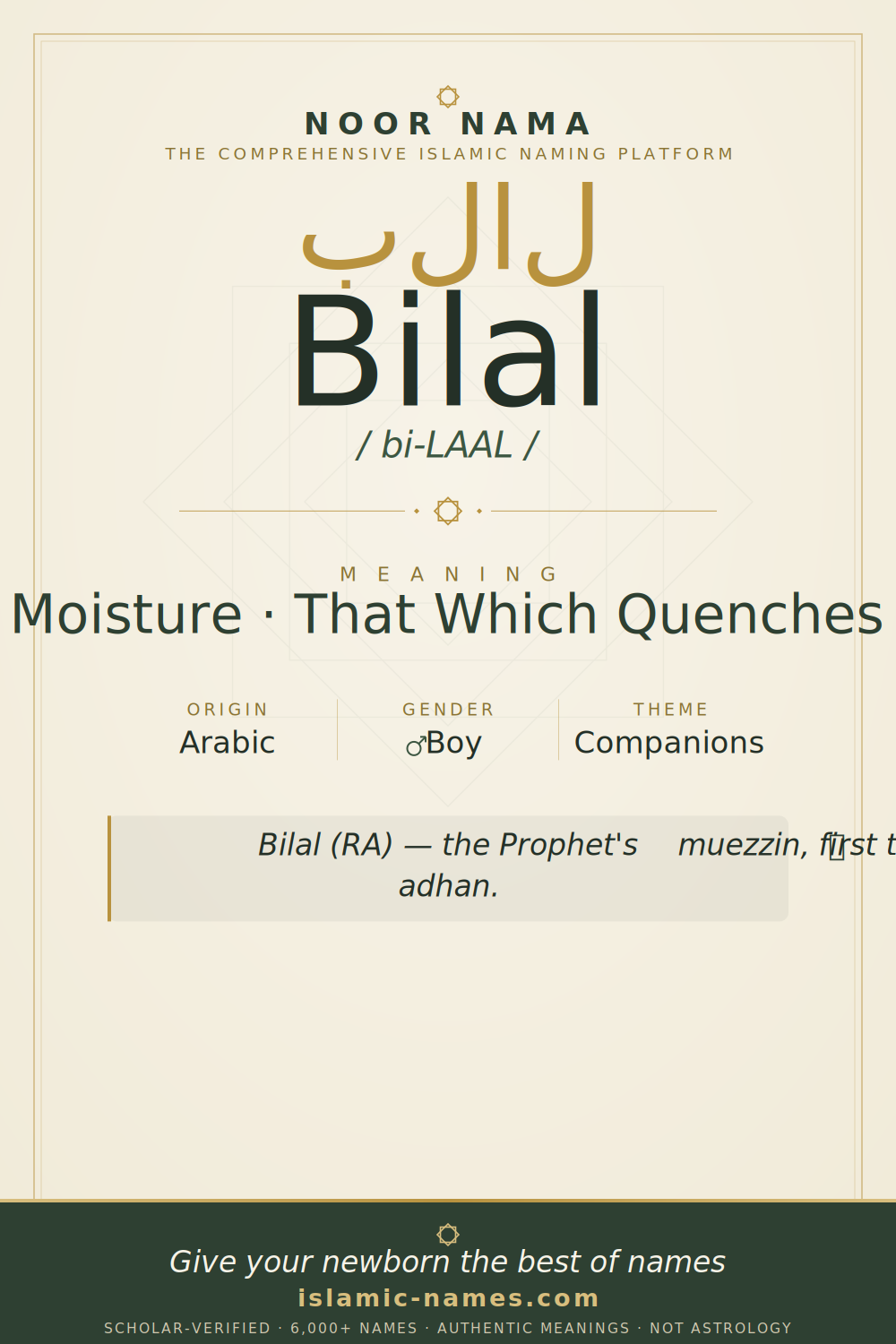
What is the meaning of the name Bilal Name Meaning, Origin & Islamic Significance in Islam?
The name Bilal Name Meaning, Origin & Islamic Significance is a traditional Islamic boy name rooted in Arabic origins meaning "Moisture · That Which Quenches". In Muslim culture, naming a child Bilal Name Meaning, Origin & Islamic Significance is deeply significant because of its beautiful spiritual connotations. It is a widely accepted and scholar-approved name drawn from authentic Islamic heritage, making it an excellent choice for parents seeking a meaningful name.
Moisture · That Which Quenches
Bilal Name Meaning in Arabic
This content has been reviewed by our Scholarly Board. Name meanings are verified against classical Arabic dictionaries (Lisan al-Arab, Taj al-Arus) and authentic Hadith collections (Sahih al-Bukhari, Sahih Muslim, Sunan al-Tirmidhi).
Bilal stems from the Arabic triliteral root ب ل ل (b-l-l), which conveys the idea of moisture, dampness, and the life-giving quality of water. Classical lexicons such as Lisān al-ʿArab describe bilāl as the moisture that revives parched land, a metaphor for spiritual nourishment. The form follows the pattern fiʿāl, often used for nouns denoting a quality or state, giving the name a sense of enduring freshness and vitality.
While the root appears in Quranic vocabulary describing rain and divine mercy (e.g., wa-anzalnā mina-s-samāʾi māʾan bilālan — “We sent down from the sky water in abundance”), the name itself is not a direct Quranic word. Its fame rests on the Companion Bilal ibn Rabah (RA), whose life transformed the name into a symbol of unwavering conviction and the beauty of the adhān.
Is Bilal Mentioned in the Quran?
The name Bilal does not appear as a proper noun in the Quran, but its root meaning aligns with Quranic themes of divine refreshment and guidance. Islam encourages choosing names with beautiful meanings and noble associations, and the Prophet ﷺ said: “You will be called on the Day of Resurrection by your names and the names of your fathers, so give yourselves good names.” Naming a son Bilal honors a Companion whose voice was chosen for the first call to prayer, linking the child to a legacy of faith, resilience, and the sweetness of remembrance.
Bilal ibn Rabah (RA): The First Muezzin
Bilal ibn Rabah (RA) was an Abyssinian slave in Makkah who embraced Islam early, enduring brutal torture for refusing to renounce his faith. His steadfast declaration “Ahad, Ahad” (“One, One”) under persecution became legendary. Freed by Abu Bakr (RA), he migrated to Madinah where the Prophet ﷺ appointed him as the first muezzin. His powerful, melodious voice summoned the faithful to prayer, and he fought in every major battle. After the Prophet’s ﷺ passing, Bilal (RA) could not bear to call the adhān in Madinah and spent his final years in Damascus, where he is buried.
How to Pronounce Bilal
The classical Arabic pronunciation is bi-LAAL. The name flows easily in both Arabic and English, making it a practical choice for Muslim families in the USA, UK, Canada, and Australia.
| Pronunciation | Where It’s Common |
|---|---|
| bi-LAAL | Standard Arabic pronunciation with stress on the second syllable |
| bee-LAHL | Common English approximation |
| bi-LAL | Shortened variant heard in some regions |
Bilal Spelling Variations: Bilal, Bilaal, Belal & More
Choose the spelling that matches your family’s heritage:
| Spelling | Region / Community |
|---|---|
| Bilal | Most common transliteration |
| Bilaal | Reflects the long Arabic vowel |
| Belal | Phonetic spelling common in South Asia |
| Bilel | North African French-influenced variant |
| Bilâl | With diacritic indicating long vowel |
Cute Nicknames for Bilal
Bilo, Lalo, Bibi, Bil
Abjad Value of Bilal
In the traditional Abjad system of Arabic letter values, بلال calculates to 63. This classical scholarly numbering of Arabic letters is presented for knowledge only and carries no fortune-telling meaning. A child’s destiny is with Allah alone.
How Popular Is Bilal?
Bilal remains a perennial favorite across the Muslim world, from the Middle East and South Asia to Africa, Europe, and North America. Its brevity, clear pronunciation, and profound historical resonance make it equally at home in diverse cultures. In Western countries, it ranks among the most recognizable Islamic names, often chosen by families seeking a name that is both authentically rooted and easily pronounced by non-Arabic speakers. The name’s association with the beautiful call to prayer gives it a timeless spiritual appeal that transcends trends.
Bilal & Muslim Baby Names Across American Cities
From the Muslim communities of Dearborn and New York to growing families in Houston, Chicago, Dallas, Los Angeles, Atlanta, and Minneapolis, parents searching for authentic Muslim boy names choose Bilal for its clear meaning and easy pronunciation. Explore our city naming guides for local trends and community favorites:
Muslim Names in Houston
Muslim Names in Chicago
Muslim Names in Dallas
Muslim Names in Los Angeles
All USA City Guides
Names That Pair Beautifully with Bilal
Sister Names
Aisha · Fatimah · Khadijah · Maryam · Hafsa · Zaynab · Asma · Ruqayyah
Brother Names
Hamza · Umar · Ali · Hassan · Husayn · Zayd · Sa’d · Abdullah
Frequently Asked Questions About the Name Bilal
Is Bilal a Quranic name?
Bilal is not mentioned as a proper name in the Quran, but its root meaning of moisture and refreshment appears in Quranic vocabulary. It is primarily honored as the name of a prominent Companion.
Who was Bilal ibn Rabah?
Bilal ibn Rabah (RA) was an early Muslim convert, former slave, and the first muezzin (caller to prayer) in Islam, chosen by the Prophet ﷺ for his beautiful voice and steadfast faith.
What does the root ب ل ل mean?
The root ب ل ل (b-l-l) conveys moisture, wetness, and the quenching of thirst. It is used in classical Arabic for rain, dew, and the life-giving quality of water.
Is Bilal popular worldwide?
Yes, Bilal is widely used across Muslim communities globally and is one of the most recognized Islamic names in Western countries due to its easy pronunciation and strong historical association.
Can Bilal be used for girls?
Bilal is traditionally a masculine name. For girls, names like Bilqis or those sharing the root meaning of freshness (e.g., Nadiah) are more common.
Sources & method: Meaning verified against classical Arabic sources. NoorNama presents Abjad values as classical scholarship only, never as fortune-telling. All destiny is with Allah سبحانه وتعالى.
Need help choosing the perfect name?
Get scholar-guided, personalized recommendations for your baby.
Find the perfect name for your child
Check our complete database for free names, or get a personalized scholarly naming report based on the precise date of birth.