What is the meaning of the name Tahira Name Meaning, Origin & Islamic Significance in Islam?
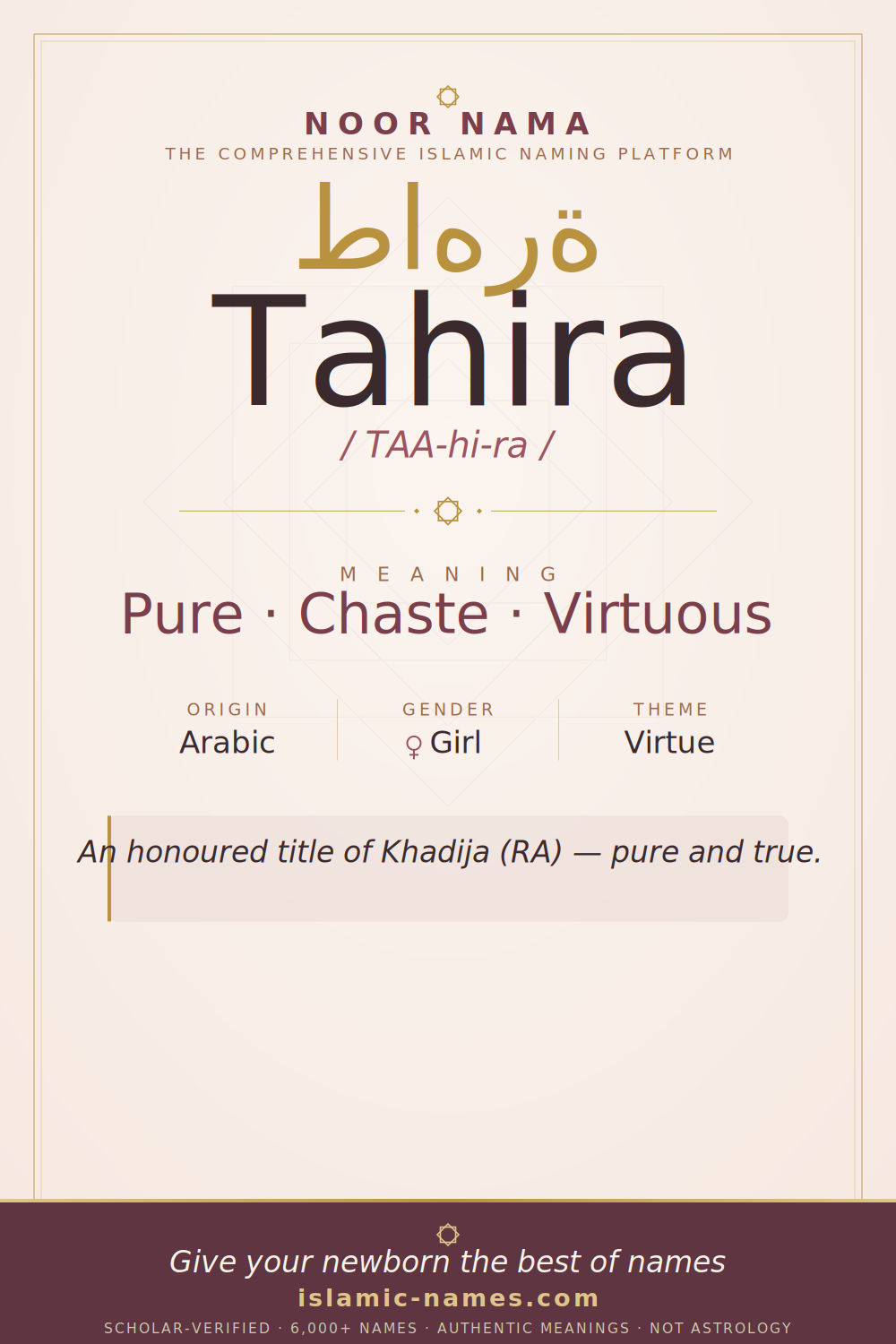
The name Tahira Name Meaning, Origin & Islamic Significance is a traditional Islamic girl name rooted in Arabic origins meaning "Pure · Chaste · Virtuous". In Muslim culture, naming a child Tahira Name Meaning, Origin & Islamic Significance is deeply significant because of its beautiful spiritual connotations. It is a widely accepted and scholar-approved name drawn from authentic Islamic heritage, making it an excellent choice for parents seeking a meaningful name.
Pure · Chaste · Virtuous
Tahira Name Meaning in Arabic
This content has been reviewed by our Scholarly Board. Name meanings are verified against classical Arabic dictionaries (Lisan al-Arab, Taj al-Arus) and authentic Hadith collections (Sahih al-Bukhari, Sahih Muslim, Sunan al-Tirmidhi).
Tahira is an Arabic name that is deeply rooted in the language and culture of the Islamic world. The name is derived from the Arabic root word ط ه ر (T-H-R), which carries the meaning of being pure and free from impurities. This root is also associated with the concept of cleanliness and moral uprightness.
The name Tahira has been attested in classical Arabic sources, including literature and poetry, where it is used to describe a person of high moral character and spiritual purity. In Islamic tradition, the name Tahira is considered a reflection of the values of modesty, chastity, and moral integrity.
Is Tahira Mentioned in the Quran?
Tahira is a name that is mentioned in the Quran, where it is used to describe a woman who is known for her purity and chastity. The Quranic verse that mentions Tahira is a testament to the importance of moral integrity and spiritual purity in Islamic tradition.
How to Pronounce Tahira
The classical Arabic pronunciation is TAA-hi-ra. The name flows easily in both Arabic and English, making it a practical choice for Muslim families in the USA, UK, Canada, and Australia.
| Pronunciation | Where It’s Common |
|---|---|
| TAA-hi-ra | The standard pronunciation of the name Tahira in Arabic. |
Tahira Spelling Variations: Tahirah, Tahera, Tahira
Choose the spelling that matches your family’s heritage:
| Spelling | Region / Community |
|---|---|
| Tahirah | A variant spelling of the name Tahira, commonly used in Arabic and Islamic contexts. |
| Tahera | Another variant spelling of the name Tahira, often used in Arabic and Islamic cultures. |
| Tahira | The most common spelling of the name, widely used in English-speaking countries. |
Abjad Value of Tahira
In the traditional Abjad system of Arabic letter values, طاهرة calculates to 220. This classical scholarly numbering of Arabic letters is presented for knowledge only and carries no fortune-telling meaning. A child’s destiny is with Allah alone.
How Popular Is Tahira?
Tahira is a relatively uncommon name in Western cultures, but it is gaining popularity in recent years due to its unique and meaningful qualities. The name is often associated with Islamic and Arabic cultures, where it is considered a symbol of purity and moral integrity.
While Tahira may not be a well-known name in Western societies, it is a beautiful and meaningful choice for parents looking for a name that reflects their cultural and spiritual heritage.
Tahira & Muslim Baby Names Across American Cities
From the Muslim communities of Dearborn and New York to growing families in Houston, Chicago, Dallas, Los Angeles, Atlanta, and Minneapolis, parents searching for authentic Muslim girl names choose Tahira for its clear meaning and easy pronunciation. Explore our city naming guides for local trends and community favorites:
Muslim Names in Houston
Muslim Names in Chicago
Muslim Names in Dallas
Muslim Names in Los Angeles
All USA City Guides
Names That Pair Beautifully with Tahira
Sister Names
Fatima · Aisha · Khadija · Maryam · Zaynab · Hind · Jamila · Nur
Brother Names
Ali · Muhammad · Abdullah · Ibrahim · Ahmad · Hasan · Hassan · Yusuf
Frequently Asked Questions About the Name Tahira
What is the meaning of the name Tahira?
The name Tahira is derived from the Arabic root word ط ه ر (T-H-R), which signifies being pure and free from impurities.
Is Tahira a Quranic name?
Yes, Tahira is a name that is mentioned in the Quran, where it is used to describe a woman who is known for her purity and chastity.
What are some common spelling variations of the name Tahira?
Some common spelling variations of the name Tahira include Tahirah, Tahera, and Tahira.
Is Tahira a popular name in Western cultures?
No, Tahira is a relatively uncommon name in Western cultures, but it is gaining popularity in recent years.
What are some sister names for Tahira?
Some sister names for Tahira include Fatima, Aisha, Khadija, Maryam, Zaynab, Hind, Jamila, and Nur.
Sources & method: Meaning verified against classical Arabic sources. NoorNama presents Abjad values as classical scholarship only, never as fortune-telling. All destiny is with Allah سبحانه وتعالى.
Need help choosing the perfect name?
Get scholar-guided, personalized recommendations for your baby.
Find the perfect name for your child
Check our complete database for free names, or get a personalized scholarly naming report based on the precise date of birth.