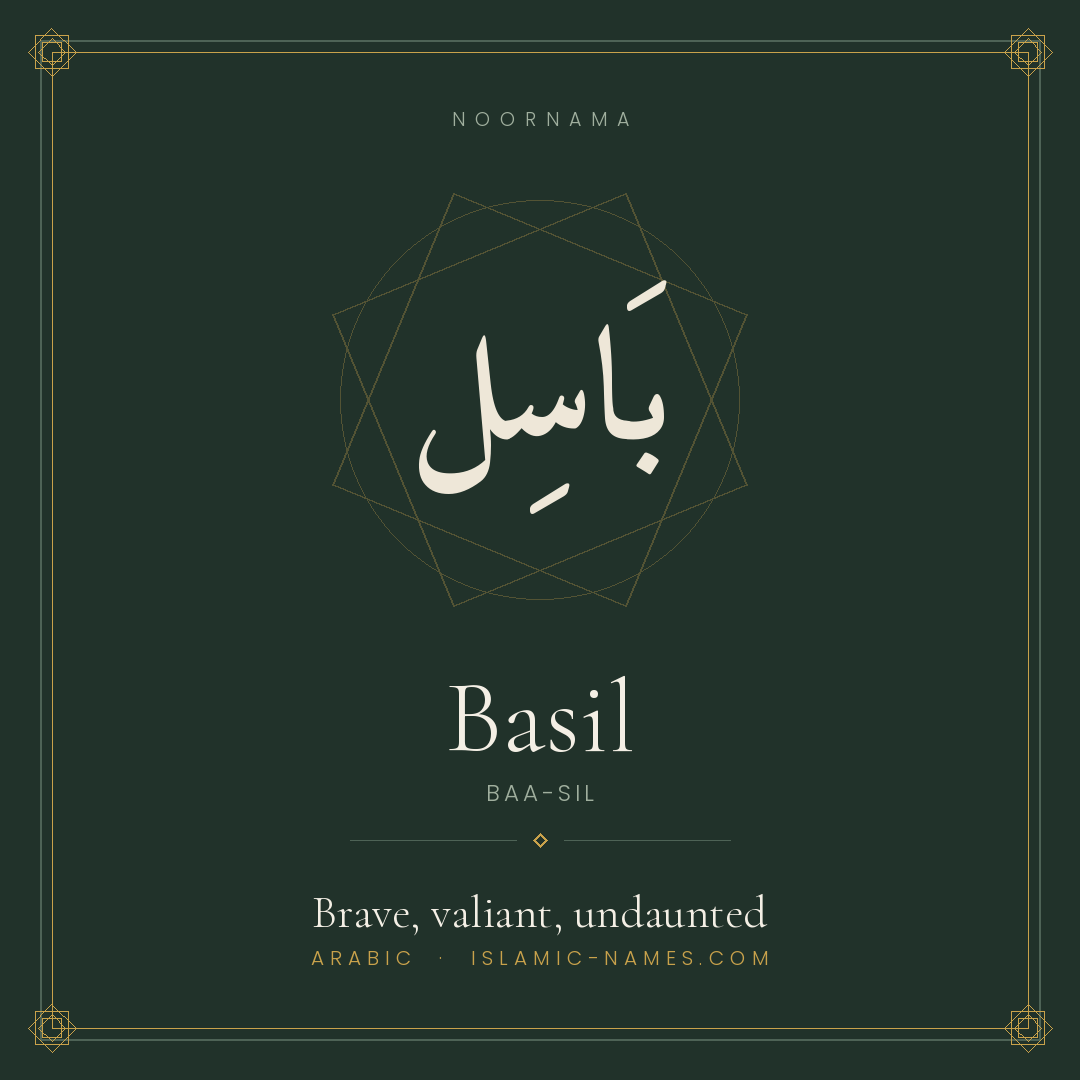
What is the meaning of the name Basil Name Meaning, Origin & Islamic Significance in Islam?
The name Basil Name Meaning, Origin & Islamic Significance is a traditional Islamic child name meaning "Brave, valiant, undaunted". In Muslim culture, naming a child Basil Name Meaning, Origin & Islamic Significance is deeply significant because of its beautiful spiritual connotations. It is a widely accepted and scholar-approved name drawn from authentic Islamic heritage, making it an excellent choice for parents seeking a meaningful name.
Brave, valiant, undaunted
Basil Name Meaning in Arabic
This content has been reviewed by our Scholarly Board. Name meanings are verified against classical Arabic dictionaries (Lisan al-Arab, Taj al-Arus) and authentic Hadith collections (Sahih al-Bukhari, Sahih Muslim, Sunan al-Tirmidhi).
The name Basil originates from the Arabic triliteral root ب س ل (b-s-l), which centers on the concept of bravery, valor, and fearlessness. In classical Arabic, bāsil describes a warrior or hero who advances without hesitation, one whose courage is innate and unwavering. The root appears in early poetry and prose to praise those who stand firm in battle or trial, making it a name steeped in a rich linguistic tradition of honor.
Morphologically, Basil is the active participle (ism al-fāʿil) of the Form I verb basula (بَسُلَ), meaning “to be brave” or “to show valor.” This grammatical form emphasizes the enduring quality of the trait — not a momentary act, but a defining characteristic. The name thus linguistically encodes a lifelong aspiration: that the bearer consistently embodies courage as a core identity, not merely an occasional deed.
Is Basil Mentioned in the Quran?
The word bāsil (بَاسِل) appears in the Quran, notably in Surah Al-Anfal (8:48), where it describes those who turn their backs in battle — “and [remember] when Satan made their deeds pleasing to them and said, ‘No one can overcome you today from among the people, and indeed, I am your protector.’ But when the two armies sighted each other, he turned on his heels and said, ‘Indeed, I am disassociated from you. Indeed, I see what you do not see; indeed I fear Allah. And Allah is severe in penalty.'” The term underscores the Quranic valorization of steadfast courage versus fear-driven retreat. Islamic naming tradition encourages names with virtuous meanings, and the Prophet ﷺ said, “You will be called on the Day of Resurrection by your names and the names of your fathers, so make your names good.” Choosing Basil aligns with this guidance, invoking a Quranic vocabulary of bravery.
How to Pronounce Basil
The classical Arabic pronunciation is BAA-sil. The name flows easily in both Arabic and English, making it a practical choice for Muslim families in the USA, UK, Canada, and Australia.
| Pronunciation | Where It’s Common |
|---|---|
| BAA-sil | Standard Arabic pronunciation with elongated first vowel |
| BAH-sil | Common English approximation, shorter first vowel |
| BAY-sil | Anglicized variant often heard in Western contexts |
Basil Spelling Variations: Baasil, Bassel, Basile & More
Choose the spelling that matches your family’s heritage:
| Spelling | Region / Community |
|---|---|
| Baasil | Double ‘a’ reflects long vowel in Arabic script |
| Bassel | Phonetic spelling common in Levantine diaspora |
| Basile | French-influenced form used in Francophone regions |
| Basilius | Latinized historical variant from Greek Basileios |
| Bazil | Simplified spelling sometimes seen in South Asia |
Cute Nicknames for Basil
Bas, Basi, Baz, Bazzy
Abjad Value of Basil
In the traditional Abjad system of Arabic letter values, بَاسِل calculates to 93. This classical scholarly numbering of Arabic letters is presented for knowledge only and carries no fortune-telling meaning. A child’s destiny is with Allah alone.
How Popular Is Basil?
Basil enjoys steady usage across the Arab world, Turkey, South Asia, and Muslim communities in the West. Its appeal lies in its strong, concise sound and unambiguous virtuous meaning. In English-speaking countries, the name is familiar yet distinctive — recognizable from the herb (via Latin basilicum), but with an entirely separate, noble Arabic etymology. This cross-cultural resonance makes it accessible to non-Arabic speakers while retaining authentic Islamic roots. The name has seen modest but consistent popularity in the UK, US, and Canada over recent decades, favored by parents seeking a name that is both meaningful and easily pronounced internationally.
Basil & Muslim Baby Names Across American Cities
From the Muslim communities of Dearborn and New York to growing families in Houston, Chicago, Dallas, Los Angeles, Atlanta, and Minneapolis, parents searching for authentic Muslim boy names choose Basil for its clear meaning and easy pronunciation. Explore our city naming guides for local trends and community favorites:
Muslim Names in Houston
Muslim Names in Chicago
Muslim Names in Dallas
Muslim Names in Los Angeles
All USA City Guides
Names That Pair Beautifully with Basil
Sister Names
Amira · Karima · Samira · Nadia · Layla · Hana · Zahra · Amina
Brother Names
Hamza · Omar · Khalid · Tariq · Zayd · Bilal · Saad · Rayyan
Frequently Asked Questions About the Name Basil
Is Basil a Quranic name?
Yes, the word <em>bāsil</em> appears in the Quran (8:48) in the context of bravery versus cowardice in battle. It is considered a Quranic name by virtue of its direct lexical presence.
What is the Arabic root of Basil?
The name comes from the root ب س ل (b-s-l), which conveys bravery, valor, and fearlessness. The verb <em>basula</em> means “to be brave,” and <em>bāsil</em> is its active participle.
Is Basil used for girls?
No, Basil (بَاسِل) is grammatically masculine in Arabic. The feminine form would be <em>Bāsila</em> (بَاسِلَة), though it is rarely used as a given name.
Does the name relate to the herb basil?
No. The herb’s name derives from Greek <em>basilikon</em> (“royal”), via Latin. The Arabic name Basil has a completely separate Semitic root meaning “brave.”
How common is Basil in Western countries?
Basil is recognized but not overly common in the US and UK. It ranks outside the top 1000 in recent US data, making it a distinctive yet familiar choice for Muslim families in the West.
Sources & method: Meaning verified against classical Arabic sources. NoorNama presents Abjad values as classical scholarship only, never as fortune-telling. All destiny is with Allah سبحانه وتعالى.
{“@context”: “https://schema.org”, “@type”: “Article”, “headline”: “Basil Name Meaning, Origin & Islamic Significance”, “description”: “Basil (بَاسِل) means brave, valiant, undaunted. Complete Islamic naming guide: pronunciation, origin, and heritage.”, “author”: {“@type”: “Organization”, “name”: “NoorNama”, “url”: “https://islamic-names.com”}, “publisher”: {“@type”: “Organization”, “name”: “NoorNama”, “url”: “https://islamic-names.com”}, “about”: {“@type”: “Thing”, “name”: “Basil (given name)”}}
{“@context”: “https://schema.org”, “@type”: “FAQPage”, “mainEntity”: [{“@type”: “Question”, “name”: “Is Basil a Quranic name?”, “acceptedAnswer”: {“@type”: “Answer”, “text”: “Yes, the word bāsil appears in the Quran (8:48) in the context of bravery versus cowardice in battle. It is considered a Quranic name by virtue of its direct lexical presence.”}}, {“@type”: “Question”, “name”: “What is the Arabic root of Basil?”, “acceptedAnswer”: {“@type”: “Answer”, “text”: “The name comes from the root ب س ل (b-s-l), which conveys bravery, valor, and fearlessness. The verb basula means “to be brave,” and bāsil is its active participle.”}}, {“@type”: “Question”, “name”: “Is Basil used for girls?”, “acceptedAnswer”: {“@type”: “Answer”, “text”: “No, Basil (بَاسِل) is grammatically masculine in Arabic. The feminine form would be Bāsila (بَاسِلَة), though it is rarely used as a given name.”}}, {“@type”: “Question”, “name”: “Does the name relate to the herb basil?”, “acceptedAnswer”: {“@type”: “Answer”, “text”: “No. The herb’s name derives from Greek basilikon (“royal”), via Latin. The Arabic name Basil has a completely separate Semitic root meaning “brave.””}}, {“@type”: “Question”, “name”: “How common is Basil in Western countries?”, “acceptedAnswer”: {“@type”: “Answer”, “text”: “Basil is recognized but not overly common in the US and UK. It ranks outside the top 1000 in recent US data, making it a distinctive yet familiar choice for Muslim families in the West.”}}]}
Need help choosing the perfect name?
Get scholar-guided, personalized recommendations for your baby.
Find the perfect name for your child
Check our complete database for free names, or get a personalized scholarly naming report based on the precise date of birth.