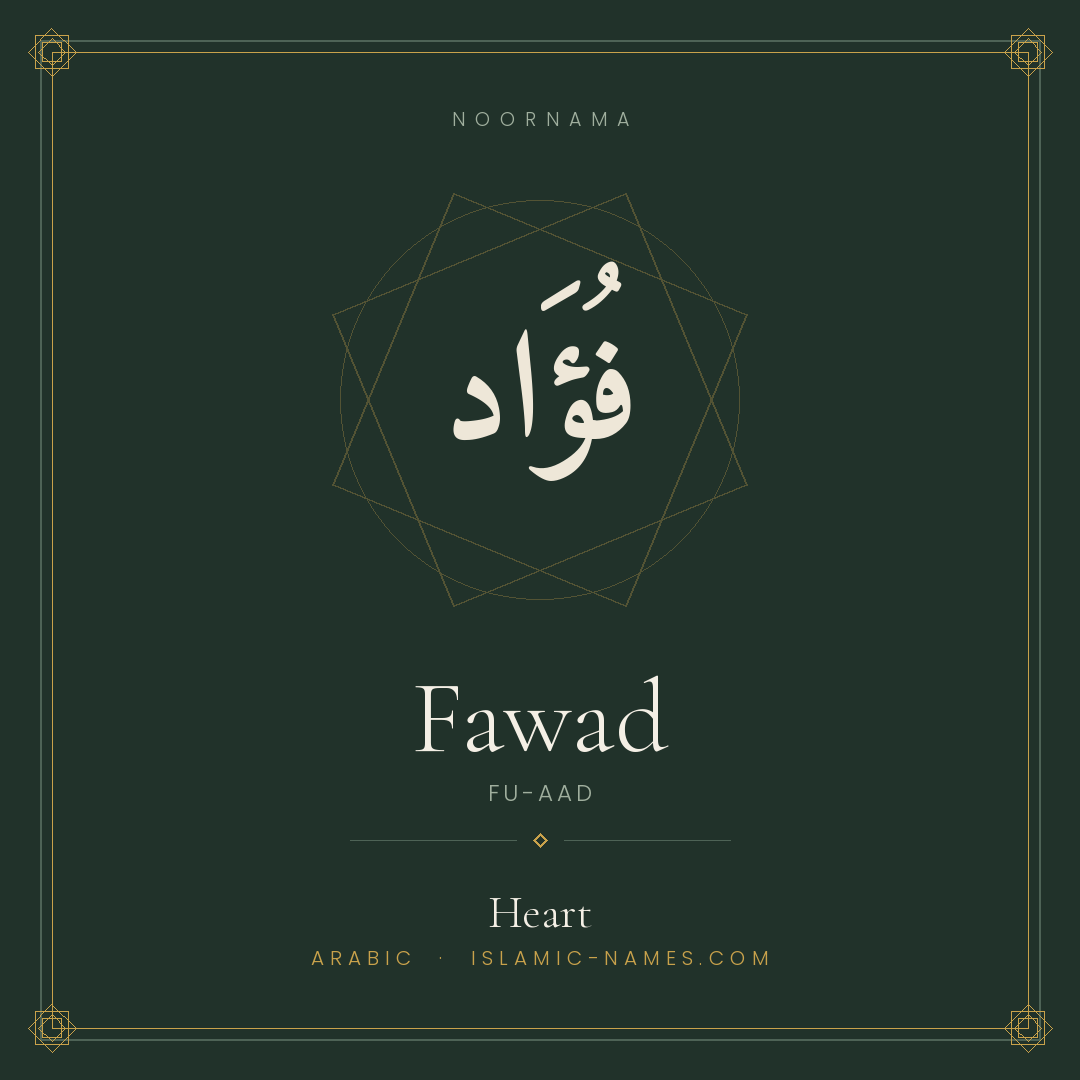
What is the meaning of the name Fawad Name Meaning, Origin & Islamic Significance in Islam?
The name Fawad Name Meaning, Origin & Islamic Significance is a traditional Islamic child name meaning "Heart". In Muslim culture, naming a child Fawad Name Meaning, Origin & Islamic Significance is deeply significant because of its beautiful spiritual connotations. It is a widely accepted and scholar-approved name drawn from authentic Islamic heritage, making it an excellent choice for parents seeking a meaningful name.
Heart
Fawad Name Meaning in Arabic
This content has been reviewed by our Scholarly Board. Name meanings are verified against classical Arabic dictionaries (Lisan al-Arab, Taj al-Arus) and authentic Hadith collections (Sahih al-Bukhari, Sahih Muslim, Sunan al-Tirmidhi).
The name Fawad derives from the Arabic root ف أ د (f-‘-d), which conveys the meaning of “heart,” “core,” or “innermost being.” In classical Arabic, fu’ad specifically denotes the heart as the locus of perception, reasoning, and moral discernment, distinct from the physical organ (qalb). This root appears in ancient poetry and prose to describe the seat of true knowledge and sincere intention.
Lexicographers such as Ibn Manzur in Lisan al-Arab note that fu’ad implies a heart that is awake, aware, and receptive to truth. The word carries connotations of clarity, purity, and the capacity for deep reflection. As a given name, Fawad invokes these qualities, expressing a parent’s hope that their child will possess a sound heart — one that recognizes guidance, embodies compassion, and remains steadfast in faith.
Is Fawad Mentioned in the Quran?
The word fu’ad appears multiple times in the Quran, most notably in verses that speak of the heart’s role in understanding divine signs and bearing witness to truth. For example, Allah describes the heart as a faculty that can perceive, reflect, and be held accountable (e.g., 16:78, 17:36, 22:46). Its Quranic usage underscores that the heart is not merely an organ but a spiritual instrument granted by the Creator. Naming a child Fawad thus connects him to a Quranic concept central to Islamic spirituality — the cultivation of a sound, conscious heart (qalb salim) that turns toward its Lord.
How to Pronounce Fawad
The classical Arabic pronunciation is fu-AAD. The name flows easily in both Arabic and English, making it a practical choice for Muslim families in the USA, UK, Canada, and Australia.
| Pronunciation | Where It’s Common |
|---|---|
| fu-AAD | Standard Arabic pronunciation with emphasis on the second syllable |
| foo-AD | Common South Asian pronunciation with a long ‘oo’ vowel |
| faw-AD | Alternative rendering often heard in Western contexts |
Fawad Spelling Variations: Fuad, Fouad, Fuaad & More
Choose the spelling that matches your family’s heritage:
| Spelling | Region / Community |
|---|---|
| Fuad | Most common transliteration in the Arab world and diaspora |
| Fouad | French-influenced spelling prevalent in North Africa and Lebanon |
| Fuaad | Double ‘a’ spelling reflecting the long vowel in Arabic script |
| Fawad | Phonetic spelling popular in South Asia and English-speaking countries |
| Fouwad | Less common hybrid spelling combining ‘ou’ and ‘w’ |
Cute Nicknames for Fawad
Faw, Fawfy, Wadi, Fado
Abjad Value of Fawad
In the traditional Abjad system of Arabic letter values, فُؤَاد calculates to 91. This classical scholarly numbering of Arabic letters is presented for knowledge only and carries no fortune-telling meaning. A child’s destiny is with Allah alone.
How Popular Is Fawad?
Fawad enjoys steady popularity across the Muslim world, particularly in Pakistan, India, Bangladesh, and the Middle East. Its Quranic pedigree and elegant meaning make it a timeless choice that transcends fleeting trends. In Western countries, the name is relatively uncommon but easily pronounced, with the “Fuad” and “Fouad” variants familiar through notable public figures. Parents appreciate its brevity, clear Arabic heritage, and the positive associations of a “sound heart” — a concept deeply valued in Islamic ethics.
Fawad & Muslim Baby Names Across American Cities
From the Muslim communities of Dearborn and New York to growing families in Houston, Chicago, Dallas, Los Angeles, Atlanta, and Minneapolis, parents searching for authentic Muslim boy names choose Fawad for its clear meaning and easy pronunciation. Explore our city naming guides for local trends and community favorites:
Muslim Names in Houston
Muslim Names in Chicago
Muslim Names in Dallas
Muslim Names in Los Angeles
All USA City Guides
Names That Pair Beautifully with Fawad
Sister Names
Aisha · Fatima · Zainab · Maryam · Khadija · Hafsa · Ruqayyah · Umm Kulthum
Brother Names
Hamza · Ali · Omar · Hassan · Hussain · Bilal · Khalid · Yusuf
Frequently Asked Questions About the Name Fawad
Is Fawad a Quranic name?
Yes, the word fu’ad appears in the Quran several times, referring to the heart as a faculty of understanding and reflection.
What is the difference between Fawad and Fuad?
They are the same name; Fawad reflects a phonetic spelling common in South Asia, while Fuad is the standard Arabic transliteration.
Does the name have a specific historical figure associated with it?
No prominent companion or early scholar bears this exact name; it is valued for its Quranic vocabulary and meaning.
Is Fawad suitable for a baby born in a non-Arabic speaking country?
Absolutely. It is short, easy to spell and pronounce in English, and carries a beautiful, universal meaning.
What is the root meaning of the name?
The root ف أ د conveys ‘heart,’ ‘core,’ or ‘innermost being,’ specifically the heart as the seat of intellect and conscience.
Sources & method: Meaning verified against classical Arabic sources. NoorNama presents Abjad values as classical scholarship only, never as fortune-telling. All destiny is with Allah سبحانه وتعالى.
Find the perfect name for your child
Check our complete database for free names, or get a personalized scholarly naming report based on the precise date of birth.
{“@context”: “https://schema.org”, “@type”: “Article”, “headline”: “Fawad Name Meaning, Origin & Islamic Significance”, “description”: “Fawad (فُؤَاد) means heart. Complete Islamic naming guide: pronunciation, origin, and heritage.”, “author”: {“@type”: “Organization”, “name”: “NoorNama”, “url”: “https://islamic-names.com”}, “publisher”: {“@type”: “Organization”, “name”: “NoorNama”, “url”: “https://islamic-names.com”}, “about”: {“@type”: “Thing”, “name”: “Fawad (given name)”}}
{“@context”: “https://schema.org”, “@type”: “FAQPage”, “mainEntity”: [{“@type”: “Question”, “name”: “Is Fawad a Quranic name?”, “acceptedAnswer”: {“@type”: “Answer”, “text”: “Yes, the word fu’ad appears in the Quran several times, referring to the heart as a faculty of understanding and reflection.”}}, {“@type”: “Question”, “name”: “What is the difference between Fawad and Fuad?”, “acceptedAnswer”: {“@type”: “Answer”, “text”: “They are the same name; Fawad reflects a phonetic spelling common in South Asia, while Fuad is the standard Arabic transliteration.”}}, {“@type”: “Question”, “name”: “Does the name have a specific historical figure associated with it?”, “acceptedAnswer”: {“@type”: “Answer”, “text”: “No prominent companion or early scholar bears this exact name; it is valued for its Quranic vocabulary and meaning.”}}, {“@type”: “Question”, “name”: “Is Fawad suitable for a baby born in a non-Arabic speaking country?”, “acceptedAnswer”: {“@type”: “Answer”, “text”: “Absolutely. It is short, easy to spell and pronounce in English, and carries a beautiful, universal meaning.”}}, {“@type”: “Question”, “name”: “What is the root meaning of the name?”, “acceptedAnswer”: {“@type”: “Answer”, “text”: “The root ف أ د conveys ‘heart,’ ‘core,’ or ‘innermost being,’ specifically the heart as the seat of intellect and conscience.”}}]}