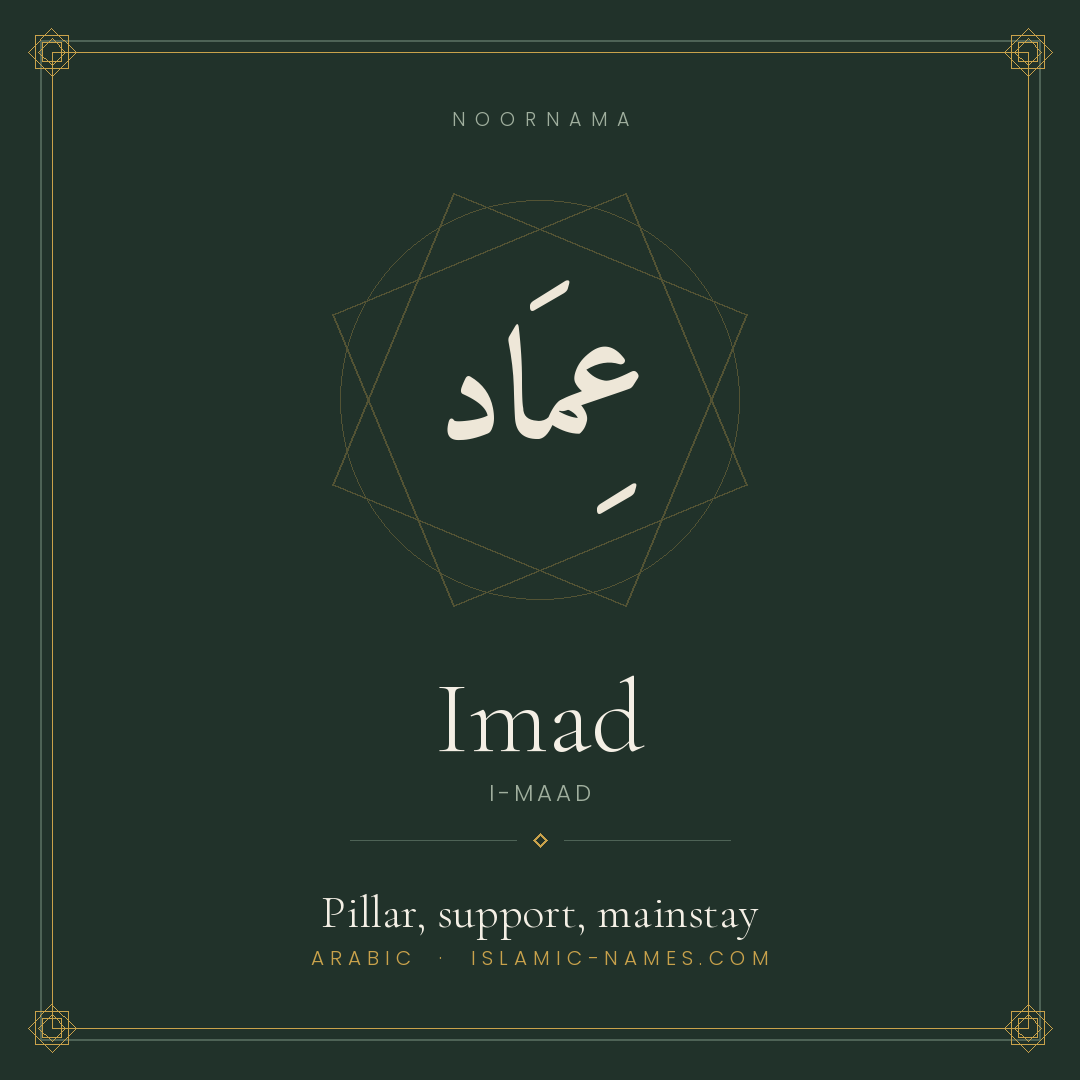
What is the meaning of the name Imad Name Meaning, Origin & Islamic Significance in Islam?
The name Imad Name Meaning, Origin & Islamic Significance is a traditional Islamic child name meaning "Pillar, support, mainstay". In Muslim culture, naming a child Imad Name Meaning, Origin & Islamic Significance is deeply significant because of its beautiful spiritual connotations. It is a widely accepted and scholar-approved name drawn from authentic Islamic heritage, making it an excellent choice for parents seeking a meaningful name.
Pillar, support, mainstay
Imad Name Meaning in Arabic
This content has been reviewed by our Scholarly Board. Name meanings are verified against classical Arabic dictionaries (Lisan al-Arab, Taj al-Arus) and authentic Hadith collections (Sahih al-Bukhari, Sahih Muslim, Sunan al-Tirmidhi).
Imad derives from the Arabic root ع م د (ʿayn-mīm-dāl), which carries the core sense of “to support,” “to prop up,” or “to establish firmly.” From this root come words like ʿamūd (pillar/column) and iʿtimād (reliance/trust). The form عِمَاد (imād) functions as a noun of place or instrument, signifying “that which provides support” — a foundational pillar, whether physical or moral.
Classical Arabic lexicons such as Lisān al-ʿArab describe imād as the central pole of a tent or the mainstay of a structure, extended metaphorically to a person who upholds justice, family, or faith. The name thus carries a linguistic weight that blends architectural strength with ethical responsibility, making it a timeless choice for a boy expected to grow into a pillar of his community.
Is Imad Mentioned in the Quran?
The word imād appears in the Quran, notably in Surah Al-Fajr (89:7) where Allah swears by “Iram of the pillars” (Iram dhāt al-imād), referencing a legendary city famed for its towering columns. This Quranic occurrence elevates the name beyond mere vocabulary — it is anchored in divine speech, associated with grandeur, endurance, and the remnants of mighty civilizations. Choosing a name whose root is voiced in revelation connects the child to a linguistic heritage honored by Allah Himself, a subtle but profound blessing for Muslim parents seeking names with scriptural resonance.
How to Pronounce Imad
The classical Arabic pronunciation is i-MAAD. The name flows easily in both Arabic and English, making it a practical choice for Muslim families in the USA, UK, Canada, and Australia.
| Pronunciation | Where It’s Common |
|---|---|
| i-MAAD | Standard Arabic pronunciation with emphasis on the second syllable |
| ee-MAAD | Common English approximation with elongated first vowel |
| IM-ad | Simplified anglicized version often heard in Western contexts |
Imad Spelling Variations: Emad, Imaad, Imad & More
Choose the spelling that matches your family’s heritage:
| Spelling | Region / Community |
|---|---|
| Emad | Most common transliteration in South Asia and the Levant |
| Imaad | Double ‘a’ spelling reflecting long vowel in Arabic script |
| Imad | Standard simplified spelling used internationally |
| Emaad | Variant with initial ‘E’ and double ‘a’ for phonetic clarity |
| Imād | With macron indicating long vowel, used in academic contexts |
Cute Nicknames for Imad
Madi, Immy, Addy, Mido
Abjad Value of Imad
In the traditional Abjad system of Arabic letter values, عِمَاد calculates to 115. This classical scholarly numbering of Arabic letters is presented for knowledge only and carries no fortune-telling meaning. A child’s destiny is with Allah alone.
How Popular Is Imad?
Imad enjoys steady popularity across the Arab world, Turkey, South Asia, and Muslim communities in Europe and North America. Its brevity, clear pronunciation, and strong meaning make it accessible cross-culturally — it travels well without anglicization. In recent decades, it has ranked consistently in baby name charts in France, Belgium, and the UK among Muslim families, while remaining a classic in Egypt, Jordan, Pakistan, and Indonesia. The name’s Quranic root and virtue theme give it enduring appeal beyond fashion cycles.
Western familiarity with similar-sounding names like Adam or Aidan eases adoption, though Imad retains its distinct Arabic identity. It is equally at home in a madrasa, a corporate office, or a playground in London or Dearborn — a name that carries dignity without pretense.
Imad & Muslim Baby Names Across American Cities
From the Muslim communities of Dearborn and New York to growing families in Houston, Chicago, Dallas, Los Angeles, Atlanta, and Minneapolis, parents searching for authentic Muslim boy names choose Imad for its clear meaning and easy pronunciation. Explore our city naming guides for local trends and community favorites:
Muslim Names in Houston
Muslim Names in Chicago
Muslim Names in Dallas
Muslim Names in Los Angeles
All USA City Guides
Names That Pair Beautifully with Imad
Sister Names
Aisha · Fatima · Maryam · Khadija · Zainab · Hafsa · Ruqayya · Umm Kulthum
Brother Names
Ali · Hassan · Hussain · Omar · Abdullah · Ibrahim · Yusuf · Musa
Frequently Asked Questions About the Name Imad
Is Imad a Quranic name?
Yes, the word imād appears in the Quran (Surah Al-Fajr 89:7) in the phrase “Iram of the pillars,” giving it direct scriptural presence.
What is the root of Imad?
Imad comes from the Arabic root ع م د (ʿayn-mīm-dāl), meaning to support, prop up, or establish firmly.
Is Imad only for boys?
Traditionally Imad is a masculine name. The feminine form Imāda exists but is rare; parents seeking a related girl’s name often choose Amida or Muʿtamida.
How popular is Imad in Western countries?
Imad ranks moderately in France, Belgium, the UK, and Canada among Muslim families, valued for its easy pronunciation and strong meaning.
Are there famous historical figures named Imad?
Several scholars and rulers bore the name, notably Imad al-Din Zengi (12th-century atabeg of Mosul), but the name’s virtue lies in its meaning, not any single figure.
Sources & method: Meaning verified against classical Arabic sources. NoorNama presents Abjad values as classical scholarship only, never as fortune-telling. All destiny is with Allah سبحانه وتعالى.
Find the perfect name for your child
Check our complete database for free names, or get a personalized scholarly naming report based on the precise date of birth.
{“@context”: “https://schema.org”, “@type”: “Article”, “headline”: “Imad Name Meaning, Origin & Islamic Significance”, “description”: “Imad (عِمَاد) means pillar, support, mainstay. Complete Islamic naming guide: pronunciation, origin, and heritage.”, “author”: {“@type”: “Organization”, “name”: “NoorNama”, “url”: “https://islamic-names.com”}, “publisher”: {“@type”: “Organization”, “name”: “NoorNama”, “url”: “https://islamic-names.com”}, “about”: {“@type”: “Thing”, “name”: “Imad (given name)”}}
{“@context”: “https://schema.org”, “@type”: “FAQPage”, “mainEntity”: [{“@type”: “Question”, “name”: “Is Imad a Quranic name?”, “acceptedAnswer”: {“@type”: “Answer”, “text”: “Yes, the word imād appears in the Quran (Surah Al-Fajr 89:7) in the phrase “Iram of the pillars,” giving it direct scriptural presence.”}}, {“@type”: “Question”, “name”: “What is the root of Imad?”, “acceptedAnswer”: {“@type”: “Answer”, “text”: “Imad comes from the Arabic root ع م د (ʿayn-mīm-dāl), meaning to support, prop up, or establish firmly.”}}, {“@type”: “Question”, “name”: “Is Imad only for boys?”, “acceptedAnswer”: {“@type”: “Answer”, “text”: “Traditionally Imad is a masculine name. The feminine form Imāda exists but is rare; parents seeking a related girl’s name often choose Amida or Muʿtamida.”}}, {“@type”: “Question”, “name”: “How popular is Imad in Western countries?”, “acceptedAnswer”: {“@type”: “Answer”, “text”: “Imad ranks moderately in France, Belgium, the UK, and Canada among Muslim families, valued for its easy pronunciation and strong meaning.”}}, {“@type”: “Question”, “name”: “Are there famous historical figures named Imad?”, “acceptedAnswer”: {“@type”: “Answer”, “text”: “Several scholars and rulers bore the name, notably Imad al-Din Zengi (12th-century atabeg of Mosul), but the name’s virtue lies in its meaning, not any single figure.”}}]}