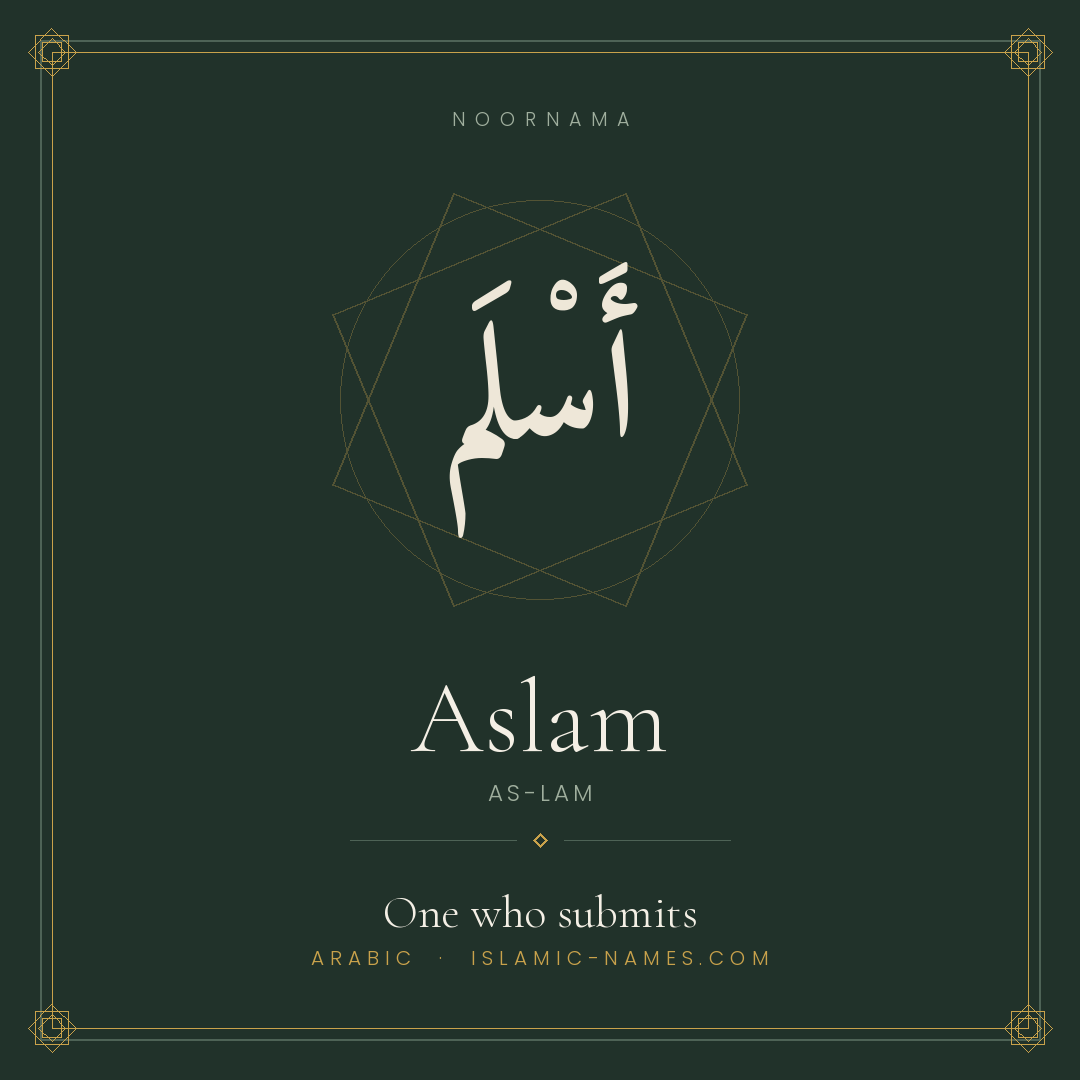
What is the meaning of the name Aslam Name Meaning, Origin & Islamic Significance in Islam?
The name Aslam Name Meaning, Origin & Islamic Significance is a traditional Islamic child name meaning "One who submits; safest". In Muslim culture, naming a child Aslam Name Meaning, Origin & Islamic Significance is deeply significant because of its beautiful spiritual connotations. It is a widely accepted and scholar-approved name drawn from authentic Islamic heritage, making it an excellent choice for parents seeking a meaningful name.
One who submits; safest
Aslam Name Meaning in Arabic
This content has been reviewed by our Scholarly Board. Name meanings are verified against classical Arabic dictionaries (Lisan al-Arab, Taj al-Arus) and authentic Hadith collections (Sahih al-Bukhari, Sahih Muslim, Sunan al-Tirmidhi).
The name Aslam springs from the triliteral root س-ل-م (S-L-M), one of the most fertile roots in Arabic. From it flow words like Islam (voluntary submission to Allah), Muslim (one who submits), salam (peace, safety), and salama (to be safe, sound, unharmed). Aslam is the active participle (ism al-fa’il) of Form IV aslama, literally “he who has submitted” or “he who has made himself safe.”
This root appears over 140 times in the Quran in various forms, underscoring the centrality of submission and peace in the Quranic worldview. Classical lexicons such as Lisan al-Arab and Taj al-Arus define aslama as entering into Islam, surrendering one’s face to Allah, and attaining safety. The name thus binds together the twin pillars of Islamic spirituality: heartfelt surrender and the tranquil security that follows.
Is Aslam Mentioned in the Quran?
While the exact personal name Aslam is not recorded as a companion’s name in the Quran, the verb aslama and its derivatives appear frequently, most notably in Surah Al-Baqarah 2:112: “Yes, whoever submits (aslama) his face to Allah while he is a doer of good will have his reward with his Lord.” The Quran repeatedly honors those who aslamu (submit) as the true believers. Naming a child Aslam invokes this Quranic ideal of willing, conscious surrender to the Creator, a meaning celebrated throughout revelation from the early Makkan surahs to the Madinan period.
How to Pronounce Aslam
The classical Arabic pronunciation is AS-lam. The name flows easily in both Arabic and English, making it a practical choice for Muslim families in the USA, UK, Canada, and Australia.
| Pronunciation | Where It’s Common |
|---|---|
| AS-lam | Standard Arabic pronunciation |
| AS-ləm | Common English approximation |
| Us-lam | South Asian variant |
Aslam Spelling Variations: Aslaam, Aslem, Eslam & More
Choose the spelling that matches your family’s heritage:
| Spelling | Region / Community |
|---|---|
| Aslaam | Double ‘a’ transliteration |
| Aslem | Phonetic variant |
| Eslam | Turkish/Persian-influenced spelling |
| Asllam | Rare doubled ‘l’ form |
| Islam | Related root form (distinct name) |
Cute Nicknames for Aslam
Asli, Lammy, Sami, Aslami
Abjad Value of Aslam
In the traditional Abjad system of Arabic letter values, أَسْلَم calculates to 131. This classical scholarly numbering of Arabic letters is presented for knowledge only and carries no fortune-telling meaning. A child’s destiny is with Allah alone.
How Popular Is Aslam?
Aslam enjoys steady usage across the Muslim world, particularly in South Asia, the Middle East, and East Africa. Its clear Quranic root and virtuous meaning make it a timeless choice for parents seeking a name that embodies the essence of Islamic identity. In Western countries, Aslam is recognizable yet not overly common, striking a balance between cultural authenticity and ease of pronunciation for non-Arabic speakers.
The name’s phonetic simplicity — two syllables, familiar sounds — helps it travel well across languages. While it does not rank among the top 100 names in the US or UK, it appears consistently in Muslim communities worldwide. Its close linguistic tie to “Islam” and “Muslim” gives it an immediate, positive association for those familiar with the faith, while remaining accessible to broader audiences.
Aslam & Muslim Baby Names Across American Cities
From the Muslim communities of Dearborn and New York to growing families in Houston, Chicago, Dallas, Los Angeles, Atlanta, and Minneapolis, parents searching for authentic Muslim boy names choose Aslam for its clear meaning and easy pronunciation. Explore our city naming guides for local trends and community favorites:
Muslim Names in Houston
Muslim Names in Chicago
Muslim Names in Dallas
Muslim Names in Los Angeles
All USA City Guides
Names That Pair Beautifully with Aslam
Sister Names
Salma · Salima · Aamina · Amina · Sulma · Selma · Taslim · Muslima
Brother Names
Abdullah · Muslim · Salim · Sulaiman · Ibrahim · Yusuf · Hamza · Omar
Frequently Asked Questions About the Name Aslam
Is Aslam a Quranic name?
The verb aslama appears in the Quran (e.g., 2:112), but Aslam as a personal name is not directly mentioned. It is a Quranic-root name derived from S-L-M.
What is the difference between Aslam and Islam?
Aslam is a personal name meaning ‘one who submits’; Islam is the religion’s name meaning ‘submission to Allah’. Both share the root S-L-M but function differently.
Is Aslam a common name?
Aslam is widely used in Muslim-majority regions, especially South Asia and the Arab world, but remains less common in Western countries, offering familiarity without overuse.
Can Aslam be used for girls?
Aslam is traditionally masculine. Feminine counterparts from the same root include Salma, Salima, and Muslima, which carry parallel meanings of submission and peace.
Does the name Aslam have a specific historical figure?
No prominent companion or early scholar named Aslam is recorded in canonical hadith or history books. The name is chosen for its beautiful meaning, not a specific namesake.
Sources & method: Meaning verified against classical Arabic sources. NoorNama presents Abjad values as classical scholarship only, never as fortune-telling. All destiny is with Allah سبحانه وتعالى.
Find the perfect name for your child
Check our complete database for free names, or get a personalized scholarly naming report based on the precise date of birth.
{“@context”: “https://schema.org”, “@type”: “Article”, “headline”: “Aslam Name Meaning, Origin & Islamic Significance”, “description”: “Aslam (أَسْلَم) means one who submits; safest. Complete Islamic naming guide: pronunciation, origin, and heritage.”, “author”: {“@type”: “Organization”, “name”: “NoorNama”, “url”: “https://islamic-names.com”}, “publisher”: {“@type”: “Organization”, “name”: “NoorNama”, “url”: “https://islamic-names.com”}, “about”: {“@type”: “Thing”, “name”: “Aslam (given name)”}}
{“@context”: “https://schema.org”, “@type”: “FAQPage”, “mainEntity”: [{“@type”: “Question”, “name”: “Is Aslam a Quranic name?”, “acceptedAnswer”: {“@type”: “Answer”, “text”: “The verb aslama appears in the Quran (e.g., 2:112), but Aslam as a personal name is not directly mentioned. It is a Quranic-root name derived from S-L-M.”}}, {“@type”: “Question”, “name”: “What is the difference between Aslam and Islam?”, “acceptedAnswer”: {“@type”: “Answer”, “text”: “Aslam is a personal name meaning ‘one who submits’; Islam is the religion’s name meaning ‘submission to Allah’. Both share the root S-L-M but function differently.”}}, {“@type”: “Question”, “name”: “Is Aslam a common name?”, “acceptedAnswer”: {“@type”: “Answer”, “text”: “Aslam is widely used in Muslim-majority regions, especially South Asia and the Arab world, but remains less common in Western countries, offering familiarity without overuse.”}}, {“@type”: “Question”, “name”: “Can Aslam be used for girls?”, “acceptedAnswer”: {“@type”: “Answer”, “text”: “Aslam is traditionally masculine. Feminine counterparts from the same root include Salma, Salima, and Muslima, which carry parallel meanings of submission and peace.”}}, {“@type”: “Question”, “name”: “Does the name Aslam have a specific historical figure?”, “acceptedAnswer”: {“@type”: “Answer”, “text”: “No prominent companion or early scholar named Aslam is recorded in canonical hadith or history books. The name is chosen for its beautiful meaning, not a specific namesake.”}}]}