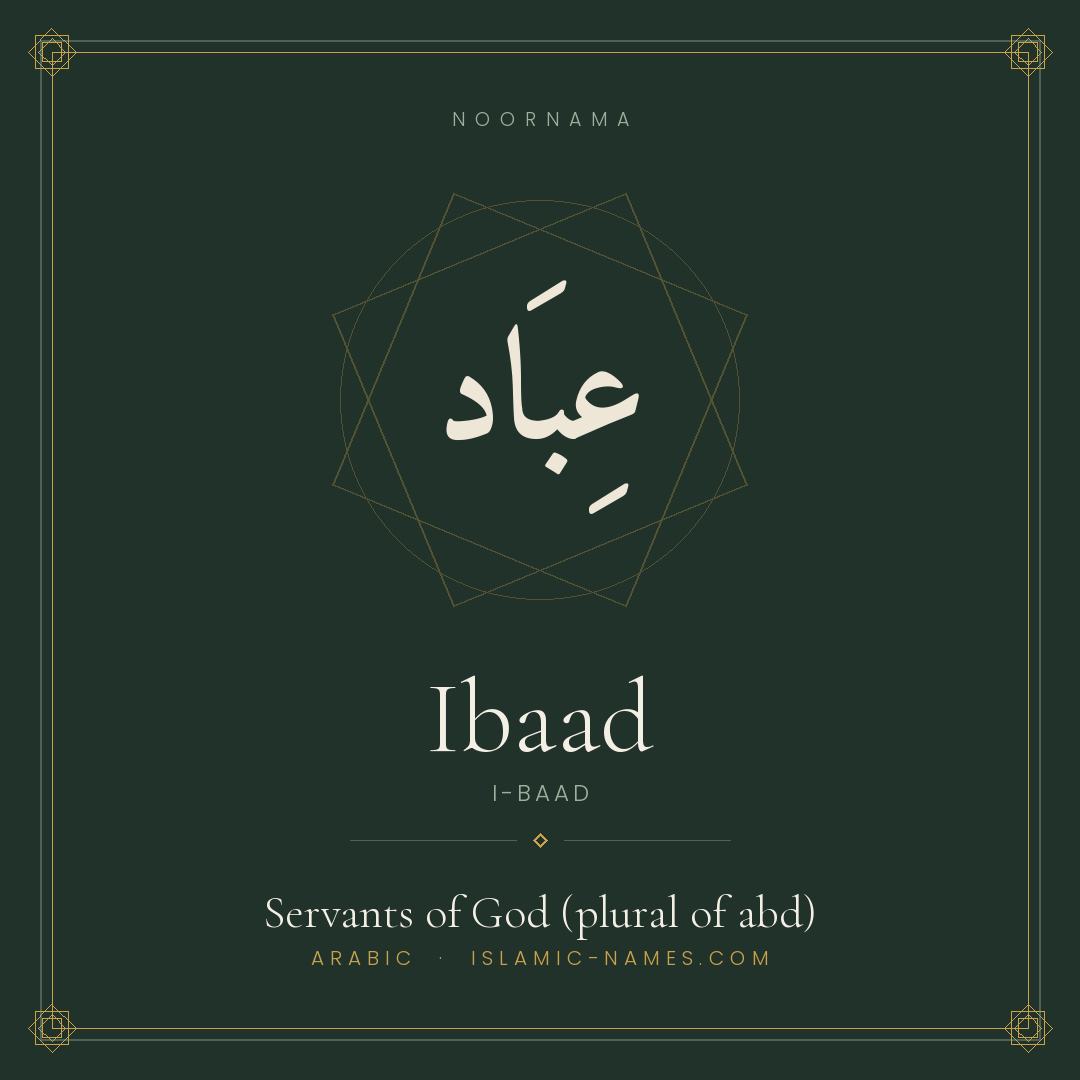
What is the meaning of the name Ibaad Name Meaning, Origin & Islamic Significance in Islam?
The name Ibaad Name Meaning, Origin & Islamic Significance is a traditional Islamic child name meaning "Servants of God (plural of abd)". In Muslim culture, naming a child Ibaad Name Meaning, Origin & Islamic Significance is deeply significant because of its beautiful spiritual connotations. It is a widely accepted and scholar-approved name drawn from authentic Islamic heritage, making it an excellent choice for parents seeking a meaningful name.
Servants of God (plural of abd)
Ibaad Name Meaning in Arabic
This content has been reviewed by our Scholarly Board. Name meanings are verified against classical Arabic dictionaries (Lisan al-Arab, Taj al-Arus) and authentic Hadith collections (Sahih al-Bukhari, Sahih Muslim, Sunan al-Tirmidhi).
Ibaad derives from the trilateral root ع ب د (ʿ-b-d), which carries the core senses of worship, servitude, and devoted obedience. From this root flow words like ʿabd (servant), ʿibādah (worship), and maʿbūd (that which is worshipped). The form ʿibād is a plural pattern (fiʿāl) often used in the Quran to denote “servants” as a category, especially “servants of Allah” (ʿibādu Llāh).
Linguistically, the root implies not forced labor but a relationship of love, trust, and willing surrender. Classical lexicons such as Lisān al-ʿArab note that ʿubūdiyyah (servanthood) is the highest station a creature can attain. As a given name, Ibaad invokes this collective spiritual identity — a reminder that true honor lies in being counted among the faithful servants of the Most Merciful.
Is Ibaad Mentioned in the Quran?
The word ʿibād appears numerous times in the Quran, most famously in verses such as “Indeed, My servants — no authority will you have over them” (15:42) and “And My servants, the righteous, will inherit the earth” (21:105). It is used both for humanity at large and specifically for the prophets and the pious. Naming a child Ibaad connects him to this Quranic vocabulary of honor, placing him within the community of those whom Allah calls “My servants” — a title of closeness, protection, and eternal reward.
How to Pronounce Ibaad
The classical Arabic pronunciation is i-BAAD. The name flows easily in both Arabic and English, making it a practical choice for Muslim families in the USA, UK, Canada, and Australia.
| Pronunciation | Where It’s Common |
|---|---|
| i-BAAD | Standard Arabic pronunciation with stress on the second syllable |
| EE-bad | Common Anglicized rendering in English-speaking communities |
| ib-AAD | Alternative stress pattern heard in some regional dialects |
Ibaad Spelling Variations: Ibad, Ebaad, Ibaadh & More
Choose the spelling that matches your family’s heritage:
| Spelling | Region / Community |
|---|---|
| Ibad | Most common simplified spelling without double ‘a’ |
| Ebaad | Phonetic variant emphasizing the long ‘a’ sound |
| Ibaadh | Transliteration preserving the terminal ḥāʾ (ح) in some systems |
| Ibadh | Alternative with ‘dh’ for the voiced dental fricative |
| Ebad | Shortened form occasionally seen in South Asian usage |
Cute Nicknames for Ibaad
Ibbi, Baadi, Addi, Bado
Abjad Value of Ibaad
In the traditional Abjad system of Arabic letter values, عِبَاد calculates to 77. This classical scholarly numbering of Arabic letters is presented for knowledge only and carries no fortune-telling meaning. A child’s destiny is with Allah alone.
How Popular Is Ibaad?
Ibaad remains a relatively uncommon choice in Western Muslim communities, giving it a distinctive freshness while remaining deeply rooted in Quranic Arabic. Its theme is marked “Contemporary” — not because it is newly coined, but because its use as a standalone given name (rather than a grammatical form) has grown in recent decades. Parents appreciate its direct spiritual meaning and easy pronunciation across languages.
In the UK, US, and Canada, Ibaad is recognizable to Arabic speakers yet poses no spelling or pronunciation barriers for non-Arabic environments. Its plural form subtly conveys community and belonging, resonating with families who value collective identity. While not yet in top-name charts, its usage is steadily rising among families seeking meaningful, Quranic names that travel well.
Ibaad & Muslim Baby Names Across American Cities
From the Muslim communities of Dearborn and New York to growing families in Houston, Chicago, Dallas, Los Angeles, Atlanta, and Minneapolis, parents searching for authentic Muslim boy names choose Ibaad for its clear meaning and easy pronunciation. Explore our city naming guides for local trends and community favorites:
Muslim Names in Houston
Muslim Names in Chicago
Muslim Names in Dallas
Muslim Names in Los Angeles
All USA City Guides
Names That Pair Beautifully with Ibaad
Sister Names
Aisha · Fatima · Maryam · Khadija · Zainab · Hafsa · Sumayya · Asma
Brother Names
Abdullah · Ibrahim · Yusuf · Hamza · Omar · Ali · Hassan · Hussain
Frequently Asked Questions About the Name Ibaad
Is Ibaad a Quranic name?
Yes. The word <em>ʿibād</em> (servants) appears many times in the Quran, often in the phrase <em>ʿibādu Llāh</em> (servants of Allah). It is not a personal name of a specific companion, but a Quranic vocabulary word adopted as a name.
What is the difference between Ibaad and Abdullah?
Abdullah means “servant of Allah” (singular, proper name). Ibaad is the plural “servants of Allah,” representing a collective identity. Both share the root <em>ʿ-b-d</em> but differ in grammatical number and usage.
Can Ibaad be used for a girl?
Traditionally Ibaad is masculine. The feminine singular is <em>ʿabdah</em> or <em>āmah</em>, and the feminine plural is <em>ʿibād</em> (same form) or <em>ʿibādāt</em>. As a given name, it is almost exclusively used for boys.
How do you pronounce Ibaad correctly?
In Arabic: <em>i-BAAD</em> (stress on second syllable, long ‘a’ as in ‘father’). In English, many say <em>EE-bad</em>. Both are accepted; the Arabic pronunciation preserves the Quranic phonetics.
Is there a famous historical figure named Ibaad?
No prominent companion or scholar bore Ibaad as a personal name. It is a modern adoption of a Quranic plural noun. Its virtue lies in its direct linguistic connection to the Quran, not in a namesake personality.
Sources & method: Meaning verified against classical Arabic sources. NoorNama presents Abjad values as classical scholarship only, never as fortune-telling. All destiny is with Allah سبحانه وتعالى.
Find the perfect name for your child
Check our complete database for free names, or get a personalized scholarly naming report based on the precise date of birth.
{“@context”: “https://schema.org”, “@type”: “Article”, “headline”: “Ibaad Name Meaning, Origin & Islamic Significance”, “description”: “Ibaad (عِبَاد) means servants of god (plural of abd). Complete Islamic naming guide: pronunciation, origin, and heritage.”, “author”: {“@type”: “Organization”, “name”: “NoorNama”, “url”: “https://islamic-names.com”}, “publisher”: {“@type”: “Organization”, “name”: “NoorNama”, “url”: “https://islamic-names.com”}, “about”: {“@type”: “Thing”, “name”: “Ibaad (given name)”}}
{“@context”: “https://schema.org”, “@type”: “FAQPage”, “mainEntity”: [{“@type”: “Question”, “name”: “Is Ibaad a Quranic name?”, “acceptedAnswer”: {“@type”: “Answer”, “text”: “Yes. The word ʿibād (servants) appears many times in the Quran, often in the phrase ʿibādu Llāh (servants of Allah). It is not a personal name of a specific companion, but a Quranic vocabulary word adopted as a name.”}}, {“@type”: “Question”, “name”: “What is the difference between Ibaad and Abdullah?”, “acceptedAnswer”: {“@type”: “Answer”, “text”: “Abdullah means “servant of Allah” (singular, proper name). Ibaad is the plural “servants of Allah,” representing a collective identity. Both share the root ʿ-b-d but differ in grammatical number and usage.”}}, {“@type”: “Question”, “name”: “Can Ibaad be used for a girl?”, “acceptedAnswer”: {“@type”: “Answer”, “text”: “Traditionally Ibaad is masculine. The feminine singular is ʿabdah or āmah, and the feminine plural is ʿibād (same form) or ʿibādāt. As a given name, it is almost exclusively used for boys.”}}, {“@type”: “Question”, “name”: “How do you pronounce Ibaad correctly?”, “acceptedAnswer”: {“@type”: “Answer”, “text”: “In Arabic: i-BAAD (stress on second syllable, long ‘a’ as in ‘father’). In English, many say EE-bad. Both are accepted; the Arabic pronunciation preserves the Quranic phonetics.”}}, {“@type”: “Question”, “name”: “Is there a famous historical figure named Ibaad?”, “acceptedAnswer”: {“@type”: “Answer”, “text”: “No prominent companion or scholar bore Ibaad as a personal name. It is a modern adoption of a Quranic plural noun. Its virtue lies in its direct linguistic connection to the Quran, not in a namesake personality.”}}]}