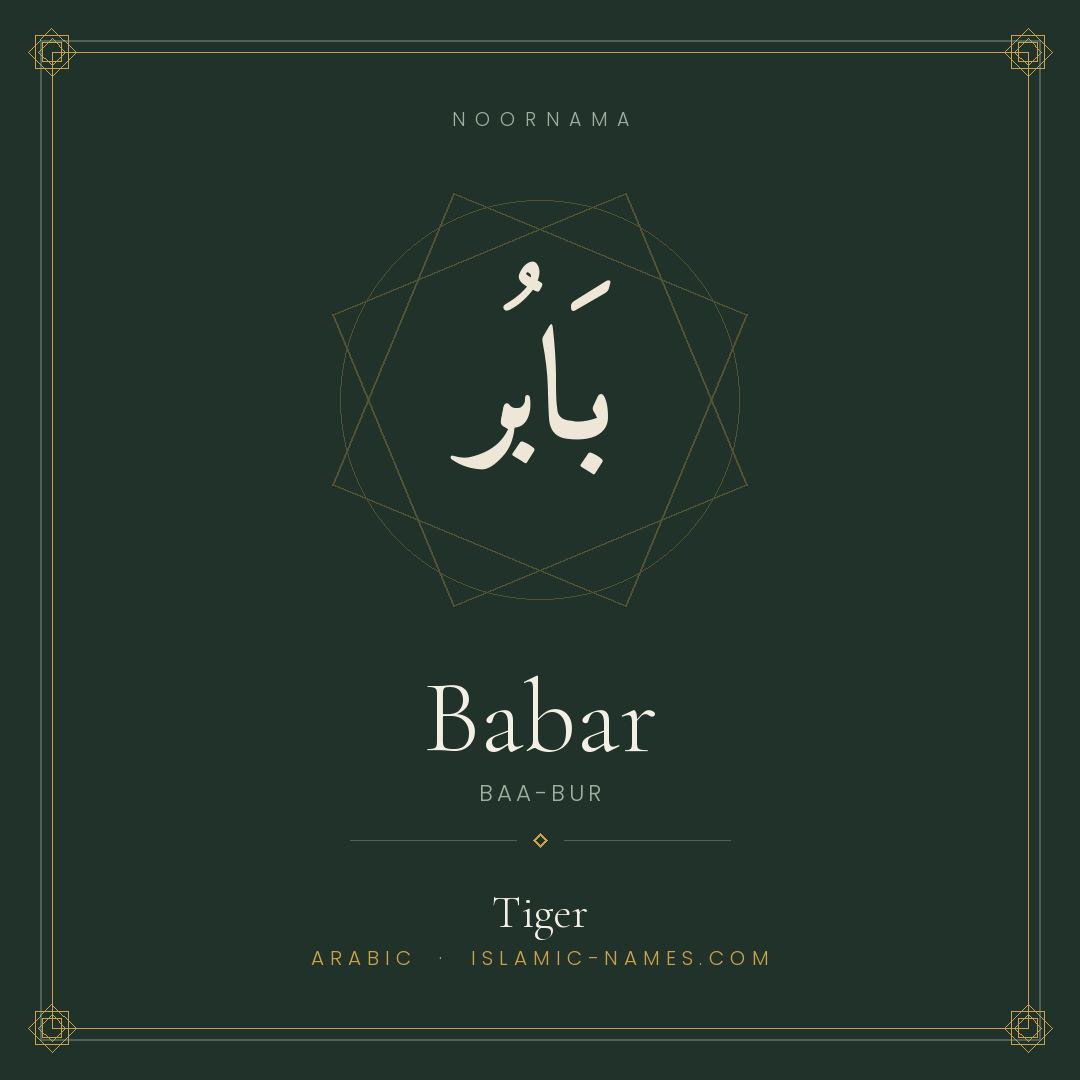
What is the meaning of the name Babar Name Meaning, Origin & Islamic Significance in Islam?
The name Babar Name Meaning, Origin & Islamic Significance is a traditional Islamic child name meaning "Tiger; of Turkic and Persian usage". In Muslim culture, naming a child Babar Name Meaning, Origin & Islamic Significance is deeply significant because of its beautiful spiritual connotations. It is a widely accepted and scholar-approved name drawn from authentic Islamic heritage, making it an excellent choice for parents seeking a meaningful name.
Tiger; of Turkic and Persian usage
Babar Name Meaning in Arabic
This content has been reviewed by our Scholarly Board. Name meanings are verified against classical Arabic dictionaries (Lisan al-Arab, Taj al-Arus) and authentic Hadith collections (Sahih al-Bukhari, Sahih Muslim, Sunan al-Tirmidhi).
Babar originates from the Turkic word babr or Persian babr (ببر), both meaning “tiger.” This term traveled westward with Turkic migrations and Persian cultural influence, reaching the Arabic-speaking world where it was transliterated as بَابُر. Unlike many Islamic names rooted in triliteral Arabic radicals, Babar belongs to a layer of vocabulary borrowed from the languages of Central Asia and Iran, reflecting the historical interplay between Arab, Persian, and Turkic civilizations.
In the medieval Islamic world, Persian served as a lingua franca of administration and high culture from Anatolia to India, carrying words like babr into everyday usage. The name appears in historical chronicles and poetry, often as a title or epithet for rulers and warriors — most famously the Mughal emperor Zahir-ud-din Muhammad Babur (1483–1530), whose memoir the Baburnama remains a literary classic. As a given name, Babar preserves this legacy of sovereignty and literary refinement.
Is Babar Mentioned in the Quran?
Babar does not appear in the Quran, nor is it derived from Quranic Arabic vocabulary. However, Islamic tradition encourages believers to choose names with beautiful meanings, and the Prophet ﷺ said: “You will be called on the Day of Resurrection by your names and the names of your fathers, so give yourselves good names” (Abu Dawud). The tiger, as a creature of strength and dignity in Allah’s creation, carries a positive connotation. Many Muslim families across South Asia, Turkey, and Central Asia have embraced Babar for centuries, valuing its resonant sound and the noble qualities it symbolizes within a culturally rich, Islamicate heritage.
How to Pronounce Babar
The classical Arabic pronunciation is BAA-bur. The name flows easily in both Arabic and English, making it a practical choice for Muslim families in the USA, UK, Canada, and Australia.
| Pronunciation | Where It’s Common |
|---|---|
| BAA-bur | Standard English approximation, stress on first syllable |
| BAH-bur | Common South Asian pronunciation, shorter first vowel |
| bab-UR | Persian-influenced rendering with equal stress |
Babar Spelling Variations: Babar, Babur, Baber & More
Choose the spelling that matches your family’s heritage:
| Spelling | Region / Community |
|---|---|
| Babar | Most common transliteration in South Asia and diaspora |
| Babur | Closer to Persian/Turkic original; used for the Mughal emperor |
| Baber | Anglicized spelling frequent in Western contexts |
| Baabar | Double-a variant emphasizing long first vowel |
| Babour | French-influenced spelling seen in North African diaspora |
Cute Nicknames for Babar
Babu, Babi, Bobo, Bari
Abjad Value of Babar
In the traditional Abjad system of Arabic letter values, بَابُر calculates to 205. This classical scholarly numbering of Arabic letters is presented for knowledge only and carries no fortune-telling meaning. A child’s destiny is with Allah alone.
How Popular Is Babar?
Babar enjoys enduring popularity across Pakistan, India, Bangladesh, Turkey, and Central Asian republics, where it ranks among familiar traditional choices for boys. In the United Kingdom, Canada, and the United States, the name remains recognizable within South Asian and Turkish Muslim communities but is uncommon in the general population, giving it a distinctive quality without being difficult to pronounce. Its two-syllable structure and straightforward phonetics make it accessible to English speakers, while its historical depth appeals to parents seeking a name with cultural resonance.
The name’s association with the Mughal emperor Babur lends it a scholarly, regal aura that transcends fleeting trends. Unlike names tied to specific Quranic verses or prophetic companions, Babar offers flexibility — it carries heritage without prescriptive religious weight, allowing families to honor their Persianate or Turkic lineage within a broadly Islamic identity. This balance of specificity and universality sustains its quiet, cross-generational appeal.
Babar & Muslim Baby Names Across American Cities
From the Muslim communities of Dearborn and New York to growing families in Houston, Chicago, Dallas, Los Angeles, Atlanta, and Minneapolis, parents searching for authentic Muslim boy names choose Babar for its clear meaning and easy pronunciation. Explore our city naming guides for local trends and community favorites:
Muslim Names in Houston
Muslim Names in Chicago
Muslim Names in Dallas
Muslim Names in Los Angeles
All USA City Guides
Names That Pair Beautifully with Babar
Sister Names
Zahra · Ayesha · Maryam · Fatima · Khadija · Hafsa · Safiya · Ruqayya
Brother Names
Hamza · Ali · Omar · Hassan · Hussein · Bilal · Zayd · Tariq
Frequently Asked Questions About the Name Babar
Is Babar a Quranic name?
No, Babar does not appear in the Quran. It is a name of Turkic and Persian origin meaning “tiger,” adopted into Muslim naming traditions through Persianate cultures in Central Asia and South Asia.
What is the origin of the name Babar?
Babar derives from the Turkic and Persian word “babr” (ببر), meaning tiger. It entered Arabic-script usage as بَابُر and spread through the Persian-influenced Islamic world, particularly in the Mughal, Ottoman, and Central Asian spheres.
Who was the famous historical figure named Babar?
Zahir-ud-din Muhammad Babur (1483–1530) was the founder of the Mughal Empire in India. A descendant of Timur and Genghis Khan, he wrote the Baburnama, a celebrated autobiographical memoir in Chagatai Turkish.
Is Babar commonly used in Western countries?
Babar is uncommon in the general Western population but well-known within South Asian, Turkish, and Central Asian Muslim diaspora communities in the UK, US, Canada, and Europe. Its simple pronunciation makes it accessible cross-culturally.
What are common nicknames for Babar?
Affectionate short forms include Babu, Babi, Bobo, and Bari. These are used informally by family and friends across Urdu, Hindi, Turkish, and Persian-speaking households.
Sources & method: Meaning verified against classical Arabic sources. NoorNama presents Abjad values as classical scholarship only, never as fortune-telling. All destiny is with Allah سبحانه وتعالى.
Find the perfect name for your child
Check our complete database for free names, or get a personalized scholarly naming report based on the precise date of birth.
{“@context”: “https://schema.org”, “@type”: “Article”, “headline”: “Babar Name Meaning, Origin & Islamic Significance”, “description”: “Babar (بَابُر) means tiger; of turkic and persian usage. Complete Islamic naming guide: pronunciation, origin, and heritage.”, “author”: {“@type”: “Organization”, “name”: “NoorNama”, “url”: “https://islamic-names.com”}, “publisher”: {“@type”: “Organization”, “name”: “NoorNama”, “url”: “https://islamic-names.com”}, “about”: {“@type”: “Thing”, “name”: “Babar (given name)”}}
{“@context”: “https://schema.org”, “@type”: “FAQPage”, “mainEntity”: [{“@type”: “Question”, “name”: “Is Babar a Quranic name?”, “acceptedAnswer”: {“@type”: “Answer”, “text”: “No, Babar does not appear in the Quran. It is a name of Turkic and Persian origin meaning “tiger,” adopted into Muslim naming traditions through Persianate cultures in Central Asia and South Asia.”}}, {“@type”: “Question”, “name”: “What is the origin of the name Babar?”, “acceptedAnswer”: {“@type”: “Answer”, “text”: “Babar derives from the Turkic and Persian word “babr” (ببر), meaning tiger. It entered Arabic-script usage as بَابُر and spread through the Persian-influenced Islamic world, particularly in the Mughal, Ottoman, and Central Asian spheres.”}}, {“@type”: “Question”, “name”: “Who was the famous historical figure named Babar?”, “acceptedAnswer”: {“@type”: “Answer”, “text”: “Zahir-ud-din Muhammad Babur (1483–1530) was the founder of the Mughal Empire in India. A descendant of Timur and Genghis Khan, he wrote the Baburnama, a celebrated autobiographical memoir in Chagatai Turkish.”}}, {“@type”: “Question”, “name”: “Is Babar commonly used in Western countries?”, “acceptedAnswer”: {“@type”: “Answer”, “text”: “Babar is uncommon in the general Western population but well-known within South Asian, Turkish, and Central Asian Muslim diaspora communities in the UK, US, Canada, and Europe. Its simple pronunciation makes it accessible cross-culturally.”}}, {“@type”: “Question”, “name”: “What are common nicknames for Babar?”, “acceptedAnswer”: {“@type”: “Answer”, “text”: “Affectionate short forms include Babu, Babi, Bobo, and Bari. These are used informally by family and friends across Urdu, Hindi, Turkish, and Persian-speaking households.”}}]}